





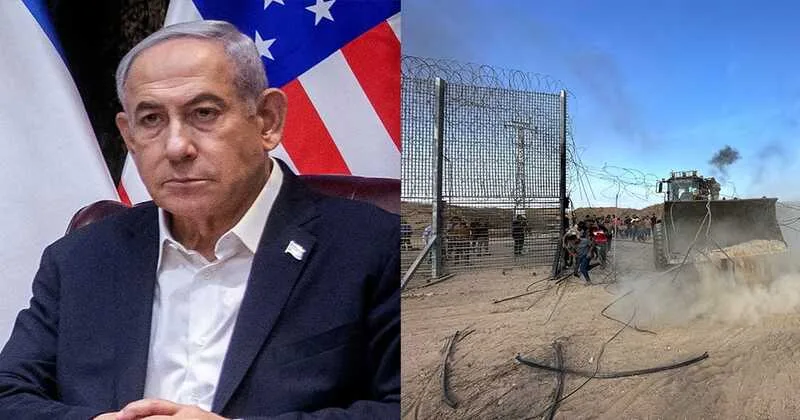
Israel is preparing to move forward with its decision to capture Gaza City, with Prime Minister Benjamin Netanyahu earlier confirming that various operational plans have been finalised. The Israeli security cabinet has approved measures including the disarmament of Hamas, the return of all hostages, alive or dead, the demilitarisation of Gaza, the establishment of Israeli military control over the territory, and the creation of a civil administration in Gaza excluding both the Palestinian Authority and Hamas.
However, international media suggest Israel may be preparing for additional steps beyond these official objectives. Reports indicate that the country is exploring the possibility of mass evacuations of Palestinians from the war-ravaged Gaza Strip, which has endured a 22-month-long offensive against Hamas terrorists. According to the Associated Press, citing individuals directly involved in the matter, Israel is considering resettling these Palestinians in the East African nation of South Sudan. The extent of these discussions remains unclear, but if implemented, the plan would mark a major geopolitical shift. Moving people from what they describe as a hub of Islamic terrorism to another region could bring long-term stability to the Middle East.
US President Donald Trump had previously declared his vision of transforming Gaza into a “world-class tourist destination” and even released an AI-generated image illustrating this concept. Netanyahu has expressed his intention to make Trump’s idea of relocating most of Gaza’s population a reality, framing it as a “voluntary resettlement.” Reports suggest Israel has also presented similar proposals to other African nations.
“In my understanding of the laws of war, the right course of action is to allow civilians to leave, and then fight the enemy that remains with full force,” Netanyahu said in an interview with an Israeli television channel, though he did not explicitly mention South Sudan.
Palestinian representatives and pro Islamic-left human rights groups have strongly criticised Netanyahu’s proposals, condemning them as a blueprint for forced displacement and a violation of international law. For South Sudan, however, such a deal could foster closer ties with Israel, the region’s dominant military power. While Trump first floated the resettlement idea in February, recent indications suggest he has been retreating from the proposal.
Israeli Deputy Foreign Minister Sharon Haskel’s office confirmed his official visit to South Sudan but denied any intention to discuss Palestinian relocation. Similarly, South Sudan’s Foreign Ministry issued a statement dismissing reports of talks with Israel on the matter as unfounded.
The decision to seize Gaza City itself has provoked considerable opposition. Several European nations, including Britain, France, and Germany, have voiced their disapproval as they depend on Arab countries for oil after Russia Ukraine war. In Israel, opposition leader Yair Lapid has labelled the move a “disaster,” warning it could lead to more hostage and soldier casualties and trigger political instability. Despite his criticism, government argues it could ultimately end terrorism and extremism carried out in the name of the Palestinian cause.
With the situation developing rapidly, Israel’s actions, both in Gaza City and in potential relocation efforts, are poised to shape the next phase of the long-running and deeply entrenched conflict.
















Comments