





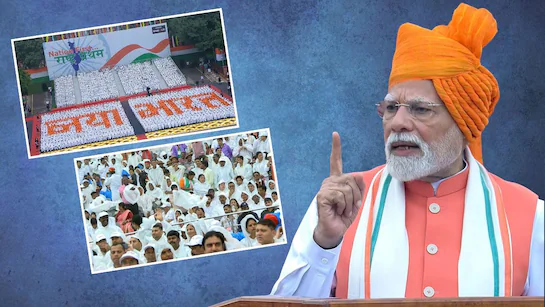
On 15 August 2025, as Bharat marks its 79th Independence Day the atmosphere is filled not just with patriotic pride but also with a growing sense of accomplishment. The nation is steadily freeing itself from technological dependence on others. From the political independence won in 1947 to the pursuit of scientific and technological self-reliance in the 21st century, this journey is being powered by the Aatmanirbhar Bharat vision under the leadership of Prime Minister Narendra Modi, which places science and technology at the heart of Bharat’s national strategy.
From the ramparts of the Red Fort, PM Narendra Modi shared his views on Bharat’s leap from political freedom to scientific self-reliance, celebrating it breakthroughs in quantum computing, semiconductors, space docking, green energy and deep-ocean exploration. All initiatives is driving the Aatmanirbhar Bharat vision towards true technological independence. PM Narendra Modi also shared about the rich thought of ancient knowledge of semiconductor, which has motivated government to approve budget for six Semiconductor plant and in upcoming year four more semiconductor will be launched, to support Aatmanirbhar Bharat.
Between 15 August 2024 to 14 August 2025, Bharat recorded some of its most remarkable breakthrough from outer space to oceanic depths, quantum computing to semiconductor manufacturing. All development reflects a single goal to design, develop and deploy advanced technologies within our own borders.
Building the Brains of the Future: Quantum & AI
One of the most developing indicators of Bharat’s rising tech is the National Quantum Mission, approved in 2023 and in last one year has presented remarkable results. By September 2024, four thematic quantum research hubs (T-Hubs) were established at IISc, IIT-Madras, IIT-Bombay and IIT-Delhi, bringing together 152 researchers from 43 institutions. These hubs are the foundation for innovations in quantum communication, computing and sensing fields, which are most critical to national security and next generation computing.
In a landmark moment on 14 April 2025, Bharat startups like QpiAI unveiled Indus, the nation’s first 25-qubit full-stack quantum computer, developed under the National Quantum Mission. This achievement represents more than just computing power it’s a conclusive step to involve private entities in removing dependence on foreign quantum platforms.
Artificial intelligence is being cultivated with a strong focus on ethics and national interest. In January 2025 the IndiaAI Safety Institute was launched to ensure AI development is safe, transparent and socially beneficial. Operating through a hub model, it connects Bharat academia, industry and global bodies like UNESCO. The 2025 Union Budget gave the IndiaAI Mission a huge push by allocating ₹500 crore for AI Centres of Excellence and IIT-based infrastructure, as part of a Rs 10,372-crore five-year plan. This is how the government is building a domestic AI ecosystem by ensuring that Bharat data trains Bharat algorithms.
Semiconductor & Research Infrastructure: Foundations of Self-Reliance
In present world where technology wars are fought over supply chains, Bharat has moved boldly to secure its future. Research Development and Innovation (RDI) Scheme, approved with an outlay of ₹1 lakh crore over six years (including ₹20,000 crore for FY 2025–26), focuses on frontier areas such as deep tech, biotech, quantum, AI, digital agriculture and climate action.
The FY 2025–26 Budget reflected the determination of Aatmanirbhar Bharat by MeitY’s allocation surged by 48 percent to over Rs 26,000 crore. IndiaAI Mission funds jumped nearly 11-fold to Rs 2,000 crore. PLI schemes for semiconductors were expanded and a dedicated R&D fund of Rs 20,000 crore was created.
One of the biggest steps towards self-reliance came with the Union Cabinet’s approval of four semiconductor projects in different states worth of Rs 4,009 crore to establish the facility with semiconductor fabrication and advanced packaging units, while two of previous facility has started manufacturing. These are not just industrial investments they are insurance policies against global supply disruptions. Bharat’s state-owned IREL reached out to Japan and South Korea to build a domestic rare-earth magnet supply chain reducing dependency on critical imports.
The Samudrayaan Project a Rs 600-crore manned deep-ocean mission under the Deep Ocean Mission is another example of the government’s willingness to invest in indigenous capability rather than rent technology from abroad.
Space: Reaching the Final Frontier on Our Own Terms
If a domain that is truly proving the success of Aatmanirbhar Bharat it is space technology. On 16 January 2025, ISRO successfully conducted the SpaDeX satellite docking mission, making Bharat the fourth nation in the world to achieve this capability. This is vital for future Bharat space stations and in-orbit servicing task that previously required foreign assistance.
The Aditya-L1 mission launched in September 2023, entered full science operations through 2024–25. It recorded its first X6.3-class solar flare in February 2024 and by early of 2025 it shared two datasets with the global scientific community.
In September 2024 also saw Cabinet approval for a series of next-gen missions like:
- Gaganyaan follow-on flights
- Chandrayaan-4 (Lunar Sample Return)
- Next-Generation Launch Vehicle (NGLV)
- Venus Orbiter Mission
To support this mission two new launchpads one in Sriharikota (Andhra Pradesh) and another in Tamil Nadu were announced. Back on Earth, ISRO’s geospatial platforms like Bhuvan, Electrical Infrastructure Management and NyayaVikas Portal aided governance, while 238 AMRUT cities used ISRO’s tools for urban planning and embedding space technology into everyday administration.
Ocean, Health & Education: Diversifying Indigenous Strength
While rockets reach for the skies the Samudrayaan Project takes Bharat deep under the sea. With the indigenously developed Matsya-6000 submersible, Bharat achieved a record dive beyond 5,000 metres, joining an elite global club capable of human deep-sea exploration. The mission strengthens Bharat’s capacity to study seabed minerals, crucial for the clean energy future.
In health technology IISc and startup Theranautilus developed CalBots, a magnetic nanobots capable of delivering bioceramic plugs into tooth tubules to treat sensitivity. This indigenous innovation eliminates dependence on imported dental nanotech and could open a new era for precision medicine.
The government is also sowing seeds for long-term innovation culture. The Prayaas Scheme, launched for students of Classes IX–XI which provides Rs 50,000 grants for STEAM-based projects, creating a future generation that thinks like scientists and engineers from a young age.
IIT (ISM) Dhanbad was recognised as a Centre of Excellence under the National Critical Mineral Mission, a move that directly supports the domestic supply chain for minerals essential to renewable energy and electronics.
Powering Aatmanirbhar Bharat: Energy Breakthroughs in 2024–25
Between August 2024 and August 2025, Bharat’s energy economy noticed the record growth in government missions, thus taking the country closer to the goal of energy independence. Renewable energy generation capacity has improved significantly, with 30 GW of clean energy, bringing total renewable generation to 24.7 billion kWh, a 17.2% increase from previous years. The Pradhan Mantri Surya Ghar Muft Bijli Yojana, supported by ₹75,021 crore, is providing rooftop solar to 1 crore households.
The National Green Hydrogen Mission was sanctioned Rs 600 crore in FY 2024–25, contracting for 1,500 MW of electrolyser capacity and 412,000 tonnes/year of green hydrogen production. GAIL’s unit in Madhya Pradesh now has 4.3 tonnes/day of clean green hydrogen production.
Hydropower progressed with the Rs 8,000 crore Tato-II Arunachal Pradesh project, with NLCIL spending Rs 7,000 crore for accelerating 10 GW of renewable projects. Nuclear power plans to achieve 22 GW by 2032 and 100 GW by 2047, backed by proposed new small modular reactor plans.
Energy storage capacity will increase by 30 GWh under a Rs 54 billion program, with waivers on transmission going up to 2028. Energy efficiency measures under Mission LiFE now reduce 306 million tonnes of CO₂ every year. These actions are in line with Aatmanirbhar Bharat, lowering import dependence and reaffirming Bharat’s leadership in clean energy.
Political Freedom to Technological Independence
Bharat’s journey since 1947 has been about transforming sovereignty from a political aspiration into a practical reality in every sector. In the 20th century, we depended heavily on foreign suppliers for critical technologies whether it is space launch vehicles, semiconductors, deep-sea equipment or advanced computing. The dependence not only strained our economy but also limited our strategic options.
Today the Aatmanirbhar Bharat mission approach has fundamentally changed with concept of build here, innovate here and export to the world. The government’s consistent policy of heavy investment in R&D, expansion of technology missions and creation of domestic manufacturing capabilities ensures that every passing year makes Bharat less dependent on imports and more capable of shaping global markets. These are not isolated victories, they are chapters in a much larger story of national self-reliance.
The developments from 15 August 2024 to 14 August 2025 are proof of this transformation:
We are building quantum computers instead of importing them.
We are manufacturing semiconductors instead of relying on overseas fabs.
We are designing space docking systems instead of buying them.
We are diving into deep oceans with our own submersibles.
79th Independence Day of New Confidence
As the tricolour flies high on this 79th Independence Day, the celebrations carry a deeper meaning. Independence is no longer just about the absence of colonial rule, it is about the presence of self-created, self-owned and self-driven capability in every sphere of national life.
The investments made today in quantum hubs, AI safety, semiconductor fabs, space missions and deep-sea exploration are the key of our future security, prosperity and global standing. They ensure that when the next technological challenge emerges, Bharat will not rely on foreign bodies. This is the realisation of Aatmanirbhar Bharat in science and technology. A nation that not only dreams but also builds, not only aspires but also achieves, standing tall among the world’s great innovators.














Comments