





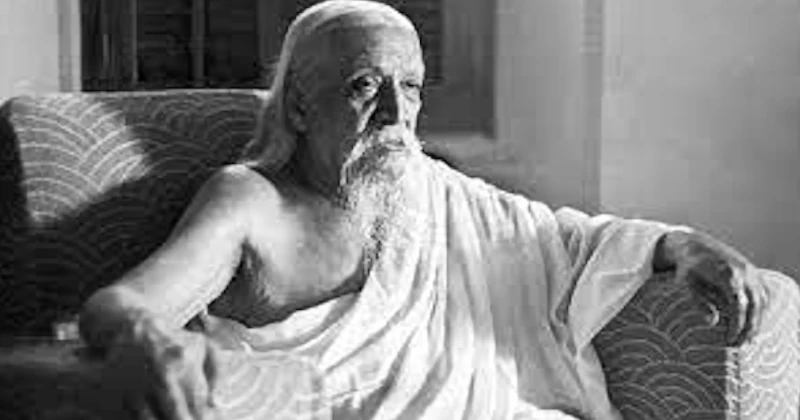
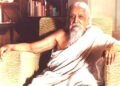
On August 15, the nation remembers Sri Aurobindo a man whose life bridged the battlefield of political revolution and the inner quest for spiritual transformation. Born in Calcutta in 1872, Sri Aurobindo was not just a thinker or philosopher; he was a revolutionary who shook the foundations of British imperial authority and later redefined India’s civilisational mission through his spiritual work.
Raised in England under an entirely Western education, Sri Aurobindo was deliberately kept away from Indian culture by his father’s instructions. Yet, upon returning to India in 1893 after fourteen years abroad, he immersed himself in Sanskrit, Indian philosophy, and the subcontinent’s cultural heritage. His thirteen years of service in Baroda — as a revenue official, royal secretary, professor, and vice-principal became years of intellectual growth and silent political networking.
The turning point came with the 1905 partition of Bengal. Sri Aurobindo abandoned his Baroda career, took charge as Principal of the Bengal National College, and entered the nationalist struggle openly. He helped shape the New Party, rallying under Lokmanya Tilak’s leadership, and challenged the Congress Moderates who were content with gradual reforms. His political creed was Swaraj complete independence not as a far-off dream but as an immediate national goal.
Through the columns of Bande Mataram, a fiery nationalist daily he edited, Sri Aurobindo infused Indian politics with boldness. He championed self-help, boycott of British goods, creation of Swadeshi industries, parallel arbitration courts, national education systems, and a disciplined citizen force — a strategy reminiscent of Sinn Féin’s later success in Ireland.
His revolutionary commitment came at a cost. Arrested for sedition in 1907 and acquitted, he was soon implicated in the Alipore Conspiracy Case of 1908, spending a year in jail as an undertrial before being cleared again. By 1909, he stood virtually alone at the helm of the Nationalist movement, but recognised that the country was not yet ready to execute his radical programme.
In 1910, after surviving a third prosecution attempt, Sri Aurobindo withdrew to Pondicherry, choosing a path of intense spiritual practice. The political world lost one of its most uncompromising leaders, but India gained a visionary seeker determined to integrate spirit and matter. His Yoga sought not escape from life, but the transformation of life itself through the descent of a higher consciousness the Supermind into the earthly plane.
From 1914 to 1921, through the philosophical monthly Arya, Sri Aurobindo produced some of the most profound works of modern Indian thought, including The Life Divine, The Synthesis of Yoga, Essays on the Gita, The Secret of the Veda, and The Foundations of Indian Culture. Around him grew the Sri Aurobindo Ashram, a living experiment in collective spiritual evolution.
Sri Aurobindo passed away on December 5, 1950. The Mother, his spiritual collaborator, continued his work until her passing in 1973. Today, his legacy lives on — as the firebrand who ignited a nationalist awakening, and the yogi who envisioned a divine destiny for humanity itself.











Comments