





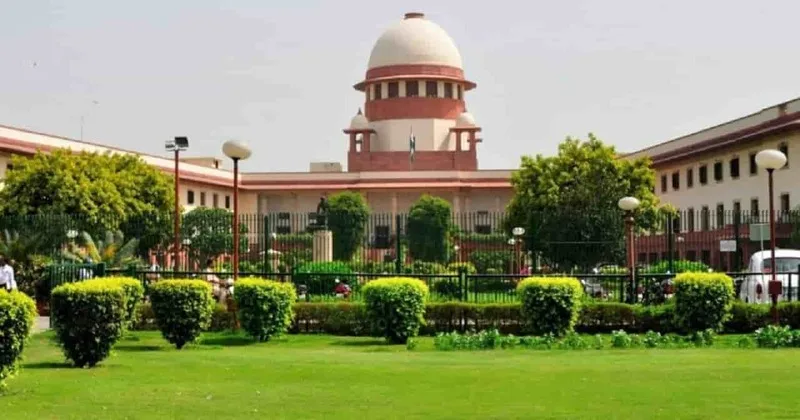
Supreme Court of India on August 14, asked the Election Commission of India (ECI) to upload on its website the names of 65 lakh voters removed during the special intensive revision (SIR) of electoral rolls in poll-bound Bihar, along with the reasons for their non-inclusion.
The order was passed by a bench comprising Justices Surya Kant and Joymalya Bagchi while hearing petitions challenging the ECI’s June 24 decision to conduct the SIR ahead of the state assembly elections. The move comes amid sharp political controversy, with opposition parties accusing the poll body of targeting voters under the guise of revision.
The bench said that the EC must make the deletion list fully accessible to the public, both digitally and at the grassroots level, so that affected citizens can take corrective action. The SC also appreciated the EC’s ground-level verification efforts but emphasised that transparency must be “reasonable” and “citizen-friendly.”
The court ordered:
Online Publication: Names of all 65 lakh voters removed, along with reasons for removal, must be displayed on the district election commissioner’s website.
Offline Display: Booth-level officers (BLOs) must display the list in panchayat offices and make it available for manual inspection.
Publicity Campaign: The list should be publicised in vernacular newspapers, Hindi and English dailies, broadcast on TV and radio, and shared via social media handles of district election officers.
Grievance Redressal: Aggrieved voters can approach poll officials with their Aadhaar cards to restore their names.
Posting the matter for further hearing on August 22, the SC said it wanted compliance reports from all district returning officers.
According to EC data presented on August 1, the reasons for removal were:
- Death: 22.34 lakh voters
- Permanently shifted/absent: 36.28 lakh voters
- Duplicate enrolment in multiple locations: 7.01 lakh voters
The bench made it clear that voter rights must not depend on political parties having access to such data: “We don’t want the rights of people to be dependent on political parties. We are not criticising political workers, but ultimately they are there for a political party,” the court remarked.
It acknowledged that while Aadhaar is not proof of citizenship, it is a legally recognised document for identity and residence, and should be accepted in voter verification as part of a “citizen-friendly” process.
Senior advocate Rakesh Dwivedi, appearing for the ECI, defended the poll body’s powers but admitted that it was operating in an “atmosphere of sharp political hostility” where its decisions were constantly contested.
Dwivedi also revealed that around 6.5 crore voters were not required to submit documents for the SIR because they or their parents were registered in the 2003 electoral roll. The court has now sought details on what documents were accepted during the 2003 revision.
Earlier this week, the SC also noted that electoral rolls cannot remain static, supporting the idea of periodic revision. It observed that the EC’s move to expand the list of acceptable identity documents from seven to eleven for the SIR was “voter-friendly and not exclusionary.”















Comments