





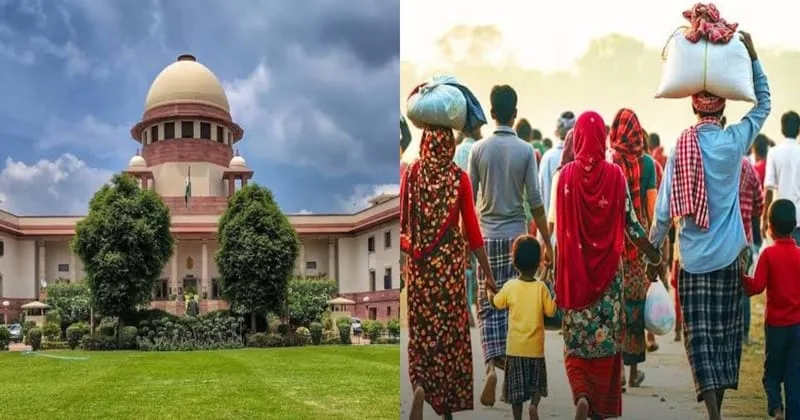
The Supreme Court on August 14 refused to grant an interim stay on the detention of Bengali-speaking migrant workers suspected of being illegal Bangladeshi nationals. A bench of Justices Surya Kant and Joymalya Bagchi, while agreeing to hear a public interest litigation (PIL) on the matter, observed that any interim order could have unintended consequences, particularly with regard to individuals who have genuinely crossed the border illegally and are liable for deportation.
The PIL, filed by the West Bengal Migrant Workers Welfare Board, alleged that a May 2024 circular from the Ministry of Home Affairs (MHA) was being misused by various state governments to arbitrarily detain Bengali Muslim migrant labourers, accusing them of being Bangladeshi nationals. The petitioner contended that many of these workers are being held in detention centres even before verification of their citizenship is completed, with some allegedly subjected to torture.
Advocate Prashant Bhushan, appearing for the petitioner, claimed that in nearly all cases where the migrants’ details were eventually verified, they were found to be Indian citizens. He cited instances where migrants were mistakenly deported, only to be brought back after confirmation of their Indian nationality. “In some cases, they even sent them out of the country… after verification, they had to bring them back. Delhi police is saying their documents are in Bangladeshi language, there is no Bangladeshi language… it’s Bangla,” he submitted.
Bhushan further argued that detaining individuals on mere suspicion of being foreigners, without due process, was in violation of the Foreigners Act, which does not empower the government to detain persons solely based on suspicion of illegal nationality. “Let them verify, no problem. Problem is that they are detaining. Some are being tortured. It’s causing panic across the country,” he said, urging the court to grant interim relief to prevent such detentions during verification.
The bench, however, refrained from passing any interim order and underlined the complexities of the issue. “If we pass any interim orders, then it will have consequences, especially for those who have illegally come from across the border and need to be deported under the law,” the court observed. It stressed the need for a proper mechanism to verify the identity of migrant workers without subjecting genuine citizens to harassment.
The court also issued notices to the Union government and nine states and Union Territories, Odisha, Rajasthan, Maharashtra, Delhi, Bihar, Uttar Pradesh, Chhattisgarh, Haryana, and West Bengal, seeking their responses before the next hearing. It questioned how the proposed directions could be practically implemented and said it would consider suggestions from the respondents on creating a coordinated framework to prevent harassment of bona fide citizens.
“There needs to be a nodal agency to coordinate between the state of origin and the state where they have gone for livelihood,” said Justice Kant. Justice Bagchi echoed the concern, questioning whether any statutory authority currently exists to facilitate such coordination.
Justice Kant also proposed a possible solution, suggesting that the state of origin could issue identity cards to migrant workers, which local police in destination states could accept as prima facie proof of citizenship and purpose of stay. “Suppose someone has come illegally in India, how to deal with that situation? If they don’t detain, he will disappear. Some mechanism required for bona fide workers… either state of origin can issue some kind of card… and local police accept it as prima facie proof of his having come for livelihood,” he said.
The court’s cautious stance comes amid a broader push by authorities to identify and deport illegal Bangladeshi nationals residing in India. In recent months, the government has taken active steps to crack down on undocumented migrants, particularly those suspected of entering the country illegally and availing welfare benefits and employment opportunities meant for Indian citizens. Officials have cited concerns over national security, demographic changes, and strain on public resources. However, rights groups and civil society organisations have warned that such measures—if not implemented with due diligence—risk targeting vulnerable populations, especially migrant workers, based solely on language or religion. The Court’s current deliberation underscores the delicate balance between national security concerns and the protection of constitutional rights for genuine Indian citizens.










Comments