





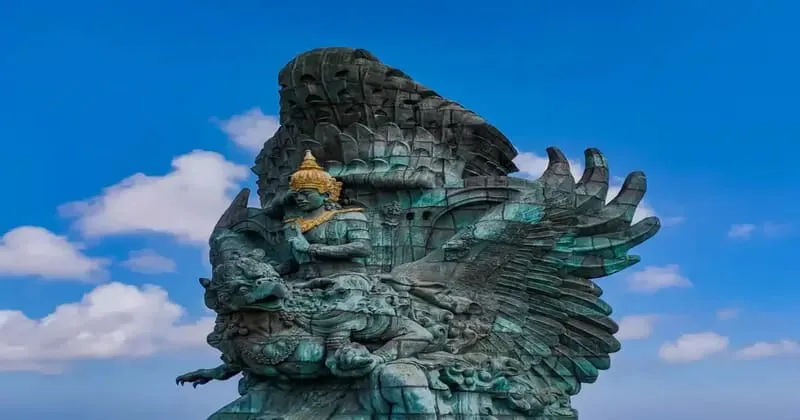
When one thinks of towering statues of Hindu deities, India often comes to mind first. But nestled atop the limestone cliffs of Bukit Ungasan in Bali, Indonesia, stands a monumental surprise: the Garuda Wisnu Kencana (GWK) statue, a stunning embodiment of spiritual heritage, cultural pride, and architectural excellence.
This awe-inspiring sculpture depicts Bhagwan Vishnu riding his celestial companion, Garuda, and reigns as one of the tallest statues in the world. Rising to a majestic height of 121 meters (nearly 400 feet) with a 64-meter (210 feet) wingspan, GWK surpasses even the Statue of Liberty in stature. But its significance stretches far beyond size, it’s a symbol of Indonesia’s unity in diversity, and a testament to the enduring spirit of Balinese Hinduism.
A Celebration of Indonesia’s Independence: Pesta Rakyat 2025
This year, the Garuda Wisnu Kencana Cultural Park will be the vibrant heart of national celebrations. From August 13 to 17, 2025, the park will host the Pesta Rakyat, a lively public festival marking Indonesia’s 80th Independence Day. The festivities will culminate in a grand music concert on August 17, bringing together thousands in a joyful blend of art, culture, and national pride.
The Story Behind GWK: Vision, perseverance & monumental effort
The dream of building GWK was conceived in the 1980s, not just as a tourist destination but as a national icon. Spearheaded by renowned Balinese sculptor I Nyoman Nuarta, construction officially began in 1997. However, the journey to completion was far from smooth. Financial and logistical challenges delayed the project multiple times, stretching its timeline across two decades.
Finally completed in 2018, GWK is now a marvel of modern engineering. Constructed using over 3,000 tons of copper and brass, the statue was designed to withstand Bali’s tropical climate and seismic activity — no small feat given its sheer scale and complexity.
Why Bhagwan Vishnu stands tall in Bali
In Hindu belief, Vishnu is the preserver of the universe, while Garuda, his vahana (vehicle), symbolises freedom, courage, and loyalty. Together, they form a powerful emblem of divine guardianship and protection of the natural world. This message resonates deeply in Indonesia. Garuda is not only a sacred figure in Hinduism but also serves as the country’s national emblem, the Garuda Pancasila, embodying the principles of unity, democracy, and cultural harmony. Thus, the statue is not only a religious icon but also a monument to Indonesia’s pluralistic identity and shared heritage.
A living legacy of Balinese Hinduism
Hinduism first reached Bali over 2,000 years ago, brought by early maritime trade between India and Southeast Asia. Over the centuries, it merged with local animist traditions and Javanese influences, giving rise to a uniquely Balinese form of Hinduism.
Today, this spiritual legacy thrives in daily life. Temples (pura) dot the island’s landscape, and rituals like daily offerings (banten) are woven into the rhythm of everyday existence. The GWK statue is a towering continuation of this sacred tradition, linking ancient beliefs with contemporary expression.
More than just a monument
The Garuda Wisnu Kencana statue is more than a visual marvel, it’s a beacon of identity, resilience, and spiritual continuity. It stands as a reminder that cultural greatness is not just inherited but cultivated over generations through shared vision and effort.
As Indonesia prepares to celebrate its 80th year of independence, the GWK statue remains a powerful symbol, uniting past, present, and future in the soaring form of Bhagwan Vishnu and his eternal guardian, Garuda.














Comments