





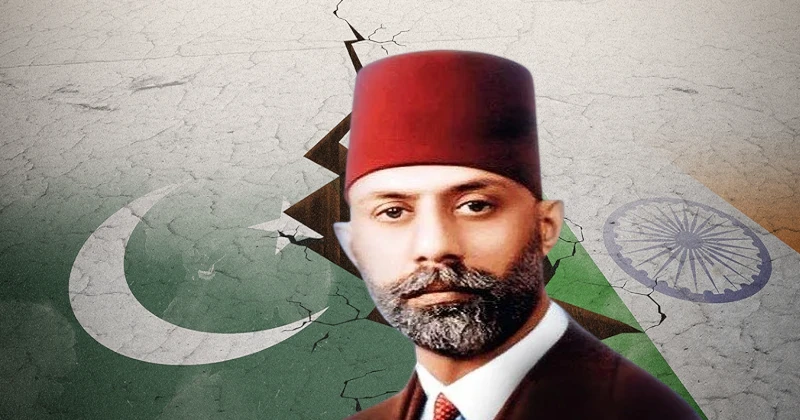
The bloody rupture of 1947 did not emerge suddenly, nor was it merely a product of British cartography or communal clashes. At its core lay an idea—an idea dangerous in its simplicity, divisive in its ambition, and catastrophic in its consequences. Its architect was not Jinnah, as is often simplistically assumed, but a relatively obscure student in Cambridge: Chaudhry Rahmat Ali. It was he who, in 1933, first formally articulated the notion that the Muslims of India must abandon the civilizational unity of Bharat and carve out a separate nation.
The Birth of an Idea: Cambridge, 1933
The seed of Partition was sown far from the soil of India—in a modest house at 3 Humberstone Road, Cambridge. On January 28, 1933, Rahmat Ali, then a 40‑year‑old graduate student of law, typed out a four‑and‑a‑half page pamphlet titled Now or Never: Are We to Live or Perish Forever? The pamphlet began with a stunning claim:
“It is a blatant falsehood that India is a single nation.”
In it, Rahmat Ali called for the creation of a new Muslim nation by uniting the north‑western provinces of Punjab, Kashmir, Sindh, the North‑West Frontier Province, and Baluchistan. He christened this proposed state Pakstan (later Pakistan), coining the term from the initials of these regions. The word was meant to symbolize “the land of the pure,” a sanctified Islamic homeland.
His language was militant, his imagery unapologetic. He wrote that Muslims were prepared to “sacrifice our lives on the cross of Hindu nationalism.” The pamphlet, smuggled into India and circulated among politicians, became the first spark that would eventually ignite into the inferno of Partition.
The Now or Never pamphlet was distributed to the members of the Parliamentary Committee formed after the Third Round Table Conference. In his covering letter, Rahmat Ali thundered:
“At this solemn hour in the history of India, when the British and Indian statesmen are laying the foundation of a Federal Constitution for India, we address this appeal on behalf of our thirty million Muslim brethren who live in Pakstan.”
This was the first formal appearance of the word “Pakistan”, a concept that delegitimized Bharat’s unity and seeded the two‑nation theory in its most uncompromising form. Rahmat Ali’s words were radical, but they soon found resonance. The Muslim League, until then a moderate organization seeking greater safeguards within a united India, gradually absorbed his vision. By the 1940s, especially under Jinnah’s leadership, it had transformed into the political vehicle of Partition.
The rise of communal Polarisation
The 1930s and 1940s saw Rahmat Ali’s vision slowly harden into political reality. The Congress leadership, dominated by Hindu majoritarian voices yet unwilling to concede genuine cultural federalism, created fertile ground for separatist propaganda.
The Congress’s refusal to acknowledge Muslim insecurities was presented by League propaganda as proof that Hindus would never treat Muslims as equals. Rahmat Ali’s ghost haunted every communal negotiation: if Muslims remained within a united India, they would be crushed by Hindu dominance. This rhetoric culminated in the Direct Action Day of August 16, 1946, when Jinnah called upon Muslims to demonstrate their determination for Pakistan. The result was a bloodbath in Calcutta.
Calcutta, 1946: When threat became reality
On the morning of August 16, Muslim mobs poured out of Calcutta’s slums armed with sticks, iron rods, and blades. Inspired by the Muslim League’s call, they attacked Hindus with unspeakable brutality. The police vanished; Hindu markets burned; bodies floated down the Hooghly. Within hours, Hindu groups retaliated with equal ferocity. The city descended into one of the bloodiest communal riots in modern history. Over 6,000 corpses littered the streets, while vultures descended to feast on the dead.
The threat Rahmat Ali had once articulated—that Muslims would rather drown India in blood than submit to “Hindu nationalism”—was no longer rhetoric. It was reality. From Calcutta, the wave of violence spread: Noakhali, Bihar, Bombay. By the time the bloodletting subsided, Partition had become inevitable.
Jinnah: The Executor, Rahmat Ali: The Architect
Mainstream narratives often credit Muhammad Ali Jinnah as the father of Pakistan. But the ideological architecture had been laid long before by Rahmat Ali. Jinnah was the executor; Rahmat Ali the architect.
Jinnah himself acknowledged the usefulness of Rahmat Ali’s vocabulary, though he later distanced himself from the man. Where Jinnah’s strategy was legalistic and pragmatic, Rahmat Ali’s vision was fanatical, absolutist, and uncompromising.
Without Rahmat Ali’s Pakstan dream, Jinnah’s demand for Partition might have remained a negotiating tactic rather than the destiny of a subcontinent.
The Hindu Tragedy: Blindness and Betrayal
For India’s Hindus, the tragedy lay in ignoring the danger until it was too late. Congress leaders, still intoxicated with the fantasy of composite nationalism, failed to grasp the ideological depth of Rahmat Ali’s separatism. They dismissed him as a crank in Cambridge, while the poison of his idea spread through the veins of Indian politics.
The Hindu leadership also underestimated the role of violence as a political weapon. Rahmat Ali and the Muslim League knew that the threat of rivers of blood could achieve what decades of petitions and negotiations could not. August 1946 proved them right.
And yet, the man who gave Pakistan its very name died in poverty and ignominy. Rahmat Ali opposed Jinnah’s truncated Pakistan, insisting on a much larger Islamic federation. For his dissent, his property was confiscated, and he was expelled from the very state he had conceptualized.
In 1951, Rahmat Ali died a lonely death in London, buried in a pauper’s grave. The “Father of Pakistan” was abandoned by the nation he had midwifed. His tragedy mirrors the fate of those revolutionaries who unleash storms they can no longer control.
Rahmat Ali was the intellectual assassin of Bharat’s unity. For millennia, Bharat had accommodated sects, tribes, languages, and faiths within a civilizational framework. The Vedic vision of Vasudhaiva Kutumbakam had allowed countless identities to coexist. But Rahmat Ali rejected this pluralism, branding India’s unity a “lie.” His vision was not of co‑existence but of separation, not of synthesis but of rupture. He sought to create a political theology where Islam could only survive by amputating itself from Hindu Bharat. This was the triumph of separatism over Sanatan civilizational continuity.
Rahmat Ali’s story carries stark warnings for contemporary India. a) Ideas matter. A pamphlet typed in Cambridge reshaped the destiny of millions. Intellectual seeds, even if sown in distant soils, can bear catastrophic fruit if left unchecked. b) Bharat cannot afford complacency. Cultural disintegration often begins not with armies but with narratives, manifestos, and propaganda.
Rahmat Ali’s life is a tragic paradox. He birthed the very idea of Pakistan, yet was cast aside by the state he dreamed into existence. But for India, his legacy was not tragic but catastrophic. His pamphlet shattered a civilization, unleashed rivers of blood, and tore apart the cultural fabric of Bharat. If Jinnah was the surgeon who cut the subcontinent, Rahmat Ali was the mind that first imagined the operation. He may have died a pauper in London, but the wound he inflicted on Bharat bleeds to this day.










Comments