





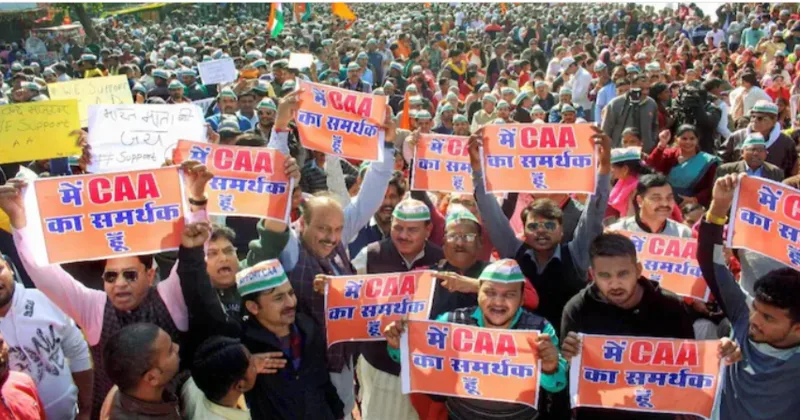
Post-August 5, 2024, Bangladesh plunged into chaos after Sheikh Hasina’s resignation. What followed was a wave of targeted violence against minorities Hindus, Buddhists, Christians, and Ahmadis. Reports indicate 1,769 verified attacks between August 4 and August 20 alone, including 152 temples vandalized, homes burned, and even rapes committed in the name of religious cleansing. For thousands of Hindus who share civilizational ties with India, the CAA is their only hope of survival. The CAA, enacted in 2019 and implemented in March 2024, grants Indian citizenship to persecuted non-Muslim minorities from Pakistan, Afghanistan, and Bangladesh who entered India before December 31, 2014. For the Modi government, this is not just a legal measure it is a moral obligation rooted in India’s cultural ethos: to shelter those who see Bharat as their natural home. On the other hand India has a dharmic duty to protect Hindus and other minorities in the subcontinent, especially when they are systematically targeted. Ignoring their plight would be both inhuman and unconstitutional to the civilizational idea of India.
Yet, the act has sparked fierce opposition, especially in states like West Bengal and Assam. Critics argue that the exclusion of Muslims violates the secular character of the Constitution. They worry that the CAA, when combined with the proposed NRC (National Register of Citizens), could become a tool of discrimination rather than protection.Chief Minister Mamata Banerjee has emerged as one of the most vocal and consistent opponents of the CAA. Declaring that the law will not be implemented in Bengal “under any circumstances,” her administration has refused to assist in any central data-gathering exercises related to citizenship verification. Her reasoning? She calls CAA an “anti-Constitutional” move that will “divide people on the basis of religion.” But let’s separate rhetoric from reality. If protecting persecuted Hindus from Bangladesh is unconstitutional, what about appeasing a specific community for votes? The recent push by Mamata to enroll names in voter lists especially targeting migrants and minorities raises serious questions. Why this sudden urgency before elections? Is it about democracy or about consolidating a Muslim vote bank that constitutes nearly 27% of Bengal’s population? When the Chief Minister publicly says, “Enrolment on voter list is your biggest shield,” it signals a dangerous trend that voting rights are being dangled as political favors to maintain power. (TOI report:https://timesofindia.indiatimes.com/city/kolkata/enrolment-on-voter-list-is-your-biggest-shield-cm-tells-migrants/articleshow/122983353.cms)
In the last two years, Bangladesh has witnessed an undercurrent of turmoil. Inflation has soared, unemployment remains stubbornly high, and the garment sector the country’s economic backbone has shown signs of fragility due to global slowdowns. Politically, Prime Minister Sheikh Hasina’s government has been accused by opposition groups of authoritarian tendencies and electoral manipulation. But most concerning, especially from an Indian standpoint, are reports of growing intolerance towards religious minorities. Sporadic violence, temple vandalism, forced conversions, and discrimination in land and property rights have sparked fear among minority communities, particularly Hindus.
According to some human rights organizations, this has led to a quiet uptick in cross-border migration, especially through the riverine and porous borders of North and South 24 Parganas, Nadia, and Cooch Behar. While official figures remain scant, anecdotal accounts from border villages and NGOs suggest that a new wave of undocumented migrants may already be trickling into West Bengal, rekindling the ghost of post-Partition displacement.
This context offers a rationale for the Modi government’s urgency in implementing the CAA. From their perspective, ignoring the situation would amount to turning a blind eye to suffering and could potentially destabilize border districts already under strain from overpopulation and resource pressure.
As Delhi and Kolkata trade barbs, the people on the ground especially those with disputed documentation find themselves caught in a bureaucratic limbo. For a Hindu migrant who arrived in 2012 from Barisal, the CAA represents a long-awaited path to legitimacy. But for a Bengali-speaking Muslim, born in Malda but with no land records due to erosion or displacement, the fear is that the CAA-NRC linkage could render them stateless.
Worse, misinformation is rampant. Many citizens do not understand the difference between CAA, NRC, and NPR. Rumors of detention camps, document raids, and deportation have created panic, especially in poor and rural areas where official paperwork is often incomplete or absent. Civil society organizations report increased anxiety among both Hindu and Muslim communities albeit for different reasons. In this haze of half-truths and hyperbole, trust in both governments is eroding.
From a constitutional standpoint, citizenship is a Union subject. However, its implementation, especially through verification drives, relies on state bureaucracies. This has created a peculiar deadlock.
The Centre says the law must be implemented uniformly. The State says it violates the spirit of federalism and regional autonomy. What results is not just a political standoff but an administrative paralysis.
Mamata Banerjee’s opposition to CAA is not about secularism; it’s about survival politics. She knows that CAA will regularize Hindu migrants, who are likely to support the BJP for granting them dignity and citizenship. This threatens her political arithmetic built on minority appeasement. But the bigger danger lies in unchecked illegal immigration. Bengal’s porous border is already under strain. Intelligence agencies have repeatedly flagged infiltration of not just economic migrants, but also radical elements. When the state government turns a blind eye or worse, encourages enrollment without verification it compromises national security.
CAA does not take away anyone’s citizenship it only gives citizenship to those who deserve it. There is no threat to Indian Muslims. The propaganda that CAA is “anti-Muslim” is a political narrative, not a legal fact.
Mamata Banerjee claims CAA violates the federal spirit. But citizenship is a Union subject under the Constitution. A state cannot veto a central law for political reasons. What Mamata Banerjee is doing is defiance for electoral dividends, not for constitutional morality. Yes, Bangladesh has protested being portrayed as a land of minority persecution. But ground realities speak louder than diplomatic niceties. The violence of 2024 exposed deep-rooted Islamist aggression in Bangladesh. If India does not step in, these vulnerable communities face extinction of culture and faith. Moreover, illegal migration cannot be ignored. Mamata Banerjee’s open invitation to enroll voter names blurs the line between citizen and infiltrator, creating a long-term demographic imbalance that threatens Bengal’s identity and India’s sovereignty.
The Modi government has done what previous regimes lacked the courage to do draw a line between compassion for the persecuted and compromise with illegality. CAA is about justice for those who had no place else to go, not about discrimination. CAA is not a communal law. It is a civilizational necessity, a humane policy for those suffering in Pakistan, Afghanistan, and Bangladesh. The opposition from Mamata Banerjee is not about principles it’s about politics. By weaponizing the voter list and stoking fear, she risks pushing Bengal into deeper turmoil. Citizenship cannot and shouldn’t be bartered for votes. National interest must come first. As the storm rages in Bengal, one truth stands out: India cannot allow porous borders and political opportunism to dictate its destiny. The nation must choose security over appeasement, clarity over confusion, and dharma over dangerous populism.















Comments