






For over a decade, the Trinamool Congress (TMC) has fended off charges that West Bengal is “industry-averse” — a label that has stuck stubbornly since Mamata Banerjee stormed into power in 2011. This week, the party tried to turn the tables on the Bharatiya Janata Party (BJP), armed with data from the Ministry of Corporate Affairs (MCA) that it claimed demolished the “myth” of industrial decline.
But the counter-offensive boomeranged spectacularly when BJP IT Cell chief Amit Malviya responded with what he called “the data TMC doesn’t want you to see” — numbers that tell the story of a state hemorrhaging businesses, losing investor trust, and sliding into economic irrelevance.
So, Mamata Banerjee’s cheerleaders think they’ve “debunked” the industry-averse tag? Let’s rip the PR mask off.
Fact 1: Between April 2011 and March 2025, 6,688 companies shifted their registered offices out of West Bengal. This isn’t some paperwork blip — it’s a mass exodus.… https://t.co/IINpWhep9Y
— Amit Malviya (@amitmalviya) August 13, 2025
On social media platform X, TMC leaders cited MCA statistics to claim:
- The number of companies with registered offices in West Bengal nearly doubled from 1,37,156 in 2011 to 2,50,343 in 2025.
- Between August 2019 and July 2025, 44,040 companies were incorporated in Bengal, while only 1,742 companies shifted their registered offices out of the state.
The spin was simple: More registered companies = industrial revival. The underlying message BJP’s “industry-averse” charge is propaganda.
Malviya’s rebuttal ripped this claim apart, arguing that TMC’s cherry-picked figures mask a deeper crisis.
Fact 1: A decade of orporate Flight
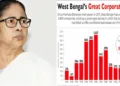
Between April 2011 and March 2025, 6,688 companies moved their registered offices out of West Bengal — including 110 listed companies. This is not a statistical blip; it represents large and mid-sized firms voting with their feet, leaving behind shuttered offices and unemployed workers.
The outflow was not evenly spread it peaked under Mamata’s watch:
- 2015–16: 869 companies fled
- 2016–17: 918 companies fled
- 2017–18: 1,027 companies fled
“This isn’t a development wave it’s a wave of departure,” Malviya posted.
Fact 2: Exodus to Business-friendly states
The departing companies didn’t disappear they went where the industrial climate is more stable and corruption is lower:
- Maharashtra: 1,308 companies
- Delhi: 1,297 companies
- Uttar Pradesh: 879 companies
- Chhattisgarh: 511 companies
- Gujarat: 423 companies
- Rajasthan: 333 companies
This relocation pattern points to one undeniable fact: investors are choosing governance and efficiency over Bengal’s chaotic bureaucracy and hostile political climate.
Fact 3: Bengal’s FDI Share: A national embarrassment
While states like Maharashtra command 39 per cent of India’s Foreign Direct Investment (FDI) and Karnataka 13 per cent, Bengal’s share stands at a humiliating 0.60 per cent. Delhi attracts 12 per cent, Gujarat 11 per cent, Tamil Nadu 7 per cent, and even younger states like Telangana capture nearly 6 per cent.
In the global market’s eyes, Bengal is almost invisible. The Bengal Global Business Summit — touted annually as a “game-changer” has produced a sobering statistic: only 4 per cent of announced projects actually materialise. “No one is fooled by glossy brochures and ribbon-cutting jamborees,” Malviya said. “Investors look for stability, transparency, and execution Bengal offers none.”
Fact 4: The ground reality: Rust, not growth
Under Mamata Banerjee’s rule:
- Over 22,000 factories have shut down since 2011.
- Once-thriving industrial belts in Howrah, Durgapur, and Asansol now resemble ghost towns.
- Britannia Industries a century-old brand with deep roots in Bengal relocated operations out of the state.
- IFB Agro, a major player in the food and beverage sector, was crippled by what Malviya called “excise mafia” harassment and political extortion.
- Multiple MSMEs (Micro, Small, and Medium Enterprises) have withered under the twin burden of political interference and lack of infrastructure.
“Registering a company’s office is not the same as running a factory that employs thousands,” Malviya argued. “Bengal’s industrial map is dotted with rusted gates and boarded-up plants that’s Mamata Banerjee’s real economic legacy.”
Economic experts warn that MCA incorporation data the centrepiece of TMC’s claim can be misleading. Many newly registered firms are small-scale shell entities or paper companies with no significant economic footprint.
Industrial health is measured by:
- Production output
- Job creation
- Capital inflow and reinvestment
- Sustained investor confidence
On all four counts, Bengal under Mamata has lagged behind.
“Bengal was the industrial pride of India,” Malviya concluded. “Mamata Banerjee inherited that legacy and turned it into an economic wasteland. Investors flee, jobs vanish, and hope dies that’s the truth TMC can’t spin away.”














Comments