





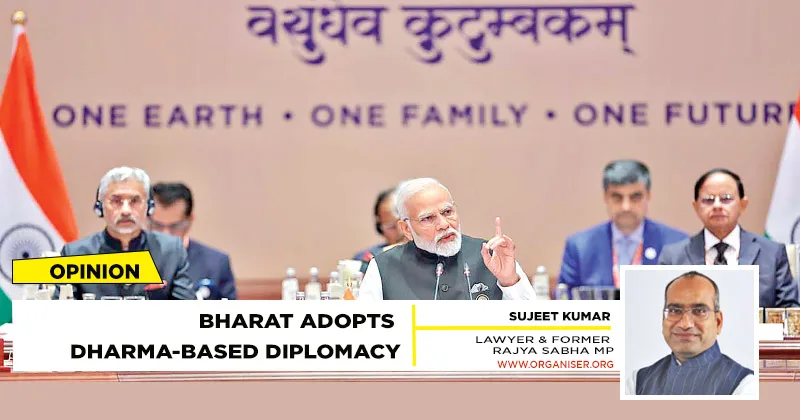
In the history of any nation’s foreign policy, moments of transformation are very rare. But when they do occur, they carry the weight of historic and civilisational momentum. In the case of Bharat as well, in the initial decades of our independence, we had several such moments but they became missed opportunities, as many argue, due to the lack of resolute and visionary leadership. But since 2014, the defining paradigm of foreign policy has shifted to a philosophy of “Nation First”. The recent deployment of all-party parliamentary delegations to 33 countries following the cowardly and reprehensible terror attack in Pahalgam and the swift response through Operation Sindoor marks one such defining moment. This is not just a tactical or strategic development; it is a civilisational response rooted in Bharat’s timeless diplomatic values, executed with the clarity, confidence and the courage of a rising global power. It signals the arrival of what can be rightfully termed Modi-era diplomacy which is rooted in Rashtra Dharma, articulated through social unity, and executed with national pride.
Nehruvian Secrecy to Bharatiya Openness
For close to six decades, Bharat’s foreign policy was conducted behind closed doors, exclusively dominated by an elite diplomatic corps largely removed from the social, cultural and civilisational pulse of the people. What Prime Minister Narendra Modi has achieved through G-20 diplomacy or now recently through post-Operation Sindoor diplomatic outreach, is a fundamental break from that tradition, bringing diplomacy out of the narrow confines of Lutyens’ Delhi and into the democratic consciousness of Bharat.
The decision to send multi-party parliamentary delegations to present Bharat’s case of Operation Sindoor is an unprecedented one. Political leaders from the ruling party, opposition and ideological extremes, BJP, TMC, AIDMK, Congress, DMK and Shiv Sena, BJD and AIMIM etc joined hands to carry the same message abroad: Bharat will not tolerate terrorism, and Bharat stands united against any such external threats. This unity that has emerged now is no accident. It is inspired by a larger civilisational ideal. As Kautilya had emphasised, “when the Dharma of the Rashtra is at stake, internal divisions must dissolve in favour of collective resolve.” This is the essence of Bharat Neeti, where national interest is seen not as a policy objective, but as a sacred duty.
Strategic Leadership Rooted in Dharma
The global outreach in the wake of Operation Sindoor was not just a diplomatic manoeuvre; it was Bharat’s newfound civilisational confidence. The initiative, led by Prime Minister Modi and ably supported by External Affairs Minister Dr S Jaishankar, presented a clear and consistent narrative to the world: Bharat is a victim of cross-border terrorism, and it has a right to respond, and will respond with both moral force of the society and the strategic will of the nation.
Our adversaries, especially Pakistan, are rattled not just by our military resolve to give befitting reply, but by our political unity, cultural coherence and moral legitimacy
Each of the seven empowered delegations was equipped with dossiers of undeniable evidence of Pakistan’s ongoing support to terrorist outfits and the direct involvement in Pahalgam. But what made this exercise different from previous attempts was the tone of conviction in presenting the case of Bharat at the global level. Gone are the hesitations of the past. In its place stood a new Bharatiya assertive voice with clarity and openness. It was the voice of a nation that knows its strength and draws it from thousands of years of spiritual and cultural continuity.
From Soft Power to Shakti-Samyukt Diplomacy
Bharat has long been admired for its soft power, be it food, cricket, spiritual traditions, yoga, ayurveda, cinema, and pluralistic ethos etc. But under the Modi government, soft power has now been fused with hard resolve — what can be called Shakti-Samyukt Diplomacy. Operation Sindoor and the subsequent global diplomatic outreach exemplify this new model.
By involving Parliamentarians from varying parties — who are the voice of the people — in diplomacy, Bharat is making a deeper statement: This is not a diplomacy from above; it is a diplomacy from within, this is not a diplomacy of strategic intelligence, it is one of emotional unity. It is a civilisational assertion that terrorism is not merely a political and security challenge, it is an adharmic (immoral) force that must be defeated through national unity, social will and the spiritual conscience of the people of Bharat.
This is also a moment to acknowledge and celebrate how far Bharat has evolved. A country once seen as a hesitant player on the global stage is today setting the benchmarks for democratic diplomatic engagement. Our adversaries, especially Pakistan, are rattled not just by our military resolve to give befitting reply, but by our political unity, cultural coherence and moral legitimacy.
The World Is Watching and Learning
The international response to this diplomatic initiative has been overwhelmingly positive and appreciative. In my interactions with journalists, thought leaders, parliamentarians and diplomats in the United States, France, Germany, Chile, South Korea, Japan, Australia and other countries have expressed admiration for Bharat’s unique ability to speak in one voice, despite being the most diverse country in the world. Several officials in bilateral and multilateral fora publicly noted how rare it is for a democratic country to send a unified delegation after such a big national crisis. For many, this marked a new and emerging model of democratic diplomacy, where internal debate coexists with external coherence.

More significantly, countries around the world are beginning to see Bharat as a stabilising force, not just in South Asia, but across the Indo-Pacific and beyond. This marks a dramatic shift from Bharat’s earlier image presented around the world as a cautious, and reactive power. Today, Bharat is perceived as a proactive leader, a Vishwa Bandhu, one that carries with it the wisdom of ancient civilisational values and the assertiveness of a modern aspirational republic.
Civilisational Awakening in Foreign Policy
At its core, this new diplomatic approach of the country is part of a larger de-colonial and civilisational awakening; a strong and deep realisation that Bharat is not just a nation-state formed in 1947, but a civilisational entity of millennia that has survived invasions, colonisation, and ideological subversion. As the spiritual heir to this civilisational continuity, today’s Bharat has a responsibility to speak the language of Dharma, justice, truth not just inwards, but to the entire world.
This is not simply about messaging; it is about reshaping the contours of global discourse. When Bharat invokes the ancient Sanskrit verse ‘Vasudhaiva Kutumbakam,’ from the Maha Upanishad, it is not performing any soft diplomacy, it is offering an alternative world vision, one that stands in contrast to the exploitative and hegemonic western systems of diplomacy that have dominated global affairs for far too long.
Institutionalising Dharma-based Diplomacy
Now that this unique initiative has shown such resounding success and acceptance, the time has come to institutionalise this new disruptive approach to diplomacy. Parliamentary involvement in key global missions is going to become a norm, not just an exception. It not only gives authenticity to our diplomatic engagements but also ensures that Bharat’s foreign policy remains grounded in its democratic and civilisational ethos.
Think tanks, academic institutions, industry bodies, government initiatives and policy training centres must invest time, energy and resources to prepare a new generation of public diplomats and youth leaders who understand the Bharatiya worldview, a view that blends statecraft with spiritual strength, realism with idealism, and strategy with Dharma.
Bharat Will Shape the World
Operation Sindoor diplomacy is not just a response to Pahalgam terror attack perpetrated by Pakistan. It is Bharat’s declaration of its new diplomatic identity, firmly rooted in national unity, guided by Dharma, and driven by a desire to shape a just and peaceful world order.
This is what true Rashtra Dharma looks like — Not reactionary, but visionary; not apologetic, but assertive; not fragmented, but unified.
Let the world take note: Bharat is not a divided society; it is a united civilisation; and it will act, speak, and lead with the confidence of its timeless truth; with the collective voice of the People, the Parliament, and the Parampara.











Comments