





Ireland, often celebrated for its history of anti-colonial solidarity and warm ties with India, is now confronting an unsettling surge of racist violence against its Indian-origin residents. In recent weeks, a series of assaults some targeting children and others accompanied by slurs telling victims to “go back to your own country” has rattled a 100,000-strong Indian community that has been integral to Ireland’s economy, healthcare, and education sectors.
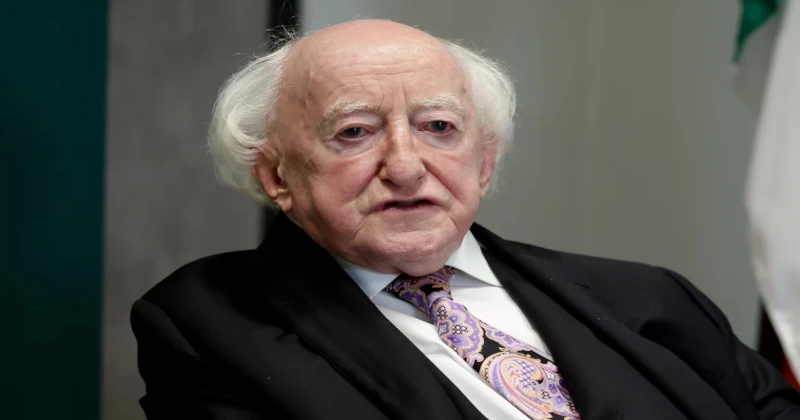
President Michael D. Higgins broke his silence with an uncharacteristically blunt condemnation, describing the incidents as “despicable attacks” that contradict “the values we hold dear as a people.” His statement carried a deeper warning: Ireland must protect not just its streets but also its “shared spaces” — including online platforms — from messages of hate and incitement.
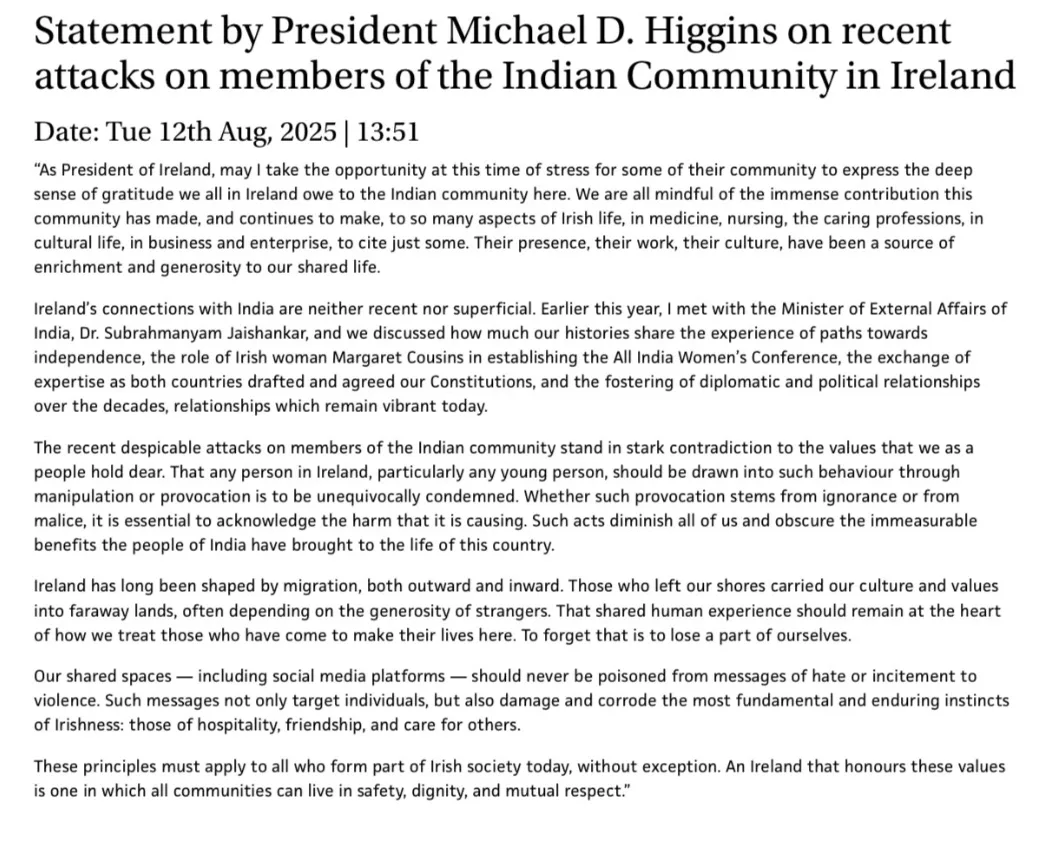
“That any person in Ireland, particularly any young person, should be drawn into such behaviour through manipulation or provocation is to be unequivocally condemned,” Higgins said. “Whether such provocation stems from ignorance or from malice, it is essential to acknowledge the harm that it is causing. Such acts diminish all of us and obscure the immeasurable benefits the people of India have brought to the life of this country.”
The attacks, according to reports verified by the Indian mission in Dublin, include:
- The brutal assault of a six-year-old Indian-origin girl in Waterford city, now under police investigation.
- The beating of 51-year-old Laxman Das in Dublin.
- A violent attack on a cab driver in Ballymun, where the perpetrator reportedly shouted, “Go back to your own country.”
The racial undertones are not subtle they are explicit, and for many Indians in Ireland, they are reminders of the growing influence of far-right xenophobic rhetoric across parts of Europe.
The Embassy of Ireland in New Delhi took the unusual step of issuing a public statement of “deep concern” over the surge in attacks. It confirmed that Irish Deputy Prime Minister and Minister for Foreign Affairs Micheál Martin will meet representatives of the Indian community on August 11 to address safety concerns and discuss concrete measures to prevent further incidents.
In its statement, the Embassy did not mince words, “We condemn these attacks in the strongest possible terms. They are an assault on the values of equality and human dignity that Ireland holds dear. Racism and xenophobia have no place in Irish society, and the actions of a few do not reflect the spirit of the Irish people.”
The Embassy also acknowledged the substantial contribution of the Indian community, “Over 100,000 Indians now call Ireland home. Our society is enriched by the diversity of people who live in Ireland, particularly our Indian community, whose contributions continue to deepen the bonds between our nations.”
The Indian Embassy in Dublin issued a safety advisory on August 1, urging citizens to:
- Avoid deserted or poorly lit areas, particularly at night.
- Report all incidents to local police and the Indian mission.
- Maintain heightened vigilance when using public transport or rideshare services.
The advisory came amid reports from victims that in some cases, the perpetrators were teenagers, raising concerns about how racist narratives are seeping into younger generations.
President Higgins, in his statement, invoked the long-standing ties between India and Ireland ties that are now being tested by these events. He recalled discussing with External Affairs Minister S Jaishankar earlier this year the parallel paths towards independence, the role of Irishwoman Margaret Cousins in founding the All India Women’s Conference, and post-independence constitutional cooperation between the two nations.
The irony is sharp: the same Ireland that once stood in solidarity with India against imperial oppression is now grappling with homegrown racial hostility toward Indian migrants, students, and workers. Community leaders warn that this shift from isolated incidents to a disturbing pattern risks eroding the trust and sense of safety that drew Indians to Ireland in the first place.
Ireland is a major hub for Indian students, with around 10,000 enrolled in its universities and colleges, particularly in technology, medicine, and business programs. These students contribute significantly to Ireland’s academic output and economy. Yet, they are among the most vulnerable often dependent on part-time jobs, reliant on public transport, and living in urban areas where recent attacks have occurred.














Comments