





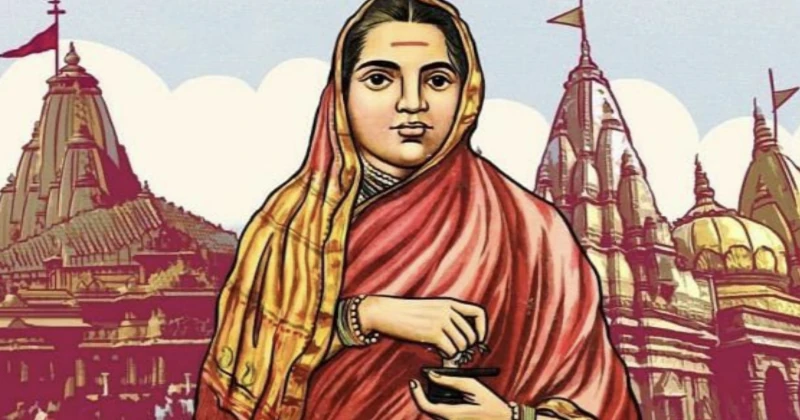
For months, I’ve watched false narratives about Bharat catch like dry grass—seeded with care, amplified with skill, repeated until the echo starts to feel like evidence. And what did most of us do? We scrolled. We sighed. We hoped someone else would step in. Silence in the face of a lie isn’t neutrality; it’s surrender. Every time we look away, those roots of untruth burrow deeper into our shared mind.
On August 13 her death anniversary we remember Punyashlok Ahilyabai Holkar and take a pledge: truth before trend, service before self, unity before ego, memory before manipulation, and courage before comfort. Write it. Sign it. Keep it where you’ll see it. Let this be our citizen’s sankalp in her name.
The Queen who chose work over noise
Punyashlok Ahilyabai Holkar wasn’t given an easy script. Married young, widowed by war, and soon after bereft of her mentor Malhar Rao Holkar—most would have stepped back. She stepped forward. From Maheshwar on the Narmada, she held together a state on the fault lines of a crumbling empire, shifting alliances, and recurring scarcity.
Her method wasn’t glamorous; it was humane and disciplined:
- Open doors, plain words. Anyone could petition her. Judgments were quick and clearly explained.
- Checks . Officers were rotated, accounts audited, and taxes eased in bad years.
- Firmness without cruelty. Force was a tool, not a reflex.
- Everyday prosperity. Safer trade routes, better crossings, fairer markets; weavers and artisans were supported, not squeezed.
- Civilization as service. She restored temples and ghats—Kashi, Somnath, Gaya, Ujjain and more—alongside dharmashalas, wells, tanks, and shelters. She funded upkeep with endowments, appointed caretakers, and used durable stonework—why so many of these spaces have stayed alive and in use for nearly three centuries and more. Faith paired with public good, not faith for a photo-op.
People called her Punyashlok—deeds worthy of sacred praise—not because she shouted the loudest, but because she delivered the most.
धर्मो रक्षति रक्षक्षिः — Dharma protects those who protect it.
Cultural revival that lasts
Rajmata Ahilyabai didn’t just rebuild shrines; she revived entire civilizational circuits. A temple or ghat, in her view, was an engine of community life: it anchored markets, safeguarded travelers, and stitched pilgrim routes into local economies. By pairing shrines with ghats, kunds, wells, rest houses, and gardens, she turned sacred sites into public infrastructure.
Three things made her work endure:
- Endowments for maintenance. She set aside revenue (devsthan lands/annuities) so priests, masons, and keepers could maintain the sites long after the ribbon was cut.
- Local craft, lasting materials. Commissioning regional artisans and stone masonry created pride of ownership—and structures that could weather centuries.
- Public access by design. Stepped ghats, broad mandapas, shaded corridors, and water points ensured constant use—use is the best preservation.
The result? From Kashi to Somnath, from Ujjain to Gaya, countless works she sponsored still function today—more than 300 years on—not as museum pieces, but as living places of prayer, community, and commerce. That is cultural revival with a warranty.
“Handling everything” without turning everything into a fight
Her challenges sound familiar today:
- Rumor and fear. Power then, as now, ran on whispers. She answered with clarity— clear letters to officers, clear rulings for people. Sunlight beats speculation.
- Polarized camps. She didn’t pick sides; she held to principles—justice, stability, dignity. Alliances were pragmatic; red lines were moral.
- Economic shocks. In scarcity, she cut or deferred taxes and safeguarded grain movement. Revenue was a means to welfare, not a trophy.
- Cultural fatigue. She rebuilt what stitched communities together—not to flaunt identity, but to weave it back into daily life.
Her pattern stayed steady: de-escalate, decide, deliver. No grandstanding. No contempt. Just the courage to do the boring, necessary thing again and again.
Five lessons Bharat can use right now
1) Service over posture: Nation-building is outcomes, not opinions: potholes fixed, classrooms lit, cases closed. Punyashlok Ahilyabai Holkar measured success by the comfort of the least powerful. So should we.
2) Systems over slogans: Charisma can win a week; only process survives its maker. Rotations, audits, clear mandates— leave behind a way of working, not just a story.
3) Unity is built, not chanted: Wells, roads, ghats—shared spaces create shared stakes. If we want harmony, fund the places where our lives meet.
4) Strength with mercy: Firm policing plus fair trials breeds trust. Cruelty looks like control in the short run; in the long run, it advertises fear.
5) Culture as a public good: Those “religious works” were also civic infrastructure—shelter for travelers, water for towns, dignity for communities. Stewarded wisely, culture is service.
What the noisy narratives miss
We’re told Bharat moves only under the whip or the wand—hard force or magical charisma.
Punyashlok Ahilyabai Holkar shows a third way: disciplined compassion. Quiet power. Stability without swagger. Tradition as a scaffold for welfare, not a weapon against “the other.” Reducing her to a textbook paragraph or a culture-war prop does her—and us—a disservice.
She isn’t a symbol to wave; she’s a standard to meet.
If her story matters, do something small and real
Admiring Punyashlok Ahilyabai Holkar while living like algorithms—forward first, think later— won’t do. Turn respect into routine:
- Verify before you share. If you can’t source it, don’t boost it.
- Adopt one local fix. A school shelf, a broken step, a patch of road, a ghat or mandir entrance—repair it, maintain it, rope in two more people. Share progress.
- Make grievance easy. In your team or housing society, set up one simple way to raise issues and commit to a response time. Justice is trust on a timer.
- Back artisans. Buy from weavers, potters, metal and wood workers. Tell their stories. Connect them to buyers. Civilizations breathe through craft.
- Speak with steadiness. When facts are distorted, correct them calmly. Don’t aim to “own” people. Aim to clarify.
None of this is glamorous. All of it is nation-building.
The ask
If false narratives are the fire of our time, answer with her method: rebuild, record, repeat. Choose the long road over the loud shortcut. Ask for evidence. Fund and fix what brings people together. Pay attention to the last person in line.
We don’t need louder heroes; we need steadier habits. Punyashlok Ahilyabai Holkar left a template: listen, decide, document, deliver. Do that in your lane, and the map shifts.
Build. Don’t bait. Serve. Don’t posture. Repair. Don’t perform.
That’s how a country grows up. That’s how Bharat deserves to be lived—by you, by me, by all of us.














Comments