





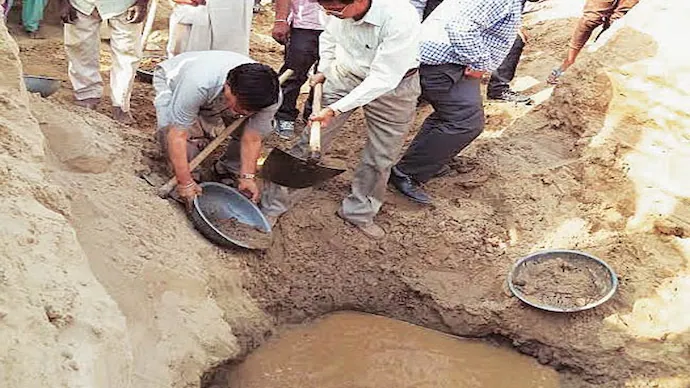
On November 17, 1985, Padma Shri Dr. V.S. Wakankar—renowned archaeologist and proponent of India’s cultural heritage- took the first step and embarked on a three-day Sarasvati ShodhYatra from Adi Badri, Yamunanagar, inspired by the vision of Manopanth Pingle, a social thinker.
Among the early participants was Union Minister and former Haryana Chief Minister, Shri Manohar Lal Khattar, who later institutionalised this legacy by establishing the Haryana Sarasvati Heritage Development Board (HSHDB) in October 2015.
The Board took off with the mandate of reviving the culture and heritage of River Sarasvati and presenting it to the world. Since then It has taken many big strides to restore the Sarasvati heritage that reflected the nation’s cultural and spiritual pride.
Thereafter, there have been myriad efforts to contextualise the Sarasvati culture to the present time. Undoubtedly, the restoration of invaluable Sarasvati heritage, cultural values and advanced ancient civilisation shall place India in a unique position in the world. The goal is to expand this revival from glacier sources in Uttarakhand all the way through HP, Haryana, Rajasthan and finally to Ram Kutch in Gujarat.
The pieces of evidence from the archaeological excavations, so far, at places like Adi Badri, Rakhigarhi in Haryana, Barod, Tarkhan Wala Dera and Chakk 86 sites in Rajasthan and Junikaran and Dholavira in Gujarat link them to the Sarasvati-Sindhu civilisation, which existed several hundred years before the Harappan and Mohenjodaro period.
Archaeological and geomorphological investigations by premier Indian institutions—such as ISRO, GSI, BARC, NIH Roorkee, SOI, ONGC, and ASI, have confirmed the existence of palaeochannels of the ancient Sarasvati River from Adi Badri in Haryana to the Rann of Kachchh in Gujarat. These studies, conducted using a combination of satellite imagery, remote sensing, seismic data, and ground-truthing, support the hypothesis that a mighty river, now dry, once flowed parallel to the present-day course of the Yamuna and Ghaggar-Hakra systems. This palaeochannel has been traced through Haryana, Rajasthan, and Gujarat, merging into the Arabian Sea via the Rann of Kachchh. Such evidence reaffirms the descriptions found in the Rigveda, where the Sarasvati is lauded as a “mighty river flowing from the mountains to the sea”. Ambitame Nadītame Devitame Sarasvati (Rigveda 7.95.2).
The restoration of this invaluable cultural, hydrological, and civilizational legacy promises to place India on a unique global pedestal, showcasing a heritage that predates the Harappan and Mohenjo-daro phases. In fact, the Sarasvati-Sindhu Civilisation, as increasingly referred to by archaeologists and historians, may well represent the world’s earliest large-scale urban culture.
According to Dr Deepa, a Chief Research Officer in the Board, based on the research documents, reports, and scientific facts, it has been established that the palaeochannels of the Sarasvati River are still existing from Adi Badri (Haryana) to Rann of Kachch (Gujarat).
The restoration of this invaluable cultural, hydrological, and civilizational legacy promises to place India on a unique global pedestal, showcasing a heritage that predates the Harappan and Mohenjo-daro phases.
Dr Deepa said the Sarasvati-Sindhu Civilisation, as increasingly referred to by archaeologists and historians, may well represent the world’s earliest large-scale urban culture.
Sarasvati and Rakhigarhi
One of the most remarkable archaeological validations of the Sarasvati narrative comes from Rakhigarhi, a prominent Harappan site located on the dry riverbed of the now-identified Sarasvati palaeochannel in Hisar district, Haryana. Excavations by the Archaeological Survey of India (ASI) and Deccan College have revealed that Rakhigarhi was a thriving urban centre with well-planned streets, drainage, granaries, and distinct evidence of early writing and metallurgy. The site’s proximity to palaeochannels strengthens the proposition that early Harappan settlements flourished along the Sarasvati River and that the river was a lifeline for this ancient civilization. Scientific studies using palaeobotany, isotope geochemistry, and satellite surveys link Rakhigarhi and other sites such as Barod, Tarkhanwala Dera, and Chakk 86 in Rajasthan to a continuous cultural landscape supported by perennial water flow along the Sarasvati system.
Revival Path
Encouraged by HSHDB’s progress, neighbouring states have begun participating in this monumental revival initiative.
Giving it a new push HSHDB vice chairman Dhuman Singh Kirmach met the Rajasthan Irrigation minister Suresh Rawat and other officials and proposed collaborative work to reintroduce water flow to parts of Rajasthan through the ancient Saraswati system. There is clear evidence that after passing through areas of Haryana, the Sarasvati river traversed through parts of Rajasthan before joining the Rann of Kutch and merging in the Arabian sea.
The Haryana Sarasvati Heritage Development Board and the Geological Survey of India are conducting comprehensive studies to reconstruct the fluvial history of the palaeo-course of ancient Sarasvati River system in parts of Himachal Pradesh, Haryana, Punjab,Rajasthan and Gujarat which is based on .
Identification and updation of database of palaeo course of the ancient Sarasvati River System in the parts of Himachal Pradesh, Punjab, Haryana, Rajasthan to Rann of Kutch, Gujarat.
Meanwhile, the HSHDB intensified its efforts in Uttaranchal and Himachal Pradesh with comprehensive archeological and hydrological studies of the Ton river, a major glacier-fed stream originating from near Dehradun in Uttaranchal. Historical and scientific evidence suggest that the Ton river might have been a key tributary of the mythical Saraswati river.
The HSHDB vice chairman recently visited Dakpathar barrage near Dehradun where the Ton river merges with Yammun. The Geological Survey of India and other institutions have also demonstrated interest to join the study that indicates that the Ton river might have flowed westward into the ancient Saraswati system before the tectonic shift diverted it to join the Yammuna.
The HSHDB has already demonstrated success in Haryana where water was channeled through a 400-km stretch from Adi Badri on the Himachal border in Yamunanagar district to Ottu headwaroks near Rajasthan border connecting seasonal rivers during monsoons. Mr Kirmach has also proposed technical collaboration to reintroduce controlled water flow through ancient channels in Rajasthan, especially during monsoon periods.
In 2021 Haryana has approved Rs 800 cores project for revival of Sarasvati river, under which Sarasvati Dam, Sarasvati Barrage and Saraswati Reservoir will be constructed at Adi Badri. Besides this, interlinking of Markanda and Saraswati rivers through Kainthla supply channel will also be undertaken. On completion of this project, around 894 hectare metres of flood water will be diverted to Saraswati reservoir. The dam is being designed by the Central Water Commission.
Meanwhile, the Haryana Government has been already engaged in constructing a Dam on Somb River in collaboration with Himachal Pradesh to ensure the perennial flow of water in Sarasvati River. Further, construction of Barrage in the lower reaches of River Somb Sarasvati to harvest water & divert excess flood water into Sarasvati Reservoir (by connecting underground pipeline) in village Rampur Herian, Rampur Kamboya and Chhlour.
In order to strengthen this understanding, the HSHDB and GSI had jointly conducted regional palaeo fluvial studies to map the ancient river course across Himachal Pradesh, Haryana, Punjab, Rajasthan, and Gujarat.
Hydrological Studies and Himalayan Tributaries
The Board has recently intensified scientific efforts in Uttarakhand and Himachal Pradesh, particularly focusing on the Tons River, a glacial stream that originates in the Himalayas near Dehradun. Historical tectonic studies, supported by geological evidence, suggest that the Tons River may once have contributed to the Sarasvati system before a major tectonic shift diverted its waters into the Yamuna.
Future Vision
A major breakthrough in Haryana has already been demonstrated, where the HSHDB successfully reintroduced water flow over a 400-km stretch from Adi Badri in Yamunanagar to the Ottu Headworks near the Haryana-Rajasthan border. This was achieved by strategically connecting seasonal rivulets and palaeochannels and implementing hydraulic interventions during the monsoon season. The long-term vision is to restore continuous flow through natural and artificial recharge, harnessing Himalayan glacial waters, rainwater harvesting, and sustainable aquifer management.
As the momentum for Sarasvati’s revival gains national support, this effort is not merely a hydrological project—it is a civilizational renaissance. Through a synthesis of ancient wisdom and modern science, India is reclaiming a lost river, along with the cultural, spiritual, and ecological identity it nurtured for millennia.
( The writer is a Chandigarh-based senior journalist)











Comments