





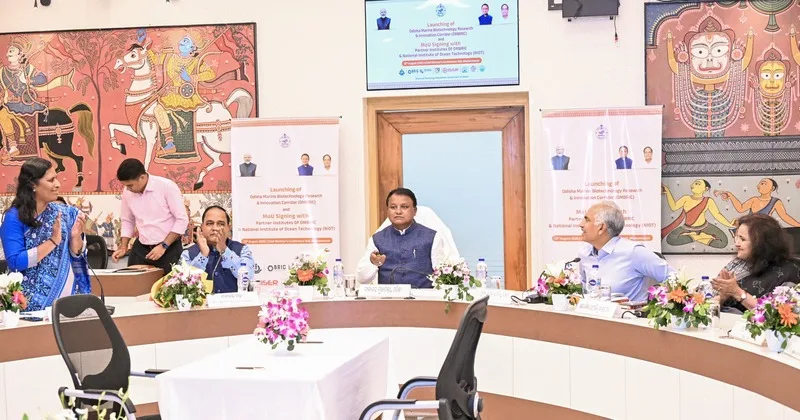
Bhubaneswar: In a landmark move aimed at harnessing Odisha’s marine potential for sustainable economic growth, Chief Minister Mohan Charan Majhi today launched the Odisha Marine Biotechnology Research & Innovation Corridor (OMBRIC), an ambitious initiative by the Department of Science & Technology, Government of Odisha.
The Chief Minister described OMBRIC as a transformative platform that will position Odisha as a national and global leader in marine biotechnology and the emerging Blue Economy. “Odisha is no longer just a coastal state; we aim to become a coastal innovator. OMBRIC connects the lab to the land, and research to real-world impact,” the CM said, addressing a packed gathering at Lok Seva Bhawan.
I am delighted to launch the Odisha Marine Biotechnology Research & Innovation Corridor (OMBRIC), an ambitious initiative to unlock the immense potential of our marine bioresources for scientific excellence, entrepreneurship, and sustainable growth.#OMBRIC will serve as a… pic.twitter.com/kTnyUEXb1y
— Mohan Charan Majhi (@MohanMOdisha) August 12, 2025
He added that the corridor is not just a research initiative but a springboard for entrepreneurship, innovation, and environmental stewardship. “OMBRIC is a vision aligned with Viksit Odisha 2036 and Viksit Bharat 2047. It will empower young entrepreneurs to create marine biotech startups that are rooted in local resources and meet global standards,” he stated.
To operationalize the initiative, a Memorandum of Understanding (MoU) was signed between the Government of Odisha and the National Institute of Ocean Technology (NIOT), under the Ministry of Earth Sciences, Government of India. Additionally, six premier academic and research institutions from Odisha have been onboarded as regional hubs for targeted R&D under OMBRIC. These include:
IIT Bhubaneswar – Tasked with comprehensive mapping of Odisha’s coastal marine biodiversity using satellite imagery, GIS, remote sensing, and drone technology. The institute will also assess coastal ecosystem health and provide capacity building.
NIT Rourkela – Focused on cultivation of unculturable marine microorganisms and extraction of bioactive compounds like enzymes, pigments, and antibiotics for industrial and pharmaceutical applications.
IISER Berhampur – Will lead novel gene discovery, structural elucidation of marine compounds, and upscale high-value marine biotech products using chemical engineering.
Institute of Life Sciences (ILS), Bhubaneswar – Responsible for establishing a Marine Microbial Biorepository and developing the Odisha Marine Bio Resource Atlas with genetic footprints. It will also foster blue tech innovation and start-up activities.
Berhampur University – Engaged in mapping marine biodiversity and characterizing metabolites in marine algae, seaweeds, fish, and other organisms.
Fakir Mohan University – Will develop commercial breeding technology for the endangered Indian horseshoe crab and study translational applications of its bioactive compounds.
Science and Technology Minister Krushna Chandra Patra lauded the initiative, describing it as a blueprint for Odisha’s future. “The state has immense untapped potential in marine biotechnology. OMBRIC is our strategic step toward unlocking it for sustainable development,” he remarked.
The Chief Minister underscored that as the world turns to oceans for answers to climate resilience, sustainable food, and new materials, Odisha is stepping forward boldly. “We are not exploiting our biodiversity, but preserving, understanding, and utilizing it responsibly,” he said, adding that OMBRIC will fuel job creation, environmental protection, and economic resilience.
Crucially, OMBRIC will foster a lab-to-market pipeline. Through intellectual property (IP) generation, incubation support, and entrepreneurial mentoring, research will be translated into market-ready products. This integrated model is expected to catalyze marine biotech enterprises and generate employment for Odisha’s youth.
The initiative will also prioritize community participation. OMBRIC’s framework includes capacity-building programs for coastal communities, hands-on training in sustainable marine practices, and participatory conservation. “We are committed to ensuring that the benefits of this innovation corridor reach the fishermen, coastal farmers, and women’s self-help groups who are the lifeline of Odisha’s coastal economy,” the CM emphasized.
Speaking at the event, Chief Secretary Manoj Ahuja called OMBRIC “a convergence of science, policy, and grassroots development,” while Development Commissioner Smt. Anu Garg highlighted the corridor’s role in climate action and livelihood security.
The launch event was attended by senior officials including Science and Technology Principal Secretary Smt. Chithra Arumugam, Additional Secretary Smt. Puja Mishra, and Directors and Vice-Chancellors of the six partner institutions. Director of NIOT, Ministry of Earth Sciences, was also present, underscoring the central government’s support for the initiative.
With 574 km of coastline teeming with marine biodiversity and a growing network of scientific institutions, Odisha is uniquely positioned to lead India’s blue revolution. OMBRIC is not just a corridor of researchit is a corridor of opportunity, innovation, and sustainable progress.
















Comments