





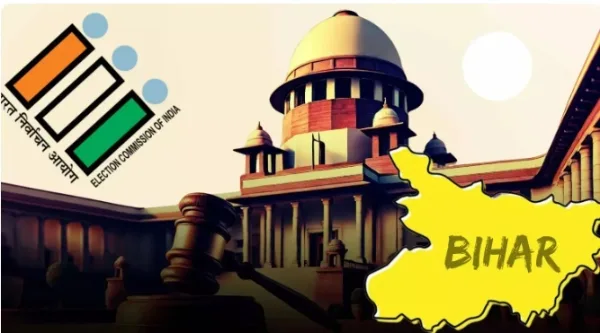
The Supreme Court on August 12 unequivocally backed the Election Commission of India’s cautious approach in the Special Intensive Revision (SIR) of Bihar’s electoral rolls, holding that an Aadhaar card, while a useful identity document cannot be treated as conclusive proof of Indian citizenship and must be subjected to verification before a person is included or excluded from the voter list.
A two-judge Bench of Justices Surya Kant and Joymalya Bagchi heard the batch of petitions challenging the ECI’s June 24, 2025 order initiating the SIR and the subsequent draft roll published on August 1. During the hearing the Bench repeatedly pressed parties on the mechanics and safeguards of the revision, underlining that the Court will step in promptly if there is any evidence of mass or arbitrary exclusion.
Senior Advocate Kapil Sibal appeared for several petitioners (including RJD MP Manoj Kumar Jha), arguing that the exclusion of a large number of names from the draft roll and the alleged non-acceptance of widely-held documents such as Aadhaar, EPIC and ration cards risked disenfranchisement of vulnerable populations. For the Election Commission, Senior Advocate Rakesh Dwivedi explained that the SIR is a fresh, targeted verification exercise aimed at cleansing the rolls of duplicates, deceased entries and migrants, and that Aadhaar by itself does not establish citizenship in the sense required for electoral inclusion. Other senior counsel who addressed the Court included Prashant Bhushan and Dr. Abhishek Manu Singhvi for intervenors and petitioning bodies.
Legally, the ECI bases the SIR on its powers under Section 21(3) of the Representation of the People Act, 1950 (the power to revise electoral rolls), read alongside the overarching constitutional responsibility under Article 324 to ensure the purity and fairness of elections. The Court observed that while the presence of identity documents (Aadhaar, EPIC, ration card, passport, matriculation certificate, etc.) is relevant, none of these documents is automatically conclusive of citizenship, the ECI must satisfy itself through the verification process stipulated under the Rules and the SIR methodology.
Practically, the Bench asked the ECI to be ready with precise data and the rationale for deletions and inclusions, including booth-level lists, the numbers before and after the exercise, and how many entries are alleged to be dead, migrated or duplicate, signalling that judicial oversight will continue to ensure that the SIR does not translate into unjust, mass disenfranchisement. The Court’s approach strikes a balance: it recognises the ECI’s statutory duty to maintain an accurate electoral roll while reserving the right to intervene if the exercise produces arbitrary or systemic exclusions.
The judgment’s practical effect is two fold. First, it affirms the poll body’s discretion to demand reliable proof and to verify identity claims rather than accept any single document as dispositive of citizenship. Second, it reiterates that any large-scale deletions must be transparent, reasoned and amenable to remedy, the draft roll stage, notices, and appeal mechanisms must work meaningfully to prevent disenfranchisement. Political observers say the Court’s direction is a legal endorsement of the ECI’s obligation to safeguard electoral integrity, while also keeping a tight judicial watch to protect voters’ rights.
















Comments