





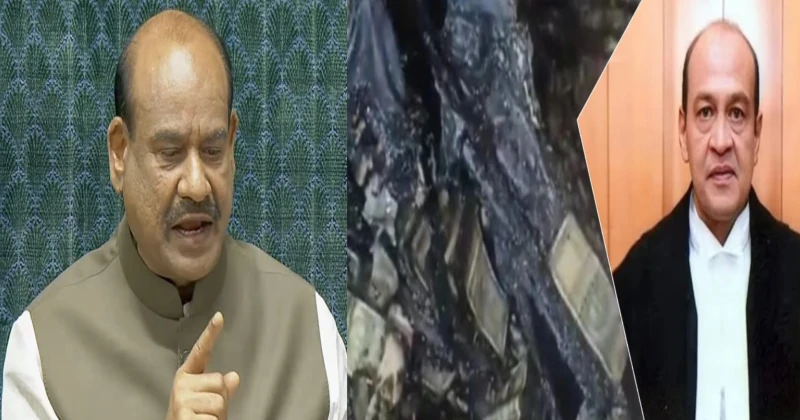
The Parliament on August 12, moved decisively into uncharted judicial territory, setting the stage for what could become the first removal of a High Court judge in independent India. Lok Sabha Speaker Om Birla announced the constitution of a powerful three-member panel to investigate Justice Yashwant Varma in connection with a sensational “cash-at-home” scandal that erupted in March this year.
The announcement came with a hard political message. “The process of removal of Justice Yashwant Varma should begin. The Parliament is united against corruption. We have accepted the impeachment motion… People have faith in the judiciary,” Birla declared, confirming that he had accepted a motion signed by 146 Members of Parliament, drawn from both the ruling and opposition benches.
The inquiry panel, appointed under Articles 124, 217, and 218 of the Constitution, comprises:
- Justice Aravind Kumar, Judge of the Supreme Court of India
- Justice Manindra Mohan Shrivastava, Chief Justice of the Madras High Court
- BV Acharya, Senior Advocate, Karnataka High Court
The committee has sweeping powers to summon documents, call witnesses, and record testimonies. Its findings will be submitted to the Lok Sabha Speaker, who will place the report before the House for debate and vote. If the panel upholds the charges, the motion for Justice Varma’s removal will be put to vote in both the Lok Sabha and Rajya Sabha. Only if both Houses pass the motion with the requisite special majority will it be sent to the President for assent — the final constitutional step for removal.
“The committee will submit its report as early as possible. The proposal [for removal of Justice Varma] will remain pending till the receipt of the report,” Birla said, underscoring that the process will not be rushed at the expense of due procedure.
The controversy began on March 14 when a fire broke out in the storeroom of Justice Varma’s official bungalow in Delhi. When firefighters entered to control the blaze, they stumbled upon a stunning discovery — stacks of cash, partially burnt, running into large sums.
The discovery immediately sparked a nationwide debate on corruption within the judiciary. Images of charred banknotes allegedly recovered from the scene circulated widely, fuelling public outrage.
Justice Varma denied any connection to the cash, dismissing the accusations as “preposterous,” but the incident prompted then Chief Justice of India Sanjiv Khanna to activate the Supreme Court’s in-house mechanism for examining allegations against sitting judges.
The in-house panel investigated the allegations and concluded that Justice Varma was guilty of misconduct, recommending his removal from office. CJI Khanna forwarded the panel’s report to President Droupadi Murmu and Prime Minister Narendra Modi.
Justice Varma responded by filing a writ petition challenging the legality of the in-house procedure. Seeking to keep his identity under wraps, he filed under the pseudonym ‘XXX’, arguing that the committee lacked jurisdiction and authority to investigate a sitting High Court judge.
On August 7, the Supreme Court dismissed Justice Varma’s challenge in a scathing ruling. The bench of Justices Dipankar Datta and Augustine George Masih noted that the in-house procedure was “scrupulously followed” and that Justice Varma had raised “no whisper” of objection during the inquiry process.
Rejecting senior advocate Kapil Sibal’s argument that the panel operated as a “parallel and extra-constitutional mechanism,” the Court held that the process “has its roots in the law declared by this court under Article 141 of the Constitution.”
The judgment stressed that the Chief Justice of India is not a mere “post office” when it comes to protecting judicial integrity. While refusing to halt the removal process, the Court clarified that Justice Varma retains the right to present his defence during impeachment proceedings in Parliament.
The case is a rare invocation of Articles 124(4), 217, and 218 — provisions that allow for the removal of judges of the higher judiciary on grounds of proved misbehaviour or incapacity. Historically, all previous impeachment motions against judges have either lapsed or failed to secure the necessary parliamentary majorities.
The three-member panel’s report will be pivotal. If it exonerates Justice Varma, the impeachment motion will be dropped. If it finds him guilty, the process will shift to the floor of both Houses of Parliament, requiring a special two-thirds majority for removal.
Should the motion succeed, Justice Varma would become the first High Court judge removed from office in independent India, setting a precedent for judicial accountability in cases of alleged corruption.












Comments