





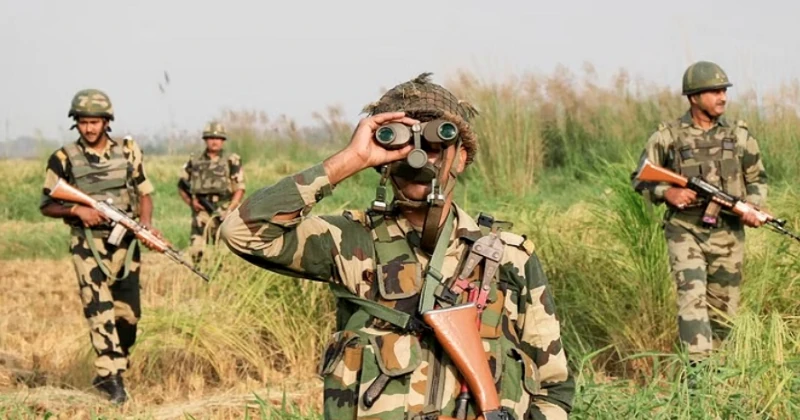
Tensions flared yet again along the International Border (IB) in Jammu’s Kathua district when the Border Security Force (BSF) troops intercepted and neutralised a Pakistani national attempting to infiltrate aggressively into Indian territory. The killing comes against the backdrop of an ongoing National Investigation Agency (NIA) probe into the April 22 Pahalgam terror attack, which was traced to Pakistan-based Lashkar-e-Taiba (LeT) operatives and directly precipitated India’s large-scale retaliatory strikes during Operation Sindoor.
According to BSF officials, around 4 p.m. alert border troops observed suspicious movement between the Chandwan and Kothey border outposts in the Hiranagar sector. The intruder, later identified as a Pakistani national, was seen crossing the IB and advancing aggressively towards the border fence.
Despite repeated verbal warnings, the man ignored calls to stop, prompting the BSF to open fire. Initial shots were aimed at his legs to incapacitate him. The injured infiltrator was taken into BSF custody and rushed to a local hospital, before being referred to AIIMS Vijaypur for specialised treatment. He succumbed to his injuries later that evening.
BSF sources confirmed that a formal protest is being lodged with Pakistani counterparts. The identity of the deceased and the motive behind his intrusion remain under investigation, though the body is expected to be repatriated.
While the Kathua incident states Pakistan’s continued attempts to breach India’s borders, investigative agencies are still unravelling the deeper operational network behind April’s Pahalgam massacre. The NIA, in its latest move, has collected blood and hair follicle samples from Parvaiz Ahmad Jothar and Bashir Ahmad Jothar both arrested on June 22 to determine whether their involvement went beyond providing shelter to the three LeT terrorists responsible for killing 25 tourists and a pony operator in Baisaran meadow.
The samples, taken from Jammu’s Amphalla prison, will be matched with clothes and weapons recovered from the slain terrorists Suleiman Shah, Hamza Afghani alias Afghan, and Jibran who were gunned down by security forces in Dachigam forest on July 28. Union Home Minister Amit Shah confirmed in Parliament on July 29 that all three attackers were Pakistani nationals and LeT operatives.
According to NIA sources, the Jothar duo allegedly harboured the terrorists at a seasonal dhok in Hill Park on April 21, providing them food, shelter, and logistical assistance. This support reportedly enabled the attackers to execute their targeted killings based on the victims’ religious identity.
Investigators are now assessing whether the Jothars had any direct operational role in the Pahalgam attack or previous terror incidents in Jammu & Kashmir. The DNA samples will also be checked against evidence from older civilian attacks to establish potential links.
So far, the NIA has questioned 1,055 individuals including tourists, mule owners, pony operators, photographers, shopkeepers, and employees — and recorded over 3,000 hours of testimony. Technical data extracted from the terrorists’ mobile and satellite devices is also being analysed to track their Pakistani handlers and cross-border communication patterns.
The brutality of the Pahalgam attack sparked India’s decisive military response Operation Sindoor launched on May 7. In coordinated pre-dawn strikes, Indian forces destroyed nine terror camps in Pakistan and Pakistan-occupied Jammu & Kashmir (PoJK), killing an estimated 100 terrorists. The retaliation escalated into a series of air and ground skirmishes between May 7 and May 10, with Indian Air Force strikes hitting 13 Pakistani airbases and military installations.












Comments