





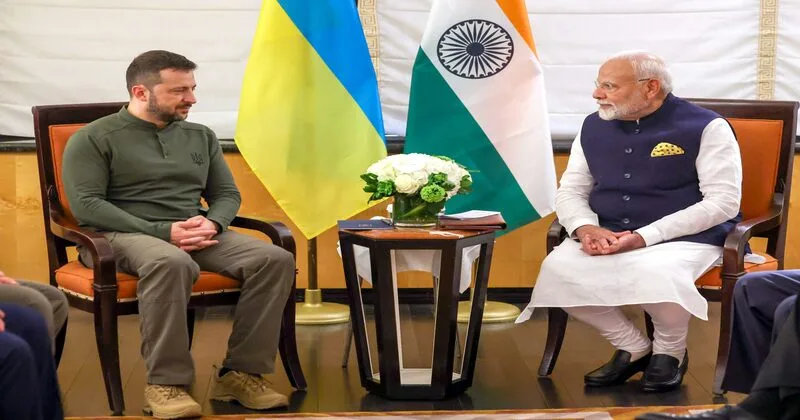
Ukrainian President Volodymyr Zelensky on August 11 held a detailed phone conversation with Prime Minister Narendra Modi, hailing India’s role in supporting peace efforts and expressing gratitude for Modi’s “warm words of support” for the Ukrainian people. The call came at a time when US President Donald Trump has imposed steep tariffs on India over its purchase of Russian oil, accusing New Delhi of “fuelling the war machine”, a charge Zelensky’s acknowledgment of India’s mediation role implicitly rebuts.
“I had a long conversation with the Prime Minister of India Narendra Modi. We discussed in detail all important issues, both of our bilateral cooperation and the overall diplomatic situation. I am grateful to the Prime Minister for his warm words of support for our people,” Zelensky posted on X after the call.
During the exchange, Zelensky emphasised the importance of India’s backing in efforts to end the war, saying, “It is important that India is supporting our peace efforts and shares the position that everything concerning Ukraine must be decided with Ukraine’s participation. Other formats will not deliver results.” The remark reflected a clear preference for India’s balanced approach over US’s past unilateral mediation attempts that have served primarily to advance Washington’s own interests.
I had a long conversation with the Prime Minister of India @narendramodi. We discussed in detail all important issues – both of our bilateral cooperation and the overall diplomatic situation. I am grateful to the Prime Minister for his warm words of support for our people.
— Volodymyr Zelenskyy / Володимир Зеленський (@ZelenskyyUa) August 11, 2025
Zelensky briefed Modi on the situation on the ground in Ukraine, including Russian strikes on civilian infrastructure. He drew attention to a recent attack on a bus station in Zaporizhzhia, which injured dozens of people, describing it as a “deliberate Russian bombing of a regular urban facility.” He lamented that instead of moving towards a ceasefire, Russia continued “the occupation and killings.”
Modi reiterated India’s consistent stance favouring an early and peaceful resolution to the conflict. “I conveyed India’s consistent position on the need for an early and peaceful resolution of the conflict. India remains committed to making every possible contribution in this regard, as well as to further strengthening bilateral ties with Ukraine,” the Prime Minister said on X.
The two leaders also discussed the issue of US sanctions. Zelensky urged action to limit the export of Russian energy, particularly oil, in order to reduce Moscow’s capacity to finance its war. “It is important that every leader who has tangible leverage over Russia sends the corresponding signals to Moscow,” he stressed.
The conversation ended with an agreement to meet in September during the UN General Assembly and to work on an exchange of visits, signalling a deepening of bilateral engagement even amid the ongoing conflict.
Zelensky’s call to Modi came just three days after the Indian Prime Minister held a detailed discussion with Russian President Vladimir Putin. “Had a very good and detailed conversation with my friend President Putin,” Modi posted on X on Friday, in a demonstration of India’s ability to maintain dialogue with both sides of the conflict.
Trump’s decision to impose a 50 per cent tariff on India, including an additional 25% penalty over Russian oil purchases, has been accompanied by sharp criticism. The US president claimed India was “fuelling the war machine,” an accusation Modi dismissed in strong terms. “For us, the interest of our farmers is our top priority. India will never compromise on the interests of farmers, fishermen and dairy farmers. I know we will have to pay a heavy price for it, and I am ready for it. India is ready for it,” he declared.
By openly recognising India’s contribution to peace mediation, Zelensky’s remarks stand in stark contrast to Washington’s punitive rhetoric. His trust in New Delhi’s role reflects growing international confidence in India’s ability to act as a fair and principled interlocutor, even as it withstands economic pressure from major powers.
With diplomatic channels open to both Kyiv and Moscow, and an upcoming face-to-face meeting between Modi and Zelensky on the cards, India’s balanced and sovereign approach to global crises remains on display, one that seeks resolution through dialogue rather than confrontation, and earns respect from both ends of a divided world.











Comments