





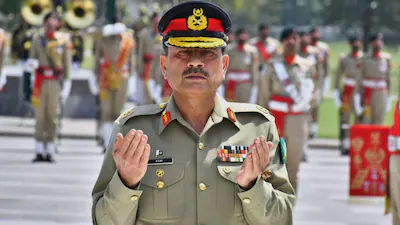
Former Pentagon analyst Michael Rubin has issued one of the harshest condemnations yet of Pakistan’s military leadership, likening Army Chief Gen Asim Munir to “Osama bin Laden in a suit” over his alleged nuclear threats made on US soil. Rubin accused Pakistan of behaving like a “rogue state” and called for immediate punitive action by Washington.
The controversy stems from reports that Munir, during a meeting with US military officials in Tampa, Florida, warned that if Pakistan “goes down, it would take half the world down” with it. The remarks, if accurate, have been widely seen as reckless nuclear sabre-rattling.
Speaking to ANI, Rubin said Munir’s statements echoed the language of terrorist groups like the Islamic State, questioning whether Pakistan was capable of fulfilling its responsibilities as a sovereign state. “The Field Marshal’s rhetoric is reminiscent of what we’ve heard from the Islamic State,” he remarked.
#WATCH | Washington DC, USA | On Pakistan Army Chief Asim Munir’s nuclear threat, Former Pentagon official Michael Rubin says, “Pakistan’s threats on American soil are completely unacceptable and it is raising questions in many people’s minds whether if it can fulfill the… pic.twitter.com/y7I5wh2VK7
— ANI (@ANI) August 11, 2025
Rubin argued that American officials should have acted instantly: “Within 30 minutes of when Asim Munir made those comments, he should have been ushered out, taken to Tampa International Airport, and flown out of the United States.”
The former Pentagon official outlined a series of retaliatory measures, including:
- Removing Pakistan’s Major Non-NATO Ally status.
- Considering designation as a State Sponsor of Terrorism.
- Banning Munir from entering the US.
He also warned that Pakistan’s nuclear threats could embolden extremist factions, some allegedly linked to the Pakistani military and its intelligence service, ISI, to seize nuclear weapons. “The alternative is simply too great to bear,” Rubin said, even suggesting that in the future, US special forces might need to enter Pakistan to secure its nuclear arsenal.
In a controversial suggestion, Rubin floated the idea of a “managed decline” of Pakistan, including the potential recognition of breakaway regions such as Balochistan. He said this could be the only way to prevent Pakistan’s nuclear weapons from falling into the wrong hands.
Rubin also took aim at President Donald Trump, hinting at possible foreign influence on his approach toward Pakistan and accusing the current administration of departing from the bipartisan US-India strategic partnership built since the George W. Bush era.
Touching on US-India trade tensions and disputes over Russian energy imports, Rubin accused Washington of hypocrisy, noting that the US itself purchases strategic materials from Moscow. Despite the current “stress test” in bilateral ties, he predicted the US-India relationship would eventually emerge stronger.
Rubin’s fiery remarks come amid rising concerns in Washington about Pakistan’s internal stability, nuclear command structure, and potential threats to global security, dangers he insists can no longer be ignored.













Comments