






A political cartoon drawn in 1925 predicting the rise of India, China, and Africa has gone viral on LinkedIn, triggering intense discussion about shifting global power balances at a time when US President Donald Trump has doubled tariffs on Indian exports.
The illustration, created by well-known American cartoonist Bob Minor and first published in Chicago’s socialist newspaper The Daily Worker, envisions a future where Western imperial powers lose their global dominance to the growing populations and influence of Asia and Africa.
The cartoon was recently shared by R.L. Narayanan, Vice-Chairman of the Centre for Innovation in Education and Empowerment (CIIEE), with the caption: “Exactly 100 years later, BRICS is shaping up to multipolar world. Together they hold 40 percent of the global population and $30 trillion GDP.”
Narayanan also quoted ancient Indian strategist Chanakya: “Before you start a war, count the cost of victory and the cost of the enemy’s revenge.” He added, “An uncalculated move against a rising power may win the day but lose the era.”
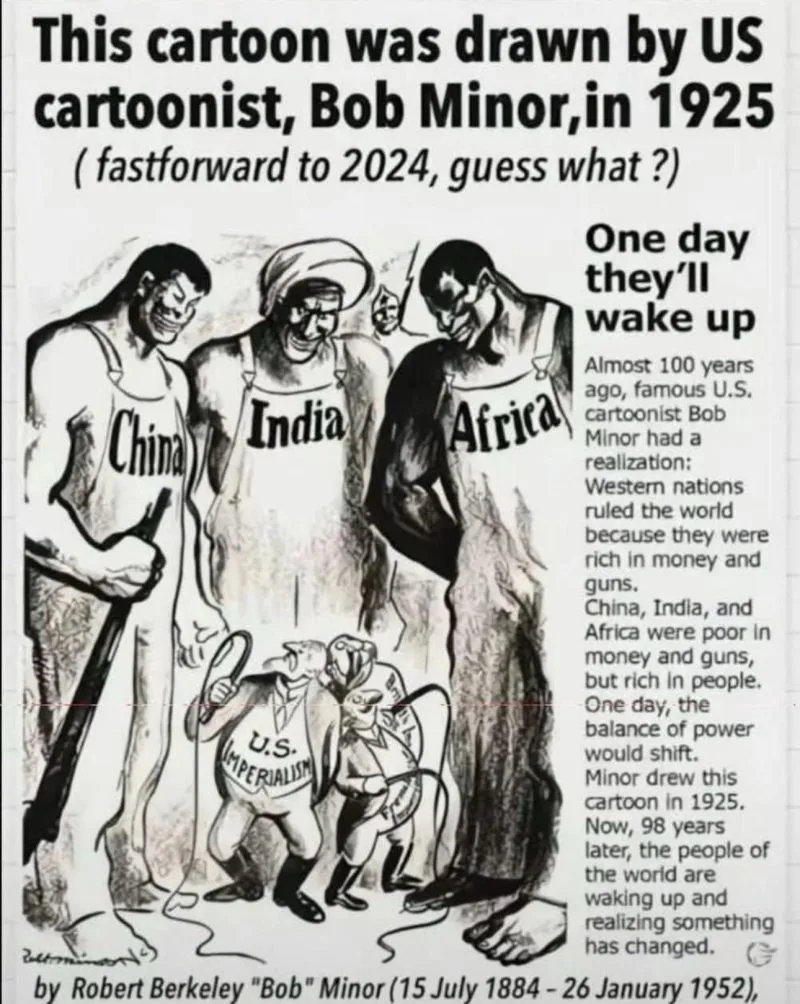
The resurfacing of the century-old cartoon coincides with heightened India-US trade tensions. On August 7, the Trump administration imposed a 25 percent tariff on select Indian goods, with another 25 percent hike scheduled for August 27, effectively doubling the tariff to 50 percent on certain exports.
The viral post has sparked strong reactions online, with many linking the cartoon’s prophecy to present-day economic and geopolitical developments. Comments ranged from calls for India to leverage its economic clout, to warnings about the cyclical nature of global power shifts.
One user wrote, “It is very important to understand and time to realise our strength too.” Another commented, “Stop buying their brands and products to make them kneel down.” Others cautioned against overconfidence, urging a balanced approach to international diplomacy and trade.
Historians note that Bob Minor’s work reflected the anti-imperialist sentiment of the early 20th century, a perspective often ignored in mainstream Western discourse at the time. The cartoon’s renewed popularity highlights how century-old ideas can resurface during moments of global tension, offering a lens through which to view today’s multipolar realities.
With BRICS nations collectively accounting for a massive share of the world’s population and economic output, and with US tariffs testing trade relationships, the viral cartoon’s message resonates as both a historical artefact and a commentary on the present.










Comments