





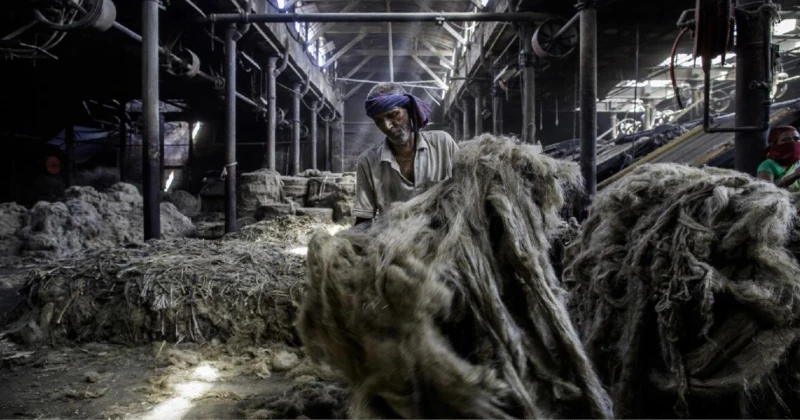
The story of India’s textile industry under British colonial rule represents one of history’s most systematic and devastating acts of economic warfare. What unfolded between the 17th and 20th centuries was not merely the collapse of an industry, but the deliberate dismantling of a civilisation’s economic backbone, cultural identity, and social fabric. This was deindustrialisation by design, a calculated assault on Indian prosperity that transformed a global textile superpower into a captive market for British manufactured goods.
In the pre-colonial era, India stood as the undisputed textile workshop of the world. The subcontinent’s handloom industry represented the pinnacle of human craftsmanship, producing fabrics of such exquisite quality that they were coveted from the courts of Europe to the palaces of the Ottoman Empire. Bengal’s muslin, in particular, achieved legendary status. This gossamer-thin cotton fabric, woven from the rare phuti karpas cotton that grew exclusively along the banks of the Meghna river, possessed an otherworldly fineness with thread counts ranging from 300 to an astounding 1,200. Contemporary observers struggled to find adequate words to describe its ethereal quality, calling it baft hawa (woven air), shabnam (morning dew), and abrawan (running water).
The Portuguese traveler Duarte Barbosa, writing in 1518, marveled at the “cotton and silk stuff manufactured by the artisans” of India, particularly noting the sophistication of textile production in Gujarat and the Coromandel coast. French physician François Bernier, who served in the Mughal court during the reigns of Shah Jahan and Aurangzeb, documented the imperial workshops or karkhanas as “a combination of large halls where different craftsmen worked under a superintendent,” describing the elaborate organization of textile production that employed thousands of skilled artisans. During the 17th and 18th centuries, Mughal Bengal emerged as the foremost muslin exporter in the world, with Dhaka serving as the capital of the worldwide muslin trade. Such was India’s dominance that by the 17th century, the subcontinent was producing 25 per cent of the world’s textiles.
This extraordinary industrial supremacy, however, posed an existential threat to British commercial interests. The East India Company, initially established as a trading enterprise, quickly recognized that India’s superior textile production capability undermined British manufacturers’ ability to compete on equal terms. The response was swift and merciless. Beginning with the Calico Acts of 1701 and 1721, Britain implemented a comprehensive strategy to destroy Indian textile manufacturing through legislative, economic, and physical means.
The first Calico Act of 1701 banned the import of dyed, painted, or printed fabrics from India into Britain. The second act of 1721 went further, prohibiting the use of all forms of calicoes in England to protect British wool, silk, and linen producers. Meanwhile, punitive tariffs were imposed on Indian textiles. By 1813, import duties on Indian cotton goods reached a staggering 85 per cent, while Indian muslin faced a 44 per cent tariff. Simultaneously, British textiles
entered India with minimal duties of just 5 per cent, creating a grossly uneven playing field that favored British manufacturers.
The East India Company employed even more sinister methods to ensure its dominance over the textile trade. The Company forced Indian weavers into exclusive contracts, binding them to sell only to British buyers at artificially suppressed prices. Contemporary accounts by William Bolts, a former Company employee, documented how weavers who attempted to sell their products to other buyers faced brutal persecution. As Bolts recorded, weavers “have, by the Company’s agents, been frequently seized and imprisoned, confined in irons, fined considerable sums of money, [and] flogged”. Some silk winders, driven to desperation, “cut off their thumbs, to prevent their being forced to wind silk”. The Company’s agents would station guards over weavers, and when cloth was being sold privately to Dutch or French traders, they would “cut the piece out of the loom when nearly finished”.
This systematic destruction of India’s textile industry created a humanitarian catastrophe of unprecedented proportions. The social impact was so severe that it prompted one of the most haunting observations in colonial history. Governor-General William Bentinck, witnessing the devastation of the Indian textile industries, remarked that “The bones of the cotton weavers are bleaching the plains of India”. This stark imagery captured the human cost of British economic policies, as millions of skilled artisans found themselves without livelihoods, their traditional occupations rendered obsolete by the flood of cheap machine-made British textiles.
The statistics tell a story of comprehensive economic devastation. India’s share of global textile production plummeted from 25 per cent in the 17th century to a mere 2 per cent by the time of independence in 1947. The historian H.H. Wilson aptly summarised the British strategy, noting that British manufacturers “employed the arm of political injustice to keep down and ultimately strangle a competitor with whom he could not have contended on equal terms”. This was not market competition but economic warfare.
The gendered dimension of this catastrophe deserves particular attention. Women had traditionally played crucial roles in textile production, particularly in spinning, which was predominantly performed by female workers. The colonial disruption of textile manufacturing disproportionately affected women, who lost not only their sources of income but also their traditional roles within the economic structure of Indian society. The Factory Act of 1891 further restricted women’s employment opportunities in the emerging mill sector, categorizing them as “unskilled” labor and limiting their working hours and mobility. This legislative framework institutionalized gender discrimination that would have lasting effects on women’s economic participation.
The consequences extended far beyond immediate economic hardship. The Great Bengal Famine of 1770, which killed an estimated 10 million people, was exacerbated by the disruption of traditional livelihoods. As contemporary records note, “It proved disastrous to the mulberries and cotton grown in Bengal; as a result, a large proportion of the dead were spinners and weavers who had no reserves of grain”. The 1943 Bengal Famine, which
claimed between 2-5 million lives, similarly reflected the vulnerability of populations whose traditional economic foundations had been systematically destroyed.
What transpired was not merely economic deindustrialization but cultural genocide. The destruction of India’s textile industry represented the systematic erasure of centuries of accumulated knowledge, artistic traditions, and social structures. The extinction of phuti karpas cotton symbolized this broader cultural loss, as the specialized knowledge required to cultivate, process, and weave this unique fiber disappeared with the artisans who possessed it. Traditional guild systems that had preserved and transmitted textile arts across generations were dismantled, leaving entire communities without their cultural anchors.
The replacement of Indian aesthetic sensibilities with Western patterns represented another dimension of this cultural assault. British manufacturers not only copied Indian designs but deliberately modified them for European taste, while simultaneously destroying the original production centers. The Great Exhibition of 1851 showcased sample books like “The Textile Fabrics of India,” which were distributed to British manufacturers as guides for replicating Indian designs using industrial methods. This systematic appropriation of Indian creative heritage while destroying its sources exemplified the colonial logic of extraction and exploitation.
The nationalist response to this devastation became a defining feature of India’s independence movement. Romesh Chunder Dutt’s monumental “Economic History of India,” published at the turn of the 20th century, provided the first comprehensive scholarly indictment of British economic policies. Dutt demonstrated that “colonial policies had resulted in the destruction of Indian textile manufacturing and the oppression of traditional handloom weavers,” forcing the population to become dependent on agriculture while rendering India dependent on foreign imports. His work inspired anti-imperialist sentiment by proving that India’s steep decline was inherent to the very nature of British rule.
The Swadeshi movement, beginning with the 1905 partition of Bengal, transformed the textile question into a tool of political resistance. The call for swadeshi encouraged Indians to reject British textiles and embrace handwoven Indian cotton known as khadi. Mahatma Gandhi elevated this economic boycott into a philosophical and spiritual movement, making the spinning wheel or charkha a symbol of self-reliance and non-violent resistance. Gandhi’s 1918 introduction of the khadi movement was explicitly designed to revive India’s textile industry while promoting economic independence.
Political leaders like Bal Gangadhar Tilak and Sri Aurobindo provided intellectual framework for this resistance. Tilak, despite his conservative social views, fearlessly criticized British economic exploitation through his newspaper Kesari. During the 1893 Hindu-Muslim riots, Tilak took an impartial stand and “severely criticised the British for instigating the Muslims,” recognizing how colonial authorities used divide-and-rule tactics to maintain economic control. Sri Aurobindo’s involvement in the Swadeshi movement reflected the understanding that “the first casualty in this vigorous onslaught of anti-Partition agitation was the British textile goods”.
The revival of handloom production became both practical necessity and symbolic resistance. Gandhi’s vision extended beyond mere economic considerations. As he articulated, “Swadeshi is that spirit in us which restricts us to the use and service of our immediate surroundings to the exclusion of the more remote”. This philosophy represented a direct challenge to the colonial economy that had made India dependent on distant British factories for goods that had traditionally been produced locally.
The colonial destruction of India’s textile industry represents far more than economic history; it illuminates the mechanisms through which imperial powers systematically dismantled subject societies. The British approach combined legislative discrimination, economic manipulation, and physical violence to destroy what historian Prasannan Parthasarathi has called “the cotton textile hub of the world”. This was not the natural evolution of market forces but the deliberate application of state power to benefit metropolitan industry at the expense of colonial subjects.
The lessons for contemporary India are profound. The colonial experience demonstrated how quickly industrial leadership could be lost when foreign powers controlled both markets and raw materials. The systematic nature of British policies, from the Calico Acts to the punitive tariffs, shows how economic warfare could be more devastatingly effective than military conquest. The cultural dimensions of deindustrialization reveal how the destruction of traditional industries could undermine entire civilizations’ confidence and identity.
Today, as India reclaims its position as a global textile power, the colonial experience provides both warning and inspiration. The revival of handloom traditions, the promotion of indigenous cotton varieties, and the celebration of traditional textile arts represent not merely economic strategies but acts of cultural reclamation. The charkha that Gandhi made the symbol of resistance remains relevant as India seeks to balance industrial development with cultural preservation and social equity.
The story of colonial deindustrialization ultimately reveals that what the British destroyed was not merely an industry but a way of life that had sustained millions of families for generations. The “bones bleaching on the plains of India” represented not just individual tragedies but the death of communities, traditions, and accumulated wisdom. Understanding this history is essential for ensuring that the mistakes of the past are not repeated and that India’s cultural and economic sovereignty remains secure in an increasingly interconnected world.
The silent catastrophe of India’s textile deindustrialization under British rule stands as one of history’s most systematic examples of economic colonialism. It demonstrates how imperial powers could weaponize trade policy, manipulate markets, and destroy traditional industries to serve metropolitan interests. The human cost, measured in millions of displaced artisans, cultural knowledge lost forever, and communities destroyed, represents a form of violence that extended far beyond conventional military conquest. This history demands remembrance not for the sake of grievance but for the wisdom it provides in understanding how civilizations can be unmade and, ultimately, how they can be rebuilt.
















Comments