





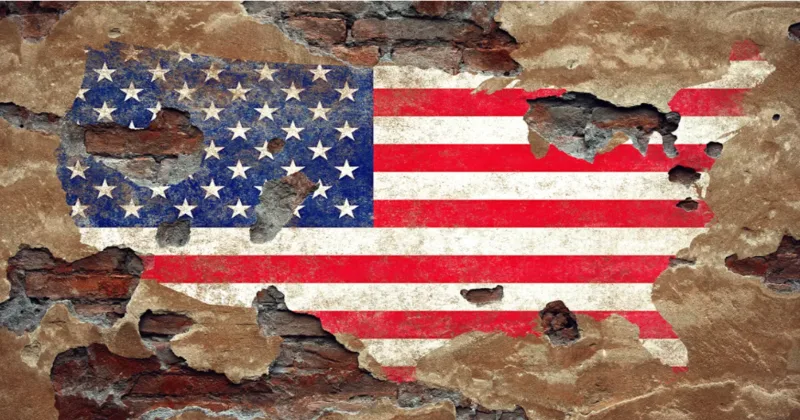
The 50 per cent US tariffs against India are the actions of an empire in decline and the task before India is clear enough. World history is a testament to the fact that most foreign policy actions by countries are born out of domestic compulsions, whether they are of political, social or economic nature. The harsh, almost punitive tariffs imposed on our exports to the US, and also the extraordinarily aggressive language used by its president Donald Trump have surely left many in our establishment reeling in shock.
These tariffs have to do with the nature of the US and the trauma that it is undergoing today with the slow realisation there that it no longer enjoys the tremendous economic and geopolitical clout it had in the 1960s and 1970s. The tariffs do not have so much to do with anything that is going on in India now. If anything, India has been extremely accommodating of the US in its economic and political positions, to the extent of displaying this stance in public and in a world where it also needs to calibrate its relationships with China, Russia and Europe.
The history of the US offers one of the strangest rises to global domination that the modern world has seen. A ragtag army scored surprise victories over a powerful British empire in 1776 and 1812 leading to its acquiring notions of moral grandeur as seen in its declaration of the Monroe doctrine in 1829. Basically, this fledgling country was telling four or five European empires that they could do whatever they liked in Asia and Africa, but the Americas were off bounds to them—and the empires listened, possibly because of the two oceanic moats that protected America. A century of manufacture by this overconfident upstart was followed by a century of global domination with Europe destroyed by the end of World War II and prostrate at America’s feet.
The megalomania continued with Richard Nixon delinking the US dollar from the gold standard in 1972, basically forcing the rest of the world to accept the dollar as the world reserve currency, taking over this role from the British pound. Nixon extended the American empire by this action for perhaps three more decades but, in the end, no empire is forever. Empires always end and the US is no exception. In trying to leverage cheaper wages in Asia, the US catalysed the economic growth of China, and also, India and with this it started losing its manufacturing capabilities.
Suppressed countries strike back when they become economically strong. China and India were no exception. The US now realises it is past its peak. It understands it no longer has the wealth to exercise global hegemony as it did in the past. The country is now split with Democrats denying it even has a problem and Republicans further split between the rednecks who fantasise that they have the power they had 50 years ago (Trump’s constituency) and moderates who recall Eisenhower and Reagan—hegemony with a friendly face. These moderates bemoan the fact that China has an unfair advantage over them because it has an authoritarian government that they don’t have!
Trump is doing the only thing he can do to please his domestic audience—invoke the foreign hand. China and India are his enemies. They have taken away all his money. They have taken away all his jobs. He will punish them. Unfortunately for him, China is now too powerful to punish. It will punish the US quite handily beginning with EVs, REEs and AI, ending who knows where. The bully Trump therefore picked on the weaker enemy India, who also and largely helplessly has been trying to become as acceptable to America as possible in the last few years.
The US today is where Britain was in 1939. Its empire is overstretched. It has entered a world war with battlegrounds in Ukraine and West Asia and potential battlegrounds in the Indian subcontinent, Central Asia and the Indo-Pacific. Its declared enemies China, India and Brazil are rising. The parallels between a dominant China and a growing India are striking—the lag between these two Asian neighbours is just about a decade. India is poised to be a major power by 2040, at least a power that cannot be ignored. BRICS is now a reality and the fall of the almighty dollar has not begun—it is already in the middle stages of decline. We don’t know if the replacement reserve currency will be a single one, a BRICS connected basket or cryptocurrency but every reserve currency in the past was related to the global hegemon. As an empire fell so did its currency.
India, like China, has found a faster way to advance economically than the US ever did. It went in for the services economy first, its natural strength, and manufactured mostly for the domestic market initially, a less demanding task. It is now attempting to enter higher end manufacturing of quality goods that are not Indian culture specific. Its defence manufacturing capability and capacity are increasing as has been witnessed in the Sindoor episode. It has seen small chinks in the supply chains of other countries for vital commodities. In the pharmaceutical sphere it has placed itself in a crucial position between China and the US. Trump understands power. He realises that drugs will become unaffordable for Americans if he extends his 50 per cent tariff to Indian pharmaceutical imports—he has excluded these imports from his tariffs.
Trump is a besieged man. His approval ratings have declined 8 to 12 per cent in the first six months of his presidency, the lowest ever for a US president except from Trump’s own ratings in the first six months of his first presidency and Nixon’s in his 1972 (second) presidency in the full glare of Watergate—hardly a standard to emulate. The confusion within American corporations would also be profound now. Imagine Apple, who shifted operations from China to India. Where do they go now with this 50% tariff—Thailand, Vietnam? American goods have also become shabby when compared to Chinese and other products. It is gradually becoming a country to which one may neither export to or import from—an empire in irreversible decline.
India is now in a troubled situation with Trump’s tariffs, but the silver lining is that this crisis provides an opportunity for us. We can address our many internal issues and contradictions and emerge stronger. For a start, all of us need to work much harder without making excuses, government employees mostly. We need to show much more consideration towards each and every fellow citizen, even in simple everyday acts like not pushing, shoving and breaking queues in kirana stores and vegetable carts. We need to ruthlessly call out corruption by the political, bureaucratic and judicial classes and demand swift and adequate punishments for transgressions. We need to demand employment linked education that goes beyond NEPs and outmoded socio-economic shibboleths. We need to teach young people the meaning of the word ‘quality’ for it is this quality that defined all the great empires of the past. Each and every one of them had it at the time of their zenith. When they lost quality, they lost everything.
India cannot become an empire without identifying and acquiring quality, and Trump’s act of kindness provides us with this opportunity to do so. Quantity never won the war alone.
is in the IISc Bangalore and UPES Dehradun. He is the author of a book “Bhārat: India 2.0” and has the highest citations-to-paper ratio among Indian scientists.












Comments