






Khudiram Bose’s name is etched in golden letters in the annals of India’s freedom struggle, symbolizing youthful courage, unflinching patriotism, and the fiery zeal of revolution. Born on December 3, 1889, in the small town of Habibpur in present-day West Bengal, Khudiram grew up in an atmosphere of nationalist awakening, influenced by the writings of Bankim Chandra Chattopadhyay and the teachings of Swami Vivekananda. From an early age, he displayed an unusual maturity and an unyielding spirit against injustice, which eventually led him to join the revolutionary movement in Bengal. The partition of Bengal in 1905 by Lord Curzon had ignited a wave of protest and resentment across the province, and Khudiram, barely in his teens, immersed himself in this growing tide of resistance. He began by distributing pamphlets, planting seeds of rebellion among the masses, and soon became associated with the Anushilan Samiti, a secret revolutionary organization committed to ending British rule through armed struggle. His devotion to the cause and his readiness to risk his life for the motherland quickly earned him a reputation among fellow revolutionaries.
At a time when many leaders advocated moderate reforms and petitions, the younger revolutionaries like Khudiram believed that direct action was essential to shake the foundations of the colonial regime. The British judge Douglas Kingsford had earned the wrath of nationalists due to his harsh and vindictive judgments against political activists, and the revolutionaries resolved to eliminate him as a symbol of imperial oppression. Khudiram, along with Prafulla Chaki, was chosen for this mission. On April 30, 1908, in the small town of Muzaffarpur in Bihar, Khudiram and Chaki awaited Kingsford’s carriage. However, in a tragic twist of fate, the bomb they hurled hit the wrong carriage, killing two British women—Mrs. Kennedy and her daughter—while Kingsford escaped unharmed. The mission had failed in its intended target but succeeded in sending shockwaves through the British administration. The colonial government, alarmed at the audacity of such a young revolutionary, launched an intense manhunt. Prafulla Chaki, cornered by the police, took his own life to avoid capture, while Khudiram, exhausted and alone, was eventually arrested at Waini railway station.
Khudiram’s trial became a moment of political theatre, exposing the deep chasm between colonial justice and the aspirations of a subjugated people. Barely eighteen years old at the time, he faced the charges with remarkable composure, his face lit with the same fearless determination that had propelled him into the heart of revolutionary activity. Throughout the proceedings, he displayed an unwavering belief in the righteousness of his cause, refusing to express remorse for his actions. His defense, led by prominent lawyers including Chittaranjan Das, could not alter the predetermined outcome in a colonial court determined to make an example of him. On May 13, 1908, Khudiram was sentenced to death, a decision that sent ripples of both grief and admiration across the nation. Appeals for clemency poured in from various quarters, not only from Indian sympathizers but also from some moderate political leaders, yet the British government was adamant.
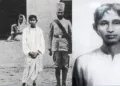
On August 11, 1908, Khudiram walked to the gallows in Muzaffarpur Central Jail with the dignity of a soldier marching to the battlefield. Dressed in a simple dhoti, he smiled at the crowd that had gathered outside, refusing to show the slightest trace of fear. The witnesses recalled that he maintained a calm and almost cheerful demeanor until the very end, a testament to his extraordinary courage and clarity of purpose. At the age of eighteen years and eight months, he became one of the youngest martyrs of India’s freedom movement. His execution ignited a wave of anger and anguish throughout Bengal and beyond, stirring the hearts of countless Indians. Public meetings, poetry, and songs immortalised his sacrifice, and his portrait began to adorn homes as a symbol of resistance. The youth saw in him not just a martyr, but a role model who had proved that even the youngest and seemingly powerless could challenge the might of the British Empire.
The aftermath of Khudiram’s death was marked by a significant shift in the psyche of the freedom struggle. His martyrdom deepened the rift between the moderates and the extremists within the Indian National Congress. For the moderates, his death was a tragedy that underlined the brutality of British rule but also a reminder of the dangers of armed rebellion. For the revolutionaries, however, it was a clarion call to intensify their efforts, proving that the fight for independence required sacrifices of the highest order. Across Bengal, his name became a rallying cry, inspiring others to take up arms against the colonial regime. British officials noted with unease the growing popularity of revolutionary groups among the youth, a trend that they directly linked to the emotional impact of Khudiram’s execution. The British may have believed that by hanging Khudiram they would quell the revolutionary spirit, but in reality, it had the opposite effect. His smiling face on the way to the gallows became an enduring image of defiance, feeding into the collective consciousness of a nation yearning for freedom. Schools, streets, and public institutions began to bear his name in the decades that followed, keeping his memory alive for generations. Revolutionary literature celebrated his bravery, and folk songs recounted his last moments, ensuring that his story reached even the remotest villages. His sacrifice became a symbolic bridge between the early phase of political awakening in India and the more militant phase of resistance that would emerge in the following decades.
In the years after his death, many young men and women, inspired by his example, joined organizations like the Jugantar and the Hindustan Socialist Republican Association, carrying forward the torch of armed resistance. The story of Khudiram Bose became intertwined with the larger narrative of India’s struggle, representing the role of youthful idealism in challenging oppression. His life demonstrated that the fight against colonialism was not the domain of the seasoned or the elderly alone; it was a cause that demanded participation from every segment of society, regardless of age. His martyrdom also highlighted the moral bankruptcy of an empire that could execute an eighteen-year-old for daring to dream of freedom, further eroding the legitimacy of British rule in the eyes of Indians and sympathetic observers abroad.
Khudiram’s death anniversary, observed with reverence each year, is more than a remembrance of his sacrifice; it is a reaffirmation of the values he embodied—fearlessness, commitment, and selflessness in the service of the nation. It reminds us that the freedom we enjoy today was won through the blood and sacrifices of countless young men and women who dared to stand against one of the most powerful empires in history. His journey from a small-town boy to a national hero in less than two decades of life is a testament to the transformative power of conviction.
The anguish his death caused in the hearts of ordinary Indians did not fade with time; it crystallized into a deeper resolve to end foreign domination. Even as decades have passed since that fateful day in August 1908, Khudiram Bose continues to inspire successive generations, his story echoing the eternal truth that no sacrifice is too great when it is made for the liberation of one’s motherland. In remembering Khudiram on his death anniversary, we are not merely honouring the past; we are also drawing strength for the future, reminded that the spirit of resistance he embodied is as relevant today as it was more than a century ago.















Comments