





Yamunanagar: In a significant achievement for the Archaeological Department, ancient remains and cultural artefacts, indicating the presence of human habitation dating back approximately 3,500 years, were found in recent explorations in a village in Haryana’s Yamunanagar district.
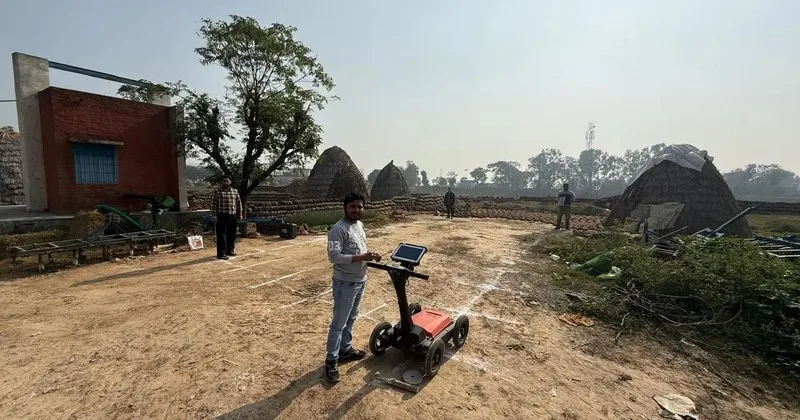
Officials of the Haryana Archaeology and Museums Department said the findings are based on analyses of two reports – the department’s on-site exploration report and a Ground Penetrating Radar (GPR) survey carried out by the Indian Institute of Technology (IIT) Kanpur at Topra Kalan village in Yamunanagar district in January. IIT Kanpur submitted its findings to the state department in July, said Professor Javed Malik of IIT Kanpur’s Department of Earth Sciences, who had led the GPR survey.
The GPR survey, which aimed to map the site’s subsurface features, revealed the presence of ancient structures and other architectural elements, besides offering insights into the site’s historical and archaeological significance.
“During exploration in Topra Kalan village, we observed several pieces of Painted Grey Ware and other ancient cultural materials,” said a senior official from the Department of Archaeology and Museums of Haryana.
The survey revealed buried architectural structures such as walls, platforms, and room-like enclosures arranged in multiple orientations. These structures reach depths of 4–5 metres, indicating a well-organised ancient settlement. The survey also points to a possible dome-like structure, which could be a stupa, and shallow wall formations that are between 0.2 and 0.8 metres deep.
Banani Bhattacharyya, Deputy Director, Haryana Archaeology and Museums Department, while speaking to the media, said, “On the basis of these discoveries during our exploration, we estimate the site dates back to around 1,500 BCE. These findings are highly significant for Haryana in the context of Buddhist sites.”
Topra Kalan village is considered the original location of the Delhi-Topra Ashokan pillar, inscribed with the Mauryan Emperor’s moral edicts. The pillar was moved to the national capital in the 14th century by Firoz Shah Tughlaq.
“Until we conduct excavations and recover dateable objects through stratified analysis, we cannot provide an exact date,” explained Dr. Banani Bhattacharyya. “Due to the dense population in the area, carrying out excavations at this site may pose significant challenges. The department first conducted an on-site exploration, followed by a Ground Penetrating Radar survey, which revealed several remains, including hollow structures, round structures, and walls. While we may not be able to give an exact date, these are definitely ancient structures,” Bhattacharyya told Indian Express.
She further emphasised that GPR surveys are essential for determining whether a structure exists beneath the surface, adding that the findings also provide valuable insights into the historical and archaeological significance of the Yamunanagar region.
Bhattacharyya further said the locals had told the state team that they had discovered remnants of Painted Grey Ware, Red Ware, and other objects while laying the foundation of their houses. While some of these items were shared with the state officials, the residents expressed their apprehension over being asked to vacate the area for an excavation.










Comments