





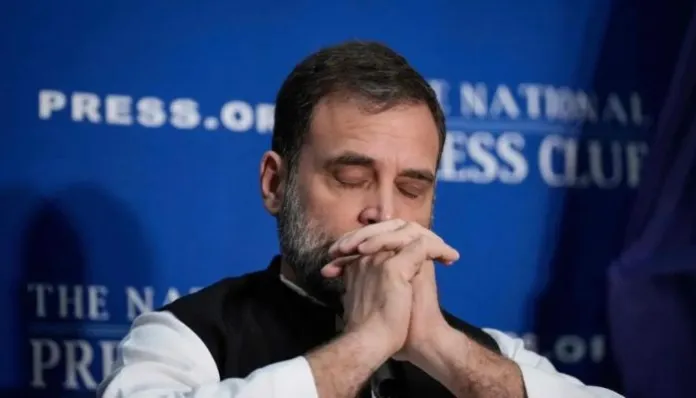
In a dramatic turn in India’s ongoing political narrative, the Election Commission of India (ECI) has publicly debunked a series of allegations made by Congress leader Rahul Gandhi, who has repeatedly accused the BJP and the ECI of orchestrating large-scale electoral fraud.
Over the past week, Gandhi’s high-profile “vote chori” claims, intended to cast doubt on the integrity of India’s electoral process, have not only faced direct rebuttals from the ECI but have also been undermined by evidence showing similar voter roll anomalies in his own constituency, Rae Bareli.
Far from revealing systemic manipulation, the anomalies he highlighted, such as “house number 0” entries and multiple voters registered at the same address, are common across India’s voter rolls due to administrative conventions, population mobility, and joint family living arrangements.
This detailed report examines the sequence of Gandhi’s accusations, the factual counterpoints provided by the ECI and media investigations, and the broader implications for India’s electoral credibility.
Rahul Gandhi’s accusations: The Karnataka flashpoint
On August 7, 2025, Rahul Gandhi held a press conference targeting the Mahadevapura Assembly constituency in Bengaluru Central Lok Sabha seat. He claimed:
- Several voter entries listed “house number 0” as the address.
- Dozens of voters were registered under the same residential address.
- In one case, 80 individuals were registered at a single address, which he described as proof of “massive electoral fraud” benefiting the BJP.
Gandhi suggested these irregularities were part of a wider conspiracy, alleging over one lakh duplicate or fake votes in Mahadevapura alone.
However, investigative reports revealed that Gandhi’s own Rae Bareli constituency in Uttar Pradesh, won by him in the 2024 general elections, contains similar entries, including:
- Numerous “house number 0” records.
- Multiple addresses hosting dozens of registered voters (e.g., “House Number 8” with 27 voters; “House Number 80” and “House Number 4” with 18 voters each).
The striking similarity has led critics to question why these anomalies are labelled fraud in Karnataka but go unquestioned in Rae Bareli.
Understanding the ‘House Number 0’ theory
Electoral officials explain that “house number 0” is a placeholder used when formal house numbers do not exist, especially in rural and semi-urban areas. This practice spans across India, including villages, urban slums, and newly developed layouts without municipal numbering.
Similarly, multiple voters at a single address can legitimately occur due to:
- Large joint family systems.
- Rental or paying-guest accommodations.
- Migrant labourers sharing temporary housing.
The ECI regularly updates electoral rolls to remove outdated entries, but the sheer scale of India’s population means such anomalies can persist between revision cycles.
The Mahadevapura Case: Inside the ‘80 voters’ house
Rahul Gandhi’s most cited example was House No. 35 in Muni Reddy Garden, Mahadevapura, allegedly hosting 80 voters.
On-ground reality
- The house is owned by BJP supporter Jayaram Reddy, who confirmed it has long been a rental property.
- Over the past 14 years, dozens of migrant tenants, security guards, domestic helpers, and delivery workers have used the address to register for voter IDs.
- Most tenants have since moved to other states or districts but have not updated their voter records.
BLO Clarification
Booth Level Officer Muniratna confirmed:
- There is no evidence of duplicate voting from the address.
- The list of departed tenants has already been submitted for roll revision.
Media Verification
India Today’s fact-check corroborated that:
- The house physically cannot accommodate 80 people at once.
- Voter ID registration is often done for legal identification purposes, not solely for voting.
- Migrant workers sometimes return during elections to vote, but this is not in itself fraudulent.
The crux: Rahul Gandhi and supportive media voices, such as Rajdeep Sardesai, painted migrant workers as “fraudulent voters” without considering socio-economic migration patterns or ECI’s ongoing revision process.
The Aditya Srivastava Episode: A personal attack unravels
At the same press conference, Gandhi targeted a citizen named Aditya Srivastava, accusing him of voting in three states simultaneously: Maharashtra, Karnataka, and Uttar Pradesh. He alleged Srivastava’s name appeared four times on voter rolls with the “same photo and same address.”
Srivastava’s Response
In an India TV interview, Srivastava revealed:
- His voter ID was first issued in Lucknow, UP.
- It was later transferred to Mumbai in 2016, where he voted in 2019.
- In 2021, it was re-transferred to Bengaluru, where he voted in 2024.
- At no point did he vote in multiple states during the same election.
He accused Gandhi of leaking his personal information and challenged him to produce call records or CCTV evidence proving multi-state voting.
ECI’s point-by-point rebuttal
On 8 August, the ECI issued a detailed #ECIFactCheck, dismantling Gandhi’s claims:
On CCTV footage preservation:
- CCTV from polling stations is retained only if an election petition is filed within 45 days.
- Without petitions, long-term storage serves no legal purpose and risks voter privacy breaches.
- Reviewing footage from 1 lakh polling stations would take 273 years with no judicial utility.
On legal challenges:
Following the 2024 Lok Sabha polls, Congress filed almost no election petitions across 36 states/UTs, despite claiming massive fraud.
On written complaints:
- Gandhi has never personally submitted a signed, detailed complaint as required under Rule 20(3)(b) of the Registration of Electors Rules, 1960.
- Even past complaints (e.g., December 2024 Maharashtra issue) were sent via advocates, to which the ECI responded publicly.
On his credibility:
The ECI stated, “If Rahul Gandhi does not sign the Declaration, it would mean that he does not believe in his analysis and is making absurd allegations. In that case, he should apologise to the nation.”
Political and public reactions
The revelations have injected new intensity into India’s pre-election discourse. BJP leaders have accused Gandhi of deliberate misinformation to undermine voter confidence. Neutral analysts note the political irony—that the irregularities Gandhi highlights elsewhere exist in his own stronghold.
Some commentators see this as a strategy to rationalise electoral defeats rather than confront internal organisational weaknesses. Others warn that repeatedly questioning the ECI without substantive proof risks eroding trust in one of India’s most respected democratic institutions.
Why the ‘Vote Chori’ narrative persists
Several factors explain why such conspiracy narratives take root:
Complexity of electoral rolls: Administrative anomalies are easy to misinterpret without understanding voter mobility.
Media amplification: Selective coverage by sympathetic outlets can turn isolated cases into perceived trends.
Lack of procedural literacy: Many citizens are unaware of how voter rolls are maintained, revised, and corrected.
Political convenience: Allegations of manipulation can rally party bases and create a ready-made excuse for poor performance.
Rahul Gandhi’s latest “vote chori” allegations have collapsed under the weight of verifiable facts and procedural explanations. The ECI’s rebuttals, media fact-checks, and parallels in his own constituency have revealed the accusations as less a revelation of systemic fraud and more a case of selective interpretation for political mileage.
While voter roll anomalies are real and worth addressing, conflating them with deliberate electoral theft without evidence risks weakening public trust in India’s democratic machinery. If the Congress party wishes to contest the integrity of the process, it must do so through the formal legal avenues available, armed with proof, not rhetoric.
For now, the institution charged with safeguarding the world’s largest democracy has made its position clear: transparency is the goal, but political mudslinging without substance will be met with facts, not silence.













Comments