





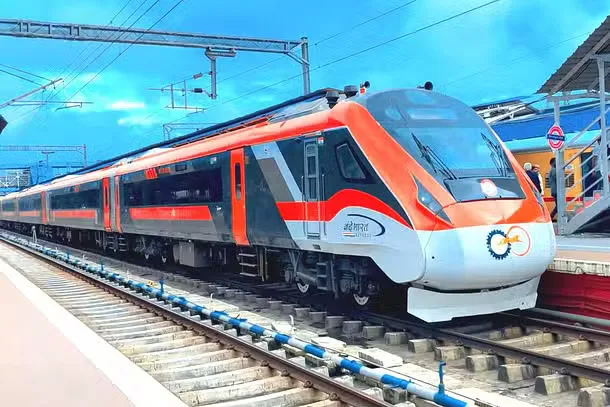
With three new Vande Bharat Express trains officially inaugurated today, the total number of these semi-high-speed trains is pushed to 75. The new routes announced by Prime Minister Narendra Modi on social media include Bengaluru to Belagavi, Amritsar to Shri Mata Vaishno Devi Katra, and Nagpur (Ajni) to Pune.
The commercial operations of these trains are set to begin on Monday, according to sources quoted in media.
Nagpur (Ajni) to Pune Vande Bharat
This eight-coach train will cover the longest chair car journey in India, taking approximately 12 hours. It starts from Ajni station, near Nagpur, on the Delhi-Chennai line. Currently, the fastest train on this nearly 900 km route is the Duronto Express, which takes nearly 13 hours.
Amritsar to Shri Mata Vaishno Devi Katra Vande Bharat
This route will complete the journey in 5 hours and 40 minutes. Chair car fares are priced at Rs 1,005, while the executive class costs Rs 1,890. The return trip from Amritsar will take 5 hours and 35 minutes, with fares of Rs 1,170 (chair car) and Rs 2,085 (executive class). The train will halt at key stations including Beas, Jalandhar City, Pathankot Cantt, and Jammu Tawi.
Bengaluru to Belagavi Vande Bharat
The journey will take approximately 8 hours and 20 minutes, with fares of Rs 1,575 (chair car) and Rs 2,905 (executive class). The return trip takes 8 hours and 30 minutes.
Since its first launch in 2019, the Vande Bharat Express has seen tremendous success, boasting nearly 100 percent occupancy on 144 routes nationwide. Maharashtra alone operates 22 such services, connecting cities like Nagpur to Secunderabad, Bilaspur, and Indore, and Pune to Hubballi and Kolhapur.
Among existing trains, the Delhi-Varanasi route covers the longest distance (over 750 km), while the Tatanagar-Brahmapur route has the longest travel time (9 hours 25 minutes).
Initially planned to launch 75 Vande Bharat trains within 75 weeks of the Amrit Mahotsav by August 15, 2024, the government has now achieved this milestone ahead of schedule, demonstrating the expanding footprint of India’s high-speed rail network.
















Comments