





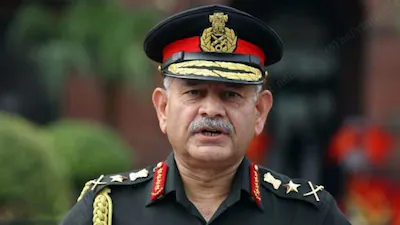
Chief of Army Staff General Upendra Dwivedi on August 9, openly ridiculed Islamabad’s self-declared “victory” following the four-day conflict that erupted after the launch of Operation Sindoor on May 7. Speaking at an event at IIT Madras, Dwivedi drew attention to Pakistan’s move to promote its Army Chief Asim Munir to a five-star Field Marshal despite evident military setbacks.
“If you ask a Pakistani whether you lost or won, he’d say, ‘My chief has become a field marshal. We must have won, that’s why he’s become a field marshal,’” Dwivedi quipped, underlining what he called Islamabad’s narrative-building exercise.
Dwivedi lauded the central government’s decisive stance following the April 22 Pahalgam terror attack, which killed 26 people. He recalled that the very next day, Defence Minister Rajnath Singh convened a high-level meeting with the three service chiefs.
“This is the first time that Defence Minister Rajnath Singh said, ‘Enough is enough.’ A free hand was given, ‘you decide what is to be done.’ That kind of confidence, political direction, and political clarity we saw for the first time,” Dwivedi said, adding that it boosted the morale of commanders on the ground.
#WATCH | During an address at IIT Madras, Chief of Army Staff (COAS) General Upendra Dwivedi says, “…If you ask a Pakistani whether you lost or won, he’d say my chief has become a field marshal. We must have won only, that’s why he’s become a field marshal…” (09.08)
(Source:… pic.twitter.com/G81nCSY9dh
— ANI (@ANI) August 9, 2025
The Army Chief stressed that the armed forces were allowed to operate entirely on their own tactical judgment without interference, enabling swift and precise execution of plans.
Earlier, Chief of Air Staff Air Chief Marshal AP Singh had also credited the success of Operation Sindoor to this unrestricted operational freedom. Speaking in Bengaluru, Singh noted:
“A key reason for success was the presence of political will. There was very clear political will and very clear directions given to us. No restrictions were put on us… The forces decided what the rules of engagement would be and how we wanted to control the escalation.”
Launched on May 7 in retaliation to the Pahalgam terror attack, Operation Sindoor saw Indian forces striking multiple terror hubs in Pakistan and Pakistan-occupied Jammu & Kashmir.
The offensive resulted in the elimination of over 100 militants linked to Jaish-e-Mohammed, Lashkar-e-Taiba, and Hizbul Mujahideen. Indian strikes crippled Islamabad’s radar systems, communication nodes, and airfields across 11 critical bases, including Nur Khan Air Base.
Pakistan’s response included cross-border shelling, drone incursions, and air defence engagement, but sustained counterstrikes by India further degraded the Pakistan Air Force’s operational capacity.














Comments