






In a controversy that has ignited heated debates on ideological bias in education, a private school in Raisen district is facing backlash after its nursery-level English textbooks used Islamic religious references in place of conventional learning examples. The book reportedly featured:
- K for Kaaba
- M for Mosque
- N for Namaz
- O for Woman in Hijab
The issue came to light when parents of a student noticed the unusual entries, expressing shock, particularly at “O for Woman in Hijab.” Instead of the more common “K for Kite” or “M for Mango,” the book presented religiously-specific symbols.
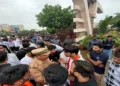
Following the discovery, the parents approached the Akhil Bharatiya Vidyarthi Parishad (ABVP), whose activists staged a protest at the school, demanding that its recognition be revoked. ABVP members alleged that the content was part of a “conspiracy against Sanatana culture” and accused the principal, E.A. Qureshi, of “Islamicising education.”
Local police station in-charge Narendra Goyal intervened, advising protesters to file a formal complaint.
“We received information about a disturbance at the school, after which I reached the spot with a police team and brought the situation under control. On questioning, the principal admitted to distributing the material. As the protest grew, parents and ABVP members were advised to submit a written complaint to the District Education Officer,” Goyal said.
ABVP’s regional coordinator, Ashwini Patel, criticised the material as “culturally confusing” for children.
“Over 500 students, most from Hindu families, study here. Religious education is being sown in young minds despite this not being a madrasa,” Patel said, adding that ABVP would escalate the matter to the National Commission for Protection of Child Rights (NCPCR), the State Child Rights Commission, the Human Rights Commission, the Education Department, and even the Chief Minister.
The organisation also plans to investigate the society running the school and seek cancellation of its registration under the Societies Registration Act.
Upon questioning, the school principal, I A Qureshi, admitted that the material was distributed without checking its content. The principal said the material was sourced from Bhopal and that, after the controversy, all parents have been asked to return the charts to the school.
Vishva Hindu Parishad (VHP) national spokesperson Vinod Bansal alleged that such incidents were not isolated and linked them to other forms of “jihad” in the state, including “love jihad,” “land jihad,” and “conversion jihad.”
“This is education jihad. Similar cases have been reported in Damoh, Gwalior, Jabalpur, and Sagar. The CM must investigate and take strict action,” Bansal urged.
District Education Officer D.D. Rajak described the matter as “serious” and confirmed that an inquiry has been initiated. If the content is deemed objectionable, a recommendation will be sent to higher authorities to cancel the school’s recognition.
Past Incidents of Islamic Influence in MP’s Schools
1) Damoh: Hindu girls allegedly forced to wear hijabs; posters of hijab-clad students prompted investigation.
2) Damoh’s Ganga Jamuna School: Non-Muslim students reportedly taught Quranic verses.
3) Jabalpur: A Video of students offering namaz in a private school led to protests.
4) Bhopal’s Ahmadiyya Mission School: Primary students taught the Kalma, sparking conversion conspiracy claims.
5) Statewide: Over 9,400 Hindu children enrolled in government-funded madrasas; some books allegedly called non-Muslims “kafirs” and “mushriks.”
Under Article 28(1) of the Indian Constitution, religious instruction is prohibited in state-funded institutions. While private schools have more leeway, making religious education mandatory at the primary level—especially for children from other faiths- raises constitutional and ethical red flags.
With similar incidents recurring across Madhya Pradesh, the Raisen case is being seen not as an isolated lapse but as part of a broader ideological experiment in education.














Comments