





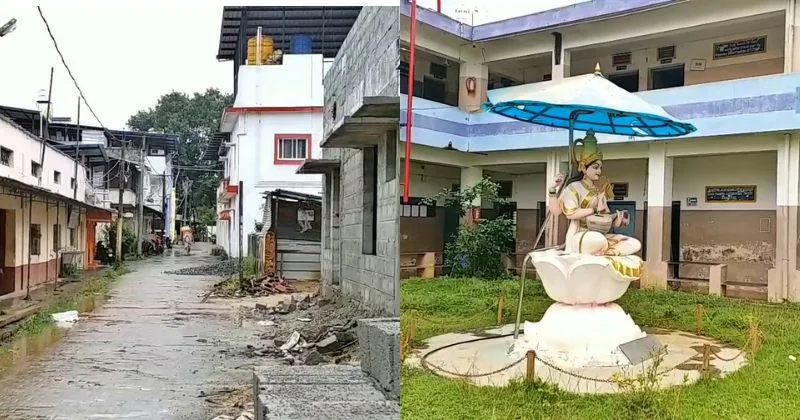
Shivamogga: Nestled on the serene banks of the Tunga River, just 10 km from Shivamogga, Mattur village stands as a rare, living example of how tradition can thrive in harmony with modern life. For over a hundred years, the villagers here have worked tirelessly to make Sanskrit often regarded as the language of scholars and rituals a spoken, everyday language of the people.
In Mattur, Sanskrit is not confined to temples, scriptures, or classrooms; it is the language spoken at home, in the streets, and during daily interactions. This unique commitment has earned Mattur recognition as the “Sanskrit Village” of India, a title first bestowed in 1982 by the revered Pejawar Sri during a Sanskrit camp that was conducted entirely in the ancient tongue. Since then, Sanskrit camps have become an annual tradition, drawing learners from across India and abroad.
Preserving an Ancient Heritage
The village’s devotion to Sanskrit dates back more than a century, with residents uniting to keep the language alive through education, culture, and community involvement. Sharada Vilas School, run by the villagers, has been central to this mission. Here, Sanskrit is taught to every student from Class 1 to Class 10, starting with oral lessons in the early years and progressing to writing, poetry, and classical literature.
Sanskrit teacher Ramachandra, who has been with the school for 16 years, explains, “From Class 1 to 4, students learn Sanskrit orally. Writing and grammar come later, with university-level texts introduced in higher classes. By the time they leave, Sanskrit is second nature to them. Learning it not only preserves culture but also sharpens memory, deepens interest in learning, and fosters devotion through bhajans and poetry.”
A Movement Beyond the Village
Mattur’s journey as a Sanskrit-speaking community gained momentum with the involvement of Sanskrit Bharati, a movement started in Bengaluru in 1981 to break stereotypes that Sanskrit was elitist, impractical, or difficult. Leaders like Krishna Shastri and Janardhan Hegde organized immersive camps in Mattur and nearby Hosahalli, training residents to converse naturally in Sanskrit.
Retired lecturer Srinidhi recalls, “We never set out to create a ‘Sanskrit village.’ Our aim was to protect culture through the language, even while embracing modernity. Now, groups from all over the country sometimes 25 to 30 people at a time come here for 10 to 15-day camps. We’ve made arrangements for their stay, and they leave not just knowing Sanskrit, but loving it.”
An Inclusive Approach to Learning
Sanskrit in Mattur is not exclusive to any age group or background. Children grow up speaking it alongside their mother tongue, Sangeethi a mix of Tamil and Malayalam while elders take pride in passing down the tradition. Seasonal camps attract learners from countries like the United States, Germany, and Japan, many of whom are surprised to find a whole village conversing fluently in the ancient language.
Schoolteacher Girish notes that while Sanskrit has been taught in the village for a century, formal government recognition for the school came in 1963. Since then, the teaching model has remained consistent step-by-step learning that builds confidence before introducing complex grammar and literature.
Students Speak of Pride and Benefits
Vishwas, a Class 10 student at Sharada Vilas, says, “I’ve been here since LKG. Learning Sanskrit has been a big advantage. We understand lessons more quickly, and we feel proud when visitors from abroad come to learn from us.”
Pratham, another student, adds, “It’s a little hard at the beginning, but once you understand it, Sanskrit is very easy. I wrote my first exam in Sanskrit. This village is famous for it, and we’re proud to be part of it.”
Mattur’s example comes at a time when UNESCO and scholars worldwide warn of the decline of ancient languages. The village demonstrates that revitalisation is possible when communities treat a language as part of daily life rather than as a relic.
Beyond language preservation, Mattur also focuses on village development, blending tradition with progress. Residents use modern technology, run businesses, and pursue higher education all while keeping Sanskrit alive as their cultural heart.
As India celebrates World Sanskrit Day on August 9, Mattur’s story serves as both inspiration and a challenge: to see Sanskrit not as a museum piece, but as a living, breathing language with the power to connect past, present, and future.
For the people of Mattur, speaking Sanskrit is not about exclusivity or nostalgia. It is about identity, continuity, and a belief that culture survives only when it is lived every day, in every home, and in every conversation.














Comments