





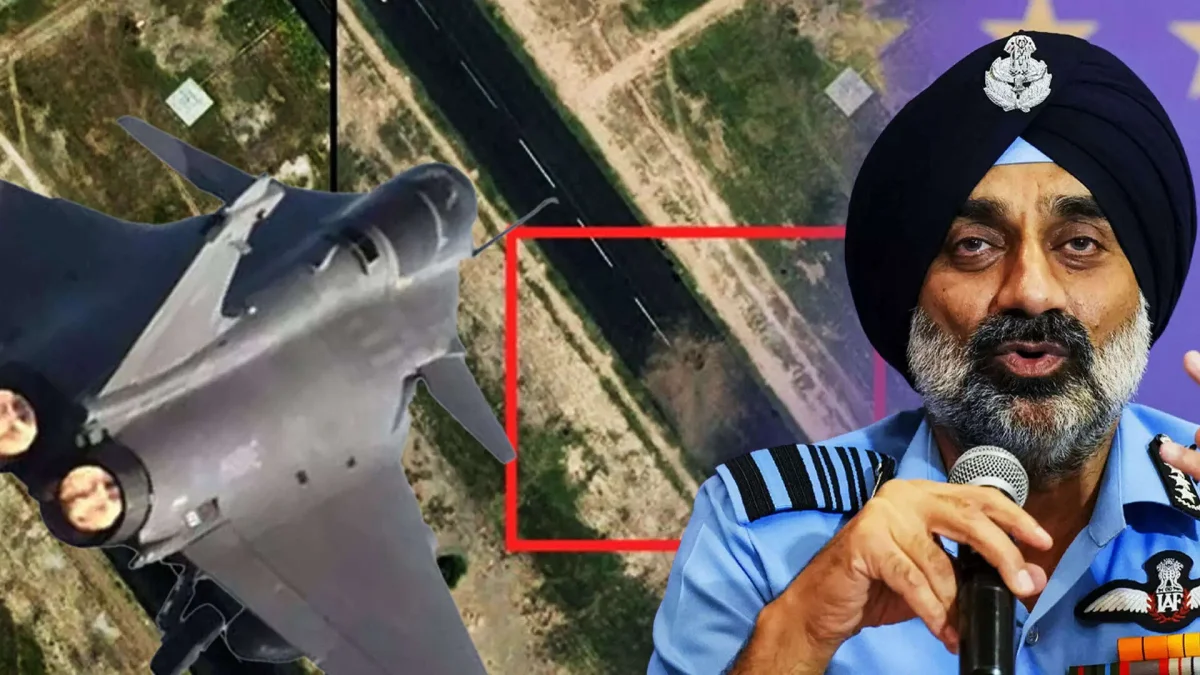
India’s superior and state-of-the-art S-400 air defence system helped to neutralize more than five intruding Pakistani aircrafts during Operation Sindoor, said the chief of Indian Airforce Air Chief Marshall AP Singh. IAF chief highlighted the stellar defensive capabilities of the S-400 missile system that helped India inch towards scripting a strategic deterrence and shield the territorial integrity against the enemy atrocities.
“Our air defense system has done a wonderful job. The S-400 system, which we had recently bought, has been a game-changer. The range of that system has really kept their aircraft away from their weapons like those long-range glide bombs that they have; they have not been able to use any of those because they have not been able to penetrate the system”, reiterated the IAF Chief AP Singh, while speaking at the Air Marshall Katre Annual Lecture in Bengaluru on 9th August. The Airforce chief also applauded the collective effort of India during the 4-day military conflict with Pakistan.
Air Chief Marshall AP Singh further added that the Pakistani fighter aircrafts were shot down at a range of 300km. Infact, some of the F-16 fighter jets stationed at the Pakistan’s Jacobabad Airbase was also destroyed by the Indian Airforce. With an unparalleled resolve and exceptional determination, along with the aid of cutting-edge weapon systems, India successfully established a clear strategic edge in Operation Sindoor.
Along with the F-16 and other Pakistani aircraft, the S-400 air defence system also helped to neutralise AEW&C/ELINT aircraft from a very long range. “We have at least five confirmed kills and one large aircraft, which could be either an ELINT aircraft or an AEW&C aircraft, which was taken on at a distance of about 300 kilometres. This is actually the largest ever-recorded surface-to-air kill that we can talk about”, the chief of Airforce added.
#WATCH | Bengaluru, Karnataka | Speaking on Operation Sindoor, Chief of the Air Staff, Air Chief Marshal AP Singh says, "…We have at least five fighters confirmed kills and one large aircraft, which could be either an ELINT aircraft or an AEW &C aircraft, which was taken on at… pic.twitter.com/ieL6Gka0rG
— ANI (@ANI) August 9, 2025
Strikes on Pakistani Airbases
During the lecture IAF Chief, Air Chief Marshall AP Singh also spoke about the destruction of Pakistan’s strategic airbases during India’s defensive attack. “Shahbaz Jacobabad airfield was one of the major airfields that was attacked. Here’s there is an F-16 hangar. One half of the hangar is gone. And I’m sure there were some aircraft inside which have been damaged there” the IAF chief claimed.
Indian Airforce was also able to destroy atleast two Pakistani command and control centres in Murid and Chaklala. Also few big and some other small Pakistani radars have also been destroyed, taking the total number of radars and surveillance mechanisms destroyed to six, Air Chief Marshall AP Singh listed the destructions done by India on Pakistani military bases as a befitting reply to the horrors committed by the enemy camp.
IAF Chief lauds the support of the political leadership
During the lecture, the Chief of Airforce also highlighted the clear direction, political will and operational freedom given to the military officers by the political leadership. He said all these aspects cumulatively led to India’s success and strategic edge in the conflict.
“There was political will, clear directions given to us and there were no restrictions. If there were any constraints they were self-made. We decided how much to escalate. We had full freedom to plan and execute. Our attacks were calibrated because we wanted to be mature about it. We cannot afford to be continuously at war. We were in a mode of deterrence”, said the IAF chief, while acknowledging the strong and strategic political leadership that led to strategic success during Operation Sindoor.












Comments