





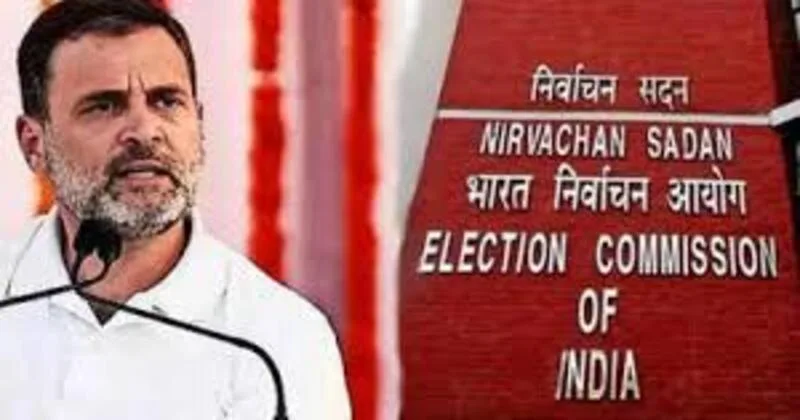
When rhetoric crosses into reckless misinformation, democracy itself becomes the casualty. From the Supreme court’s rebuke to the Election Commission’s affidavit challenge, Rahul Gandhi’s unproven “vote theft” claims risk exposing him as a leader who trades truth for theatrics, undermining the very democracy he swears to protect.
The Election Commission of India (ECI) has delivered a direct and uncompromising challenge to Congress leader Rahul Gandhi: if his allegations of massive vote theft are genuine, submit them under oath with verifiable evidence or stop misleading the nation.
The rebuke comes in the wake of Rahul Gandhi’s repeated attacks on the ECI and the BJP after the Congress party’s defeat in the 2024 Lok Sabha elections. In a press conference, he alleged that 1,25,000 votes had been “stolen” in the Mahadevapura Assembly segment of Bengaluru Central, accusing the ECI of collusion and claiming the polls were “choreographed.”
But the facts, according to the Commission, tell a different story. The Chief Electoral Officer of Karnataka has formally written to Gandhi, demanding a sworn affidavit naming the specific voters affected, along with part numbers and serial numbers from the rolls. The letter notes that Congress was provided with the draft voter list in November 2024 and the final list in January 2025, ample time to file objections. Yet, not a single formal complaint or appeal was lodged at the district or state level.
The ECI has reminded Gandhi that if he believes there were electoral irregularities, the lawful and constitutional course is to file an election petition in the High Court. Anything else, the Commission warned, risks descending into dangerous misinformation.
The warning carries legal teeth: a false affidavit or misleading submission could invite prosecution under Section 31 of the Representation of the People Act, 1950, and Section 227 of the Bharatiya Nyaya Sanhita, 2023.
In its official statement, the ECI minced no words: “If Mr. Rahul Gandhi truly believes in his claim, he should proceed under the law by submitting a sworn affidavit. If not, he must stop making false and baseless statements.”
Critics say Gandhi’s behaviour amounts to an erosion of the very democratic institutions he claims to defend. By refusing to pursue lawful remedies and instead resorting to public rhetoric without proof, he risks undermining public faith in the electoral process, a betrayal, they argue, of the trust voters place in their leaders to uphold constitutional integrity.
Rahul Gandhi now stands at a crossroads of credibility. Twice in recent days, first before the Supreme Court, and now before the Election Commission, his words have been weighed and found wanting. If he fails once more to back his accusations with facts under oath, the verdict of the public may be harsher than any court’s: that he is not a fearless truth-teller, but a habitual peddler of falsehoods.
In a democracy, truth is the oxygen of trust. Leaders who poison it for political survival commit not just a political sin, but a moral crime against the nation. History does not remember those who cried fraud without proof, it remembers them as the ones who betrayed the ballot.












Comments