





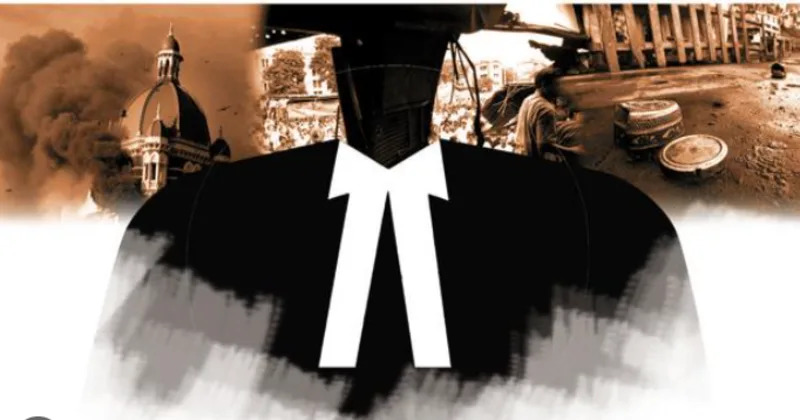
A person’s neck was cut while he supported a comment about the Prophet. In a second incident, over 200 innocent citizens boarded a train and were killed in bomb blasts. In the third, a young man was killed on taking out the tricolour—and the judge who gave justice in this case raised the question, which was postponed by all till now.
The accused in the Kanhaiyalal murder case (2022) in Rajasthan got bail, the accused in the 2006 Mumbai local train blast was acquitted after two decades due to lack of evidence, and the historic decision was pronounced by V.S. Tripathi on 3 January 2025. These three incidents exposed the alliance of India’s justice system, national security, and so-called ‘human rights organizations.’
In all these cases an invisible but highly active and impressive thread is clearly visible—and that is some NGOs, Muslim organizations, and high-profile lawyers suddenly become active. Each time a terrorist or deadly criminal is caught, an entire network comes into action: expensive legal aid and the media erecting and presenting a picture of ‘human rights’ on international forums—as if everything has been cooked in advance.
On 3 January 2025, in a historic verdict in the Chandan Gupta murder case, Special Judge V.S. Tripathi convicted 28 accused associated with the Muslim community and sentenced them to life imprisonment. But this decision was not just a punishment—it was a courageous step to break the silence, which the country’s judicial system has been ignoring till now. In his judgment, Justice Tripathi said in clear terms, “Every time a terrorist is caught, some NGOs provide expensive lawyers to protect him. Where the funding of this legal aid comes from, who gives, and what its final purpose is—it should be investigated in depth.
Judge Tripathi pointed out a well-planned network of organizations and identified seven whose role has been found suspicious. – 1. Citizens for Justice and Peace, Mumbai; 2. People’s Union for Civil Liberty, Delhi; 3. Release Forum; 4. Alliance for Justice and Accountability, New York; 5. Indian American Muslim Council, Washington DC; 6. South Asia Solidarity Group, London; and 7. Jamiat Ulema-e-Hind Justice. He sent a copy of this order and directed the Union Home Ministry and the Bar Council of India to initiate an institutional inquiry to investigate the mutual alliance and the functioning of these organizations.
Jamiat Ulema-e-Hind is the same organisation that actively advocated for the accused in the Bombay train blast case. Similarly, in the Kanhaiyalal murder case, this organization also provided legal assistance to the accused and appointed a team of senior lawyers, like Dr. S. Muralidhar, to protect them. Kamlesh Tiwari’s killers were also provided legal protection. The role of Ulema-e-Hind was not limited to these matters only. It has advocated for the accused in many serious cases challenging the country’s security and social harmony. These included the 26/11 Mumbai terror attack, the Akshardham Temple attack of 2002, the 2010 Pune German Bakery bomb explosion, the Chinnaswamy Stadium blast in Bengaluru, the Jhaveri Bazaar serial blast of 2011, conspiracies related to Indian Mujahideen and Simi, the Ghatkopar bomb blast, and cases of Uttar Pradesh related to the Al-Qaeda module and ISIS.
In all these cases, the legal assistance given by these organisations to the accused raises the question of which ideology and purpose protect people involved in anti-national activities? Is not the attachment of foreign funds in judicial cases in India not a crime? Also, its funding sources, foreign relations, and transparency of legal intervention now need extensive investigation and public discourse.
At the same time, the NGOs who name illegal infiltration as ‘refugee rights,’ after losing in the court, knock on the door of the Supreme Court and blow off the Indian law in the name of ‘education rights of children.’ When they operate from New York, London, and Washington, this question is natural: are they really human rights organizations, or part of a foreign lobby dissolving the slow poison in India’s social and legal structure?
The thinking thing is that when famous lawyers like Dr. Rajiv Dhawan, Prashant Bhushan, Colin Gonzalvis, and Kapil Sibal stand in Favor of a Rohingya intruder, why do the same lawyers remain silent for thousands of victims? Not only this, but ten expensive and influential lawyers of the country protest against the petition to stop forcible conversion, and 22 top lawyers openly protest against the petition challenging the place of worship, including the current and former MPs, MLAs, Law Minister, Home Minister, Foreign Minister, and Education Minister—so the question arises: what is the biased advocacy in the name of justice? This is the reason that such important cases have been pending for years. The behaviour of the top lawyers raises the question whether advocacy has now become a ‘fee-based service.’ Special Judge VS. Tripathi Commenting on this, the fees of the lawyers should be public, their property and income tax details should be transparent, fees should be charged only through banking mediums, and in special cases, through affidavit, it should be declared the name of the payee. This is not a political demand but requires moral responsibility and transparency. When doctors and journalists can be accountable, why not a lawyer?
Honouring the freedom of the court and lawyers is certainly necessary, but this freedom cannot be free from responsibility. Now the time has come to raise some basic and serious questions. The first demand is that the source of legal aid should be made public to the accused involved in terrorism, anti-national, and high-profile cases. Also, the fees of those lawyers, clients, and sources of funding who advocate these cases should also be revealed in a transparent manner. In addition, a fair investigation into the activities of NGOs, their foreign links, and their operations is necessary. The judiciary should no longer take decisions from the point of view of collective national interest. If we remain silent on these issues today, then tomorrow also the judiciary will also rule the silence and conspiracy. This responsibility is not only for the government or the court but also for every conscious citizen. The warning that has been exposed by Special Judge Tripathi in his judgment is an opportunity—a voice that needs support. The question is, will we support him, or will we wait for a sacrifice of Kanhaiyalal next time?












Comments