





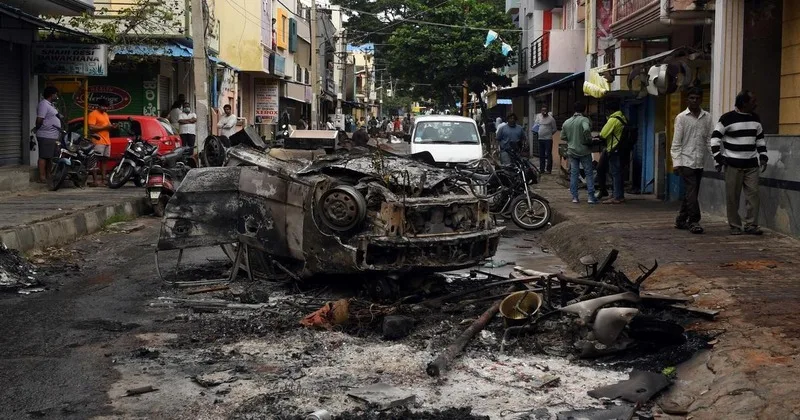
Bengaluru: The Karnataka High Court has once again refused to grant bail to two key accused in the violent 2020 incidents that saw the KG Halli and DJ Halli police stations in Bengaluru attacked and demolished during protests. The agitation, triggered by a series of politically and communally sensitive issues — including the abrogation of Article 370 in Jammu and Kashmir, the Citizenship Amendment Act (CAA), and the National Register of Citizens (NRC) — escalated into one of the most serious law and order crises in the city in recent years.
A Division Bench comprising Justice K.S. Mudagal and Justice P. Sri Sudha dismissed the criminal appeals filed by Mohammad Mudassir Khalim his second attempt to secure bail and Zia ur Rehman, who had approached the High Court for the first time in this matter.
In its order, the Bench noted that the accused had been filing multiple applications seeking bail or release, thereby consuming valuable judicial time and obstructing the trial process. The judges remarked that these repeated filings had delayed the commencement of witness examination and undermined the progress of the case.
“They are trying to secure bail by citing delays in the trial,” the Bench observed, “but the delay is not solely attributable to the trial court or prosecution — the accused themselves have contributed to it. This is highly condemnable.”
The court further stressed the gravity of the charges, pointing out that the accused were alleged to have engaged in terrorist activities under the Unlawful Activities (Prevention) Act (UAPA). These included attacks on police personnel, destruction of government property, and the burning of vehicles. One person had died in the violence. Such offences, the judges reminded, carry punishments ranging from life imprisonment to the death penalty.
Allegations and legal position
The prosecution has alleged that the accused directly challenged the sovereignty of the State by destroying police stations institutions established to maintain peace and order. The violence on the night of August 11, 2020, was marked by stone-pelting, arson, and attempts to snatch police weapons. The mob is said to have set fire to 12 government and private vehicles.
The Bench dismissed both the petition seeking quashing of the charge sheet under UAPA and the fresh bail applications, holding that the trial court had rightly exercised its discretion in rejecting earlier bail pleas.
The petitioners’ counsel argued that other accused in the case had already been sentenced to seven years in prison after confessing to their involvement, and that the same standard should apply to their clients. However, the court noted that the appellants had neither admitted guilt nor shown remorse for their actions. “The sentence imposed on others cannot be mechanically applied to these appellants,” the Bench said.
Case background
The 2020 violence was sparked by a series of controversial political decisions and religious flashpoints. The accused and others allegedly sought to protest the abrogation of Article 370, the implementation of the CAA and NRC, and Supreme Court verdicts on the Babri Masjid demolition and triple talaq.
Matters took a communal turn when derogatory social media posts targeting Hindu deities and the Prophet Muhammad surfaced. On the day of Sri Krishna Janmashtami, August 11, 2020, a video insulting Hindu gods was allegedly posted on a Facebook account linked to Naveen, the nephew of Pulakeshi Nagar MLA Akhand Srinivasamurthy. In retaliation, Naveen posted a cartoon of the Prophet Muhammad.
Outrage quickly spilled into the streets. Meetings were allegedly held to mobilise an attack on police stations, both to pressure the authorities into arresting Naveen and to send a political message. Hundreds of people descended on K.G. Halli police station demanding his immediate arrest.
When police refused to register a second FIR against Naveen — stating that one already existed at D.J. Halli station — the protest turned violent. Mobs attacked the police, vandalised the stations, and set vehicles ablaze. Curfew was imposed in the area to restore order.
The National Investigation Agency (NIA) took over the probe and filed a detailed charge sheet under the UAPA and other provisions of the IPC.
For accused Mohammed Mudassir Khalim, the trial court, High Court, and even the Supreme Court had earlier rejected bail. His latest plea was dismissed again.
Co-accused Zia ur Rehman, whose bail application was turned down by the trial court, challenged that order in the High Court — only to meet the same fate.













Comments