





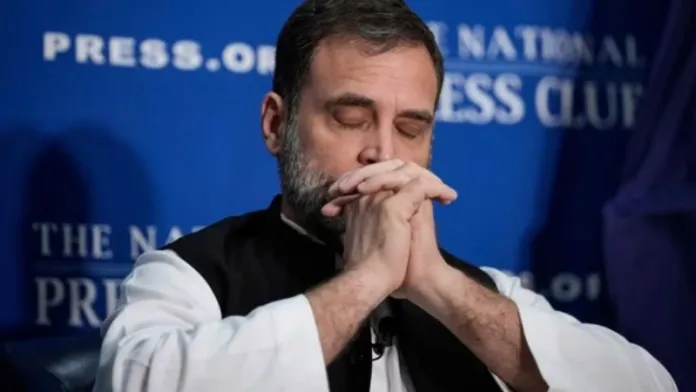
The Election Commission of India (ECI) on August 8, directly challenged the misleading claims made by Congress leader Rahul Gandhi regarding the integrity of India’s electoral process. Responding to a video posted by Gandhi that questioned the ECI’s transparency and impartiality, the Commission provided a detailed point-by-point rebuttal to set the record straight.
Rahul Gandhi had posed five critical questions in his video addressing the ECI: why voter lists were not provided in digital machine-readable format, why CCTV footage was allegedly destroyed, why the ECI was accused of committing massive fraud in voter lists, why the ECI threatened opposition parties instead of addressing queries, and why the ECI appeared to act as an agent of the BJP.
However, the ECI promptly responded that several of these assertions were baseless. The Commission reminded the public that the Supreme Court had already rejected Congress’s 2019 petition demanding machine-readable voter lists, relieving the ECI of any legal obligation to comply with this request.
❌ The statements made are Misleading #ECIFactCheck
✅Read in detail in the image given👇 https://t.co/K1sKq1DvbU pic.twitter.com/tdqudyoXU2
— Election Commission of India (@ECISVEEP) August 8, 2025
Addressing the allegation related to CCTV footage, the ECI explained that video recordings at polling stations are retained for 45 days to allow for legal challenges, such as election petitions filed by aggrieved candidates. If no petitions are filed within this window, footage is destroyed to protect voter privacy and because maintaining such data indefinitely is impractical. The Commission highlighted that reviewing footage from 100,000 polling stations would take roughly 273 years, a process without any meaningful outcome if no legal action is taken.
The claim of “massive fraud” was also refuted by the ECI, which pointed out that Congress filed almost no election petitions or legal challenges across India’s 36 States and Union Territories following the 2024 Lok Sabha elections. Despite their right to legally contest results, Congress largely remained silent, undermining the credibility of their allegations.
Furthermore, the ECI emphasised that many of Rahul Gandhi’s allegations have been widely reported in the media, yet he has never personally submitted a signed written complaint. The Commission cited an instance where, after Gandhi raised an issue regarding Maharashtra elections in December 2024, an advocate from the All India Congress Committee (AICC) sent a letter to the ECI. The Commission’s response, dated December 24, 2024, is publicly available on the ECI website, contradicting Gandhi’s claim that no reply was given.
In its concluding remarks, the ECI called on Rahul Gandhi to formally submit his specific objections and evidence against the voter lists and sign the Declaration/Oath as mandated by Rule 20(3)(b) of the Registration of Electors Rules, 1960. The Commission warned that failure to do so would indicate that Gandhi does not stand by his claims and is instead spreading unfounded allegations, in which case he should issue a public apology to the nation.













Comments