





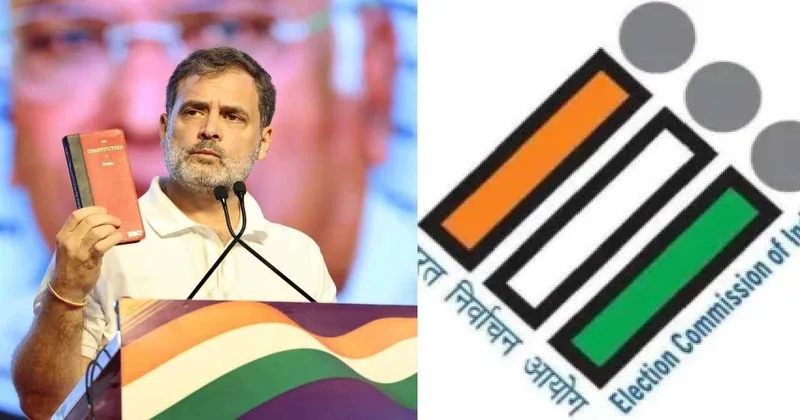
Bengaluru: Congress leader Rahul Gandhi, who has spent the past two days loudly alleging large-scale vote rigging in the recent Lok Sabha elections, has left Karnataka without doing the one thing that could give his claims teeth filing a formal complaint with the Election Commission.
On August 7, Gandhi held a high-voltage press conference in Delhi, brandishing documents and figures he claimed proved electoral irregularities, particularly in Bengaluru’s Mahadevapura Assembly constituency. Flying into Bengaluru on August 8 for the ‘Our Vote, Our Rights, Our Struggle’ protest at Freedom Park, he once again waved the Constitution and accused both the BJP and the Election Commission of complicity. He claimed that Mahadevapura saw “five different types of vote theft” and that over one lakh votes were stolen.
The stage seemed set for a formal challenge. Karnataka Deputy Chief Minister DK Shivakumar even announced publicly that a complaint would be lodged with the State Election Commission immediately after the protest. But instead of walking the short distance to the Commission’s office, Gandhi checked into the Taj West End Hotel, proceeded to Congress president Mallikarjun Kharge’s residence for dinner, and later flew back to Delhi. The promised complaint never materialised.
This inaction has sparked sharp criticism why spend two days making sensational allegations and brandishing documents, only to exit without triggering a formal investigation? Critics say the likely reason lies in the legal consequences.
State Chief Election Commissioner Anbukumar has already written to Gandhi, asking him to sign a declaration and submit evidence. That declaration carries legal weight. Under Section 31 of the Representation of the People Act, 1950, making a false statement regarding the voter list can lead to imprisonment of up to one year, a fine, or both. Giving false evidence under Section 227 of the Penal Code, 2023, carries even harsher penalties.
For Gandhi, signing such a declaration would mean taking full legal responsibility for the accuracy of his claims something he appears unwilling to risk. Political observers say this exposes the hollowness of his rhetoric: without formal action, his charges remain speeches, not substantiated legal challenges.
The credibility of his evidence is already under question. In his Delhi press conference, Gandhi showcased a document listing 80 registered voters at House No. 35, Munireddy Garden, in Mahadevapura. But when Organiser correspondent visited the house for reality check he found the house is a 10-by-15-foot plot currently occupied by just one man from West Bengal, who has lived there for only two months. The property’s owner, Jayaram Reddy, categorically denied Gandhi’s claim. “How can 80 people live here? This is a false allegation. I am not a BJP worker, I have nothing to hide, and I welcome any investigation,” he told the Organiser.
This is not the first time Rahul Gandhi has been accused of political theatre without follow-through. His opponents point to a pattern high-decibel accusations at rallies and press conferences, often accompanied by symbolic gestures like waving the Constitution, but little in the way of formal legal or administrative steps that could withstand judicial scrutiny.
The BJP has seized on the episode to label Gandhi’s campaign as “headline hunting.” Party leaders argue that if he truly believed his own evidence, he would have been the first to march to the Election Commission’s door, sign the declaration, and demand prosecution of the guilty. Instead, they say, he flew out after a day of optics, leaving his own supporters wondering what the point was.
Meanwhile, the Election Commission has said it will investigate but only if Gandhi formally submits evidence. Until then, the matter remains stalled. In the court of public opinion, however, the damage may already be done: what began as a bold charge of electoral fraud has quickly become a cautionary tale about the difference between political posturing and procedural courage.













Comments