





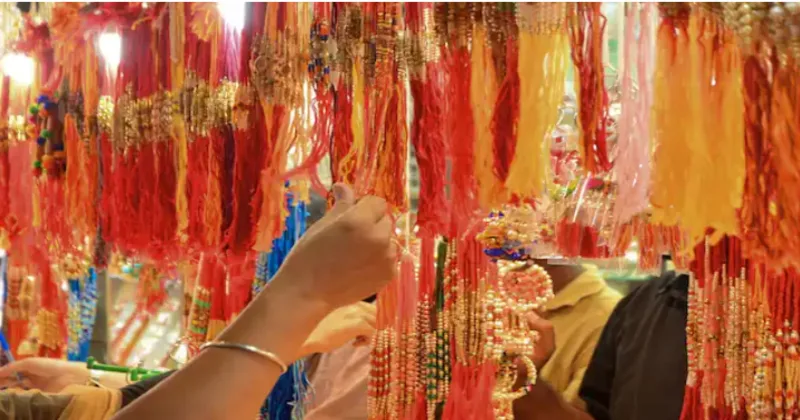
Today on August 9, 2025, Bharat is celebrating Raksha Bandhan, a festival that has evolved beyond a simple promise between siblings. Shravan Purnima marks a day where the sacred thread, or rakhi, becomes a symbol of universal protection and harmony. This year, the festival will be a powerful testament to a deeper commitment to all of society and nature.
The spirit of Raksha Bandhan will be seen in rituals that honor the protective ties we share with the world around us. People will tie rakhis to trees, acknowledging their role as the givers of life and the silent guardians of our environment. Cows, revered as a symbol of motherhood and sustenance, will also receive rakhis, a gesture that reflects our gratitude and respect for the animal kingdom. The protective sentiment will extend to rivers, symbolising a pledge to preserve our natural resources. Even soldiers, the ultimate protectors of the nation, will be honored with rakhis, reinforcing the bond between a grateful society and its brave defenders.
These diverse celebrations highlight how Raksha Bandhan has become a festival of collective care, unity, and responsibility, weaving a thread of protection around family, society, and the environment.
This report compiles nine unique Raksha Bandhan traditions from different states of Bharat. It demonstrates how this festival of protection and affection is celebrated with diverse regional customs, each deeply rooted in local culture.
Celebrating Raksha Bandhan as Kajari Purnima
In parts of Madhya Pradesh, Bihar, and Jharkhand, Raksha Bandhan is celebrated as Kajari Purnima. On this day, sisters tie rakhis to their brothers and receive gifts. The festival’s unique traditions involve women bringing pots of soil from fields, planting barley in them, and keeping them in the dark. These pots are painted with rice paste, and women later carry them in a procession to immerse them in a nearby pond or river. Women also observe a fast, praying for the long lives of their sons and brothers. The festival is further enriched by folk songs like Kajri, dances, and storytelling, particularly in regions like Varanasi and Mathura.
Kerala and Tamil Nadu observe Avani Avittam
While much of the country celebrates the bond between siblings, Kerala and Tamil Nadu observe Avani Avittam on Raksha Bandhan. This significant festival, primarily celebrated by Vedic Brahmins, is dedicated to the male members of the family. On the full moon of the Sawan month, participants take a cleansing dip in water to seek forgiveness for their past misdeeds. Following this, they replace their old sacred thread, or ‘janeu,’ with a new one, symbolising renewal and a promise to perform virtuous deeds in the coming year. The name itself is significant, with ‘Avani’ referring to a month in the Tamil calendar and ‘Avittam’ being one of the 27 lunar constellations.
Odisha celebrates Raksha Bandhan as Gamha Purnima
In Odisha, Raksha Bandhan is known as Gamha Purnima, a festival that honors both the sibling bond and the birthday of Bhagwan Balabhadra. Special rituals take place at the Jagannath Temple, and traditional games like Gamha Dian are played. Farming communities, who rely on the Langala (wooden plough), Bhagwan Balabhadra’s weapon, celebrate with great enthusiasm. A key ritual involves Devi Subhadra, the sister of Bhagwan Jagannath and Bhagwan Balabhadra, tying special rakhis on her brothers. These rakhis are exclusively made by a group of servitors called ‘Patara Bisoi,’ with red and yellow for Bhagwan Jagannath and blue and violet for Bhagwan Balabhadra, symbolising her love and protection.
Lumba Rakhi: Honouring the Bhabhi
In Rajasthan, a unique tradition called Lumba Rakhi is central to the Marwari and Rajasthani cultures. Here, sisters tie a rakhi not only to their brothers but also to their brothers’ wives, known as bhabhis. These Lumba Rakhis are often designed like decorative bangles and are larger than traditional rakhis, adorned with beads, mirrors, and intricate embroidery that showcase the state’s rich handicraft heritage. This custom symbolises the extension of the protective bond to the entire family, as it is believed that the sister-in-law plays a vital role in the household’s well-being.
Pavitropana rituals in Gujarat
Gujarat celebrates Raksha Bandhan with its own unique tradition, known as Pavitropana. While sisters tie rakhis to their brothers, the day is also marked by a strong sense of devotion to Bhagwan Shiva. On this auspicious occasion, devotees offer water to the Shiva lingam and seek his blessings. It is widely believed that worshipping Lord Shiva on Pavitropana helps absolve one of all sins, adding a spiritual dimension to the traditional celebration.
Shrawani traditions in Uttarakhand
In Uttarakhand, Raksha Bandhan is celebrated with both the traditional tying of rakhis and the observance of the Shrawani festival. On this day, which is also known as Jandhyam Purnima, people perform a ritual of taking a holy bath in a river, worshiping sages, and wearing a new sacred thread (yajnopaveet). Priests also participate by tying a raksha sutra to devotees and offering them blessings.
Jhulan Purnima and the spirit of Raksha Bandhan in eastern Bharat
In West Bengal, Odisha, and Bihar, Raksha Bandhan is celebrated as Jhulan Purnima, a tradition that honours the divine love of Bhagwan Krishna and Radha. The festival features swings adorned with intricate designs and vibrant flowers. During this time, rakhis are tied not only to brothers but also to friends and even trees, symbolizing a broader sense of love and protection. The celebration is made more special with cultural performances and devotional songs filling the streets.
Raksha Bandhan with Narali Purnima traditions in Maharashtra
In Maharashtra and Gujarat, Raksha Bandhan coincides with Narali Purnima, a significant festival for the Koli (fishermen) community. On this day, fishermen offer coconuts to the sea god, seeking his blessings for safe fishing journeys. Coconuts hold a special place in Sanatan Dharma, symbolising the Tridev, with the top representing Shiva, the middle Vishnu, and the inside Brahma. This is why it is considered highly auspicious. Sisters also tie rakhis to their brothers, and the celebration includes traditional sweets and dishes like Puran Poli.
Colour, sweets, and sibling bonds in Punjab
Punjab celebrates Raksha Bandhan with characteristic exuberance, marked by vibrant decorations, music, and feasting. Sisters tie elaborately designed rakhis, often adorned with mirrors, beads, and embroidery, on their brothers’ wrists. This is accompanied by the application of a tilak and the sharing of sweets like jalebi and ladoo. The festival is a joyous occasion for families to come together, with homes decorated with rangoli and lights to celebrate the sibling bond.
Ultimately, these nine unique traditions paint a beautiful picture of raksha bandhan, a festival that is not just a ritual but a living testament to collective care, unity, and responsibility, weaving a sacred thread of protection around all of creation a festival that is not just a ritual but a living testament to collective care, unity, and responsibility
















Comments