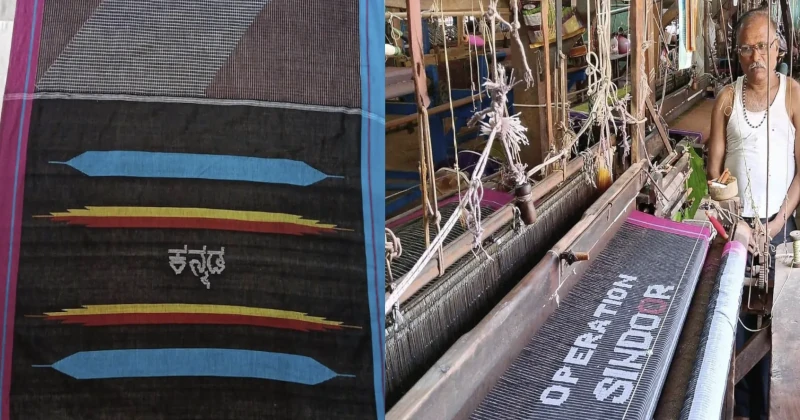
In a major recognition for Karnataka’s rich weaving heritage, the Gajendragad Weavers Cooperative Producers’ Association, an institution established even before India’s independence, has secured a prestigious Geographical Indication (GI) tag for its famous striped sarees. Woven entirely on handlooms by skilled artisans, these sarees have been a cultural and economic mainstay for the region for nearly two centuries.
The distinctive “striped saree” derives its name from the elegant stripes along the edges, a hallmark of the design. Crafted using pure cotton, eco-friendly dyes, and natural glue, the sarees are known for their comfort and durability, making them suitable for all seasons. They come in four colour variations and an impressive 35 unique designs, each reflecting the traditional artistry of the region.
The association, with over 1,126 registered members, remains a vital livelihood source for local families. About 200 weavers work daily, producing two sarees per artisan in an eight-hour shift. Notably, the workforce is predominantly female, with women constituting 75 per cent of the artisans. “Our sarees carry not just threads, but the legacy of our forefathers,” one weaver said, underscoring the deep emotional connection between craft and community.
Chief Executive Officer of the association, Maruti Kalakappa Shahbadi, expressed pride over the GI recognition, which was officially granted in March 2025 after sustained efforts since 2019. “The GI tag will protect the authenticity of our sarees and expand their market reach. Unfortunately, some power loom operators have been imitating our patterns and selling cheaper versions, which undermines the quality and reputation of our handloom products,” Shahbadi told Organiser.
The GI status now legally safeguards the product from such imitation, ensuring that only sarees woven in Gajendragad using the traditional process can bear the name. Currently priced at Rs 850 per piece, the sarees enjoy steady demand not only within Karnataka but also in Tamil Nadu, Andhra Pradesh, Maharashtra, and West Bengal.
The cooperative’s financial performance reflects the product’s strong appeal. In the last fiscal year, the association recorded a turnover of Rs 80 lakh and a profit of Rs 9.61 lakh. In a move appreciated by members, 20 per cent of the profits were distributed as bonuses to weavers. “Our society is running well, and the GI tag will give us more strength to compete in the market,” Shahbadi said.
Adding to the cooperative’s accolades, the Sindoor checks saree, another signature design, recently won a state-level award for best design, further cementing Gajendragad’s position as a handloom hub. The recognition has sparked optimism among weavers, who see in it not only economic opportunity but also validation of their craftsmanship in an era of machine-made mass production.
As the striped saree steps into a new chapter with its GI tag, the challenge will be to balance growing demand with the preservation of its traditional methods. For the weavers of Gajendragad, this milestone is not merely a commercial triumph but a tribute to a legacy woven over 200 years, one that, with the right support, will continue to thrive for generations.
The weaving community of Gajendragad expressed immense joy over the recent recognition. One artisan shared, “Receiving the Geographical Indication tag for our patteda anchu sarees is a proud moment. Saree enthusiasts have always admired this traditional design.
Traders and customers from Mumbai, Telangana, and other nearby states regularly visit to place bulk orders. Our sarees see especially high demand during the wedding season. We are grateful to our association members and everyone involved in securing the GI status.”
Shuivana Gowda Patil, a saree merchant from Gadag, remarked, “There is steady demand for Gajendragad patteda anchu sarees. Women across North Karnataka and Maharashtra prefer them for festivals and weddings. The GI tag will inspire renewed confidence among our talented handloom weavers.”