





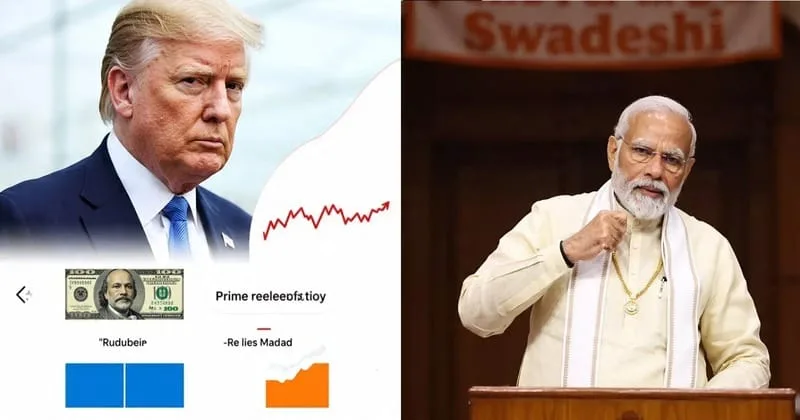
India has given a clear message to America that it will not compromise on its interests. India has said this, and it seems as if America has started weakening India with full force. In this regard, American President Donald Trump’s statements one after the other can be seen; their negative result is also visible. The rupee has crossed the historic low level against the dollar. The dollar index has reached the level of 98.68, and investors are returning to American assets. This is not the first time that America has threatened tariffs on India. Earlier, in 2018 and 2019, America had ended the exemption given to India under GSP (Generalised System of Preferences). Indian exporters had suffered a big loss due to these steps. This is not a small matter, but a very serious matter for India in terms of economy.
Now the question is, is this fall temporary, or is the rupee really surrendering to the dollar? Experts associated with the foreign exchange market believe that this fall is not just a sign of the market mood but of the global conditions. That is, after Trump became the President of America, he has constantly taken such steps, so that the dollar’s dominance remains in the world. US President Donald Trump’s 50 per cent tariff increase on India is also a part of this, and making an issue of India’s purchase of Russian oil. Now, this is also having a direct impact on the Indian stock market. In such a situation, the big question is what should we do in these circumstances? Should we keep seeing the rupee weakening like this? And after a time, witness our strong economy, which is striving to become the third largest in the world, being pushed back or should we take some effective steps to strengthen our country economically? Swadeshi is the option to strengthen India on the economic front.
Recently, Prime Minister Narendra Modi went to his parliamentary constituency, Varanasi, where he gave prominence to many topics during his speech. One of those topics was “Swadeshi” which he specifically raised. Can we take his words seriously and implement them today? In fact, to strengthen our economy, it seems most important to follow the path suggested by Prime Minister Modi. He himself has talked about “Swadeshi” and has appealed to all the people of the country to adopt 100% Swadeshi in their lives. “Let us take a pledge of Swadeshi!”
Prime Minister Narendra Modi says, “Now, whatever we buy, there should be only one scale. We will buy those things which have been made by the sweat of an Indian and which are made by the people of India. Made with the skill of the people of India, made with the sweat of the people of India. For us, that is Swadeshi. We will have to adopt the mantra of ‘Vocal for Local’. We will take a pledge that we will promote only ‘Make in India’ products. Whatever new goods come to our house, it will be Swadeshi, every citizen of the country will have to take this responsibility.” Prime Minister Modi urges every shopkeeper to we will sell only Swadeshi goods from their shop. According to him, “This pledge to sell Swadeshi goods will be true service to the country. … The feeling of Swadeshi in everything is going to decide our future in the coming days.” If seen, Prime Minister Narendra Modi is not talking about Swadeshi just like that; he has understood how to deal with the bullying of America or any other country. Today, in the dollar-based global trade, most of India’s international deals are also done in dollars, due to which imports become expensive as soon as the dollar strengthens. In which tariffs and trade wars are targeting developing countries like India due to America’s protectionist policy today. In such a situation, it has now become necessary that we emphasise on increasing trade in local currency, although India has been successful in doing this with some countries like Russia, Iran, UAE, but we should not stop, we still need to do a lot of work towards increasing trade in rupees or other alternative currencies with all countries, except the dollar.
With this, it has become necessary that we minimise our dependence on foreign investment and try to empower the MSME sector by encouraging domestic investors. Increase investment in alternatives to crude oil, like solar, biogas, and hydrogen. Bring digital currency into circulation at the international level, for this, promote digital payments through rupee-based CBDC. Along with this, the government and the RBI will also have to understand that they should focus on restructuring. In fact, India will have to create such a structure at the economic level that will not be shaken by global pressures and which will help India stand on its own feet.
There is also a need for a global call for Indian-origin people
Out of the 334 Indian billionaires in the world, about 14.8% i.e. about 42 billionaires of Indian origin, are living abroad. Some prominent names among them can be counted like Lakshmi Mittal, Anil Agarwal, Jai Chaudhary, Vivek Ranadive. Currently, about 2% of Indian millionaires are going abroad every year. Kotak Bank’s report (March 2025) shows that one to five ultra-HNIs (extremely high net worth individuals) have either gone abroad or are planning to go, which shows a migration rate of about 20%.
According to government data, about 9 lakh Indians have renounced Indian citizenship since 2015, including a large number of high-net-worth individuals. Among these, many industrialists have found it appropriate to live abroad due to their business. Vinod Adani, Siddharth Balachandran, M. Names like Arunachalam, Ryuko Hira, Prakash Loheya can be seen in this context. But even after going abroad, one thing is still special in their lives, that is, their attachment to their Indian roots and their feeling of expressing themselves emotionally from time to time.
A new India is emerging abroad
In fact, a recent American report can also be seen in this context. A new report by the Carnegie Endowment for International Peace says that US-born Indian Americans are showing a significant increase in cultural and identity-based attachment to their Indian heritage. 86% people feel proud to call themselves “Indian-Americans”. 70% of US-born Indian American respondents said being Indian was “very” important to them. The report, based on an Indian American Attitudes Survey (IASS), challenges the long-held notion that successive generations of immigrant communities gradually shed their ancestral identity in favour of Americanization.
The number of people using the label “Indian American” has declined and those identifying as “Asian Indian” have increased, the report says. That is to say, those who have migrated from India today, in any case, are still attracted to India. For children who are born abroad, the ‘motherland’ may be their country of birth now, but the ‘fatherland’ is India. They are adopting Indian values abroad. In such a situation, there is a need today to call upon all of them to adopt the new developed 21st century Indian culture. Contribute in building ‘Bharat’. Not just Adani, Ambani, Tata or some others, at least one thousand entrepreneurs of India are needed.
By the way, it is also hoped that the Government of India may be doing this experiment somewhere, but if it is not doing it, then it should definitely do it. The findings of geo-political and geo-economic studies show that many countries of the world help their industrialists in every possible way. In which China is seen to be the most ahead today. America is also one of those countries, which helps its companies and industrialists to make them global and strengthen them in every possible way. They are going to different countries of the world and submitting tenders, exploiting nature to the fullest and strengthening their country economically. Now India also needs to take steps in this direction.
Even if India becomes the third-largest economy in the world, a lot of labour is needed to match China. Today, if we want to make India the third-largest economy in the world, then we need to take steps in this direction. If we analyse the ten major economies of the world, the United States stands at GDP (USD trillion) $30.51 and per capita income is approximately USD $89,100. Here USD trillion means, 1 trillion US dollars = 1,000 billion dollars = 1,00,000 crore dollars = 1,000,000,000,000 dollars.
After this, the second economy of the world is China at $19.23, GDP (USD trillion), where per capita income is approximately $13,700. Germany has $4.74 trillion GDP (USD) and a per capita income of approximately $55,900. At the same time, India is currently running at GDP (USD trillion) $4.19 and in terms of per capita income, an average of $2,900 USD. Then behind India are the economies of Japan, UK, France, Italy, Canada and Brazil. There are arrangements. But if we look comparatively at all these, then the per capita income of the citizens of India is the lowest. If we compare it with China, then in that situation, a huge difference is seen between the ground and the sky. Where India is running at $4.19 GDP (USD trillion), China is standing at $19.23 GDP (USD trillion) in the same situation.
Actually, this gap between India and China needs to be eliminated. Which is actually possible only by awakening the feeling of “Swadeshi”. China also did the same to make itself economically strong, and India also needs to do the same today. If there is a feeling of “Swadeshi” in ‘Swa’, then rest assured that even America together cannot do any harm to India. That is, the call of Swadeshi awakening that the Prime Minister is making today, we all need to make it successful in every home. This is where the strength and power of India lie. There is capability.













Comments