





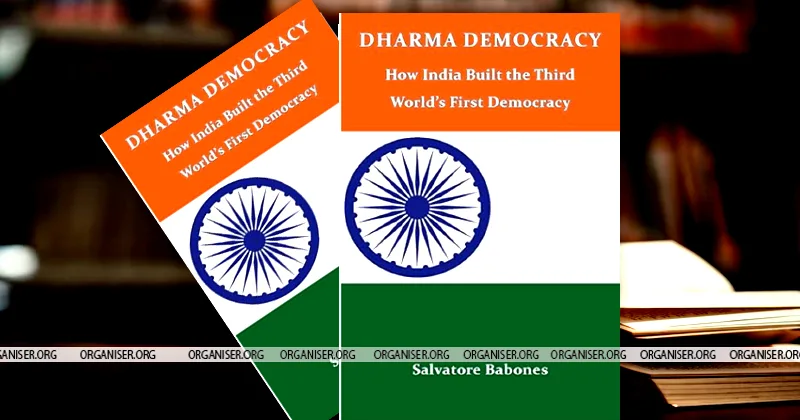
Title:Dharma Democracy: How India Built the Third World’s First Democracy; Author: Salvatore Babones ; Publisher: Connor Court Publishing, Redland Bay, Queensland, Australia; Pages: 286 ; Price: Rs 2,117.00
Dharma Democracy: This is a timely book on a topic that appears to be of general interest to the Indian book loving public. The author, an associate professor in the University of Sydney, is also a sociologist, and this is unusual, considering the main subject matter— democracy in India.
He is also a foreigner, which is not so common for a book of this type, especially when there is a mildly right-wing slant to it.
I am choosing my words carefully, and each of the above three points needs some explanation. When I say that Professor Babones’ book appears to be of general interest, this is exactly what I mean. This book is meant for serious, intelligent readers and especially for academics and scholars. It is an enjoyable read and, in doing so, I got the feeling that the author wanted to make his treatment of the topic even more rigorous but desisted, keeping a prospective Indian (non-academic) audience in mind. The book is objective in its treatment of Indian democracy and it poses questions that have not been previously asked, and attempts to answer them, not always fully but in a largely substantial measure; at least it prompts the reader to ask more questions about our democracy. This, in itself, is commendable.
The author obtained some degree of fame in our social media and television circuits when he published an authoritative study that showed that the errors committed by organizations like V-Dem about the ‘shabby’ condition of Indian democracy were on account not of the methodology used by V-Dem but by the skewed distribution of the ‘experts’ chosen by V-Dem to assess Indian democracy. He uses rigorous methodology throughout this book, as is natural for a true academic; for example, he avers, correctly, that one cannot conclude that Muslims feel unsafe in India on the basis of a survey, unless and until one can show that Hindus do not feel unsafe using the same survey methodology — which has never been done. What is shabby, according to me, is not Indian democracy, but rather the academic standard of social scientists in Indian universities today. Nothing that Babones has said in his book could not have been said by a competent sociologist in India. On the other hand, and as Babones, himself says in his book, India-focused social scientists (both in India and abroad) have transformed themselves into advocates — in the same way that he says that an advocate has transformed himself into a social scientist and popular author.
Babones, a sociologist, discusses Indian democracy, a subject that has been influenced by history, geography, economics, politics and religion. The challenge here is that the time scales in which these disciplines operate is from the extremely short one prevalent in politics, the short ones in economics, to the medium ones of history, and the longer ones that operate in religion, to the practically endless time scale of sociology — the last, because human nature does not change and never has. The author has effectively given us a composite picture of Indian democracy which is consistent with these various time scales, rounding off with the memorable Kierkegaard quotation that while national histories are constructed backwards, they must be lived forwards, something that every articulate Indian citizen living in India knows all too well! And, as for the author being a foreigner, it is probably only sociology, among the above-mentioned disciplines, that is truly country neutral so that if a foreigner wanted to take up a topic like Indian democracy, it could only be a sociologist who, by his very training, is equipped to dispassionately attempt to address baffling questions about it in terms of social structure as it affects human behaviour, individually and in societies.
In opting to devote a chapter to Yogi Adityanath, instead of the obvious choice of Narendra Modi, the sociologist in Babones is clearly apparent: religion and politics are completely intertwined in Adityanath through the common thread of his role in attempting to restructure Hindu civil society in Uttar Pradesh. In this regard, Adityanath, who is not a member of the Rashtriya Swayamsevak Sangh (RSS) closely follows the model of the RSS an organization that is described pithily by Babones in what I consider to be the most powerful two sentences in this book: “Many organizations sought to define the future Indian state in line with their own vision of nationhood. But only one organization sought to remake the Indian nation itself: the RSS”. It is telling that in 60 years, our country has moved to a Minister Monk, as Adityanath is described in this book, from a Philosopher King which was the description given to our second President, Sarvepalli Radhakrishnan, a personage who Babones clearly admires, given the number of his quotations that are sprinkled all over this book, the most notable being the one at the end of the book on dharma, or righteousness, being the king of kings, which sentiment is echoed in the book’s title itself and which answers an important question posed in the book.
The book asks many questions and I shall highlight three of them: (1) How did a country like India, which is not WEIRD, and by this is meant not Western, not educated, not industrialised and not rich, manage to fashion for herself a working democracy, in this regard the only colonized country to have been able to do so, the only democracy between Israel and South Korea? (2) Why do Muslims in India largely consider themselves to be Indian Muslims and not Muslim Indians by a factor of 25:1, at least if one was to go by mentions in the Google books database? (3) What is the Indian Nation and is it being achieved under the current political dispensations prevalent in the country today? Without revealing his answers, because a book review is not meant to be a paraphrasing of the book for the lazy reader, but rather an assessment as to whether the book is worth buying or not, I will say that the author has answered the first question fully to my satisfaction, provided a partial and fair answer to the second, and has failed to come to grips with the third question in any real way.
This third question, namely the viability of the Indian Nation needs more introspection. There was never any doubt about the existence of the Hindu Nation because this has existed in some form or the other since the time of the Vedas. V. D. Savarkar, even M. K. Gandhi in a way, the RSS and more latterly, the Bharatiya Janata Party (BJP) and its precursor the Jana Sangh have ensured that the Hindu Nation arose from the ashes of the imperial colonial era like the proverbial phoenix. The Hindu Nation has always been there, it is here now and it will always be there as long as Hindus, of some type or the other, are in political control of the landmass we call today’s Republic of India. The more vexatious matter is that of the Indian Nation because this brings about the question as to what one means by India. The book recollects that Jinnah was furious that Nehru had apportioned the name India for his new country rather than settle for Hindustan; the latter choice would have suited Jinnah fine as it would have justified his two-nation theory. In my view, defining the Indian Nation is very difficult because the two major political streams of thought in this country are in complete disagreement about what they mean by India. Does it stand for religious pluralism as understood by the Congress or does it stand merely for religious toleration of minorities, with everyone having the same rashtradharma as is suggested by the BJP? It is all coming back to dharmanirpeksha versus panthnirpeksha — never the twain shall these two meet.
The Congress remit of establishing a composite culture was a hard one anyway given the deadweight of the 5000-year Bhāratiyatva they were trying to swim against. Their efforts have largely ended in vain as they have fallen between the stools of Muslim extremism that feels they are too ‘secular’ and the demands of regional, hereditary parties with whom they must share an electoral platform but who share none of their post-modernist globalist ideas — an unenviable position indeed. It is easier for the BJP to be a liberal modernist (as opposed to post-modernist) party that is purely Indian in its concept and actions, easier at least in terms of conveying a believable ideology at the hustings to the voters.
I will add more provocatively that defining the Indian Nation would actually have been quite easy had Partition not occurred. The name Hindustan, which was used freely by Hindu freedom fighters prior to independence, might well have been the natural choice for the name of the new country, instead of it being reduced to a few Muslim appeasing politicians of today (actually just one). Let us also not forget that the suffix “-stan” in words like Pakistan, Kazakhstan, and Afghanistan is indeed equivalent to the Sanskrit word “sthan”, which means “place,” “abode,” “dwelling,” or “standing”, so that even the word “Hindustan” or shall we say, “Hindusthan” has no Muslim connotation whatsoever.
In invoking the term Indian Nation, Babones seems to be skating on the same slippery slope of “terminologically confused” entries in the literature as other writers in the field. In trying to distinguish between a civilisational state (which is a commonly used term) and a civilisational nation (which I am seeing for the first time in this book) Babones may just be adding to the confusing terminology that characterises the field. India, or should I now use the word Bhārat, for the first and only time in this review, is an archetype of a complex system. This is any construction whose form and function depend on in its parts but where these forms and functions go beyond the sums of the parts. Complex systems are non-linear, self-healing and adaptive — they survive. A feature of a complex system, which I have often observed in my own scientific researches in supramolecular chemistry, is that any attempt to characterise them accurately in terms of names and definitions leads to a plethora of nomenclature problems. It is often easier to characterise a complex system not by what it is but by what it does — function precedes form.
Babones admits that nationhood is a flexible and malleable concept. He also says India’s national identity must transcend religion (as indeed it does today even if this identity has not yet been fully defined), and yet he adds that this said nationhood need not necessarily incorporate minority religious sensibilities. How can we obtain a construct that is accommodative of both these ideas? Whether we use the definitions of B. R. Ambedkar, John Stuart Mill or James Bryce, nationality at some level demands exclusion. In today’s paradigm Muslims are being “othered” if not in the official pronouncements of politicians, at least among the social consciousness of common Hindu Indians. This is the only kind of exclusion we seem to be seeing today. Whither then the Indian Nation?
What formulation is the RSS capable of producing to define the Indian Nation that makes Muslims able to define themselves as part of such a nation that sees an “Indian” identity as more important for them than a “Muslim” identity? Equally pertinent is what formulation is the Congress capable of producing to define an Indian Nation where no cognizance is taken of anything remotely resembling Hinduism in a country that is Hindu at all levels, geographical, demographic, emotional and spiritual? Both these attempts at defining an Indian nation in my view are non-starters and seem to defy gravity. How does one even go about “valorisation of the Muslim experience in India” something that would require an enormous amount of patience, tolerance and arguably, outright forgetfulness on the part of Hindus when they do not even know if Indian Muslims will accept such “valorisation”? The author admits that “Muslim Indians are never going to be drawn into a rhetoric of national unity centred on the language of dharma”. In this case, and if we accept the author’s contention that democracy in India is stable because it is dharmic, are Muslims even a part of Indian democracy? These are troubling questions and it is insufficient to say that “history is complicated, non-linear and often unjust, but it cannot be undone”. History cannot be undone but new history can be created and possibly only Indians living in India can and do realise that we are in this process right now, a process where we are living history, living in history and making history.
The book has an enormous number of pertinent references and a bibliography that I am eager to start reading. I used the Index often in my two readings of the complete book. Vignettes such as Bipin Chandra Pal’s foreseeing the inevitability of Partition sixteen years before the Muslim League called for a separate state, Bal Gangadhar Tilak’s comments on the use of English or local language instruction and of course the passage from the Gita that one’s own dharma however badly done is a higher good than another’s dharma, however, well done, add to the relevance of this book in any serious study of democracy in India. I understand that an Indian edition, which will be more attractively priced, will hit the local markets in the near future. This is a book well worth buying and more importantly, dissecting. I congratulate Professor Babones for giving us this useful work.












Comments