





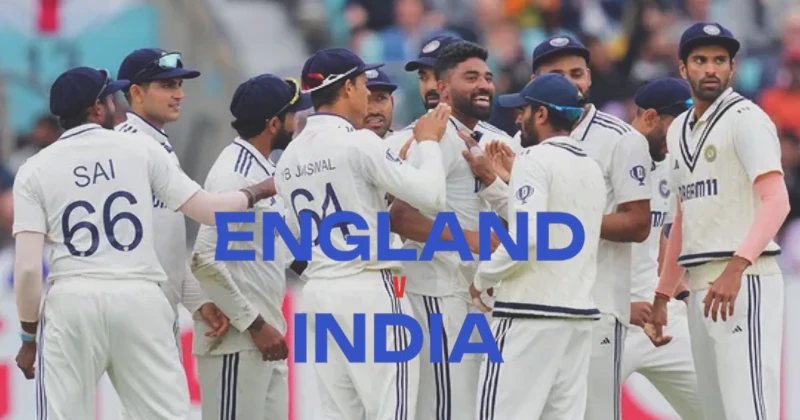
On August 4 2025, the India-England test series came to a wonderful end at Oval-London and thus in its true spirit rejuvenated the competitive legacy of international test cricket. It was also the culmination of a hard-fought 25 days of functional cricket on England pitches known for their typical character of swing & bounce. Both teams contributed to the greatness of test cricket and assured the world that test cricket is alive and will continue to be so in future as well.
This author said at the beginning of an article on June 18, 2025, before the start of the series, “The June 20 2025 will formally bring to the front a new generation of cricket geniuses on behalf of India in an important Test series to be played in England. It will be a five-match hectic schedule to be followed by the Indian players in non-homely conditions and atmosphere where their inner strength and outer skills will be on a real and formidable test. This test series will also speak out about the future of Test cricket in India for the next two years test cycle”.
The article ended with the following wishful thinking, prophecy and expectation: “England is very confident, as usual, on its home grounds. It has a long history of playing test matches in different seasons of England and has also set many records in this context. They are a good team with great players with the label of ‘Bazball’, though that label failed in India during their last tour. Their mind games have also begun claiming that the test series against India would be their good ‘practice session’ for the Ashes in winter. It is for the young brigade of India that has the relevant experience of both red-ball and the white-ball to prove to the task ahead of them. While everybody concerned waits for June 20, 2025, the decision of renaming the Trophy of the series as the Tendulkar-Anderson Trophy has also gained discussion and debate. Gautam Gambhir, the head coach of the Team India should also be rejoining the team in London soon. Hope Team India shines and exhibits great & absorbing cricket..!”.
India lost the first test match and won the 5th one as a decider of the series. In between the above two tests, the second and third ones were won by India and England, respectively. The fourth test match was a wonderful display of resilience by the Indian batters who brilliantly managed a draw despite hard labour, commitment and talent exhibited by the English team. An analysis after the event is a genuine offshoot of the finale at Oval-London.
The best thing to happen in the Indian camp was that the assured display of Team India was made possible by the players and the support staff despite the absence of its star players. The veterans Ravichandran Ashwin, Rohit Sharma and Virat Kohli decided to hang up their boots well before this important test series. It was a challenge for the coach, the new captain, youthful players and the staff to prove themselves equal to the task, and they did their job very well.
Ravinder Jadeja, the world number one all-rounder for several years now, aged 36, performed to his full capacity & strength, and amassed 516 runs throughout the series plus seven valuable wickets coupled with brilliant fielding. Surely, he made a magical difference at crucial points in all tests. He stood out as an inspiration for all on the ground as well as outside the field. He especially gave a new useful dimension to the lower-order batting.
Shubman Gill made record after record and created a hill of runs, mostly in the first three tests. His 754 runs in the series are also a record made by the captain. He also fit himself into the shoes of Saurabh Ganguly and Virat Kohli as a robust, tough and challenging captain. He led his team well in his first series and used his fast attack judiciously, barring his quality spinners in the team. Overall, his selection as a ‘joint player of the series award’ was a correct decision for which he deserves all-around praise and recognition. His double century was indeed a class.
Mohammed Siraj captured 23 wickets, the maximum by him in any test series. That was a brilliant effort by him. He is the only fast bowler who played all five tests and produced results in favour of India. He was surely a stumbling block for Team England and excelled even in the absence of Jaspreet Bumrah. Mohammed Siraj seems very close to capturing the position of Mohammed Shami in the team, who is not usually body-fit, raising questions about his selection in the team.
Bumrah and Prasidha Krishna took 14 wickets each, while Akashdeep captured 13 wickets. Bumrah couldn’t play all the tests due to the medical advice regarding his workload management. The spinner like Washington Sundar was the pick of spin bowling, and he took seven wickets in addition to his superlative batting prowess. His century and a half down the order made a huge difference in the series.
K. L. Rahul and Jaiswal kept their cool and handled the opening slot with great resilience. Rahul, especially, was the pick of the two. His batting, both defensive and offensive, was a class to watch and exhibited his character and commitment. It was a treat to the eyes, particularly the sound of his shots, which was so fascinating in the English atmosphere that he won the hearts of everyone. He also made 532 runs and took six catches in the slips. Yashasvi Jaiswal, though, made two important centuries but needs to make some serious corrections in his batting. He, unfortunately, gives up his wicket when there is no need to do so. However, he made 411 runs in the series. He requires pointed training in his shot selection as well as catching in the middle of the field.
Rishabh Pant, who played four tests, is a daring devil. He has an absolute curriculum and syllabus of his own. He is simply beyond the copy-book fashion and old-school cricket coaching so far as his batting is concerned. His follow-up centuries in both innings were a marvellous task that every batter in the world would like to imitate. He made 479 runs in the four tests that he played. However, he needs to keep on improving his wicket-keeping despite his successes in the arena. He stands out as a gem of a player undoubtedly: brave, talented and out of the book.
There were also astounding and enthralling contributions by Team England to the series. They deserve recognition and kudos for that. They made it known that they have the ability to play both the formats of test cricket, the old-school cricket and the ‘bazball’. However, they were facing a formidable challenger in the shape of India, who defeated them only last year, 4-1, in India in a five-match series. Ben Stokes, the captain of England, was surely the pick of the England players. Their batting as well as bowling was excellent. They made it known that they are the bosses of their home pitches. However, India didn’t allow them a series win again on their home turf. And that is the charm of test cricket when one has a great challenger in front of them.
JE Root, HC Brook (the joint winner as the player of the series), B.M. Duckett, and J.L. Smith made marvellous contributions in the field of batting. H.C. Brook also took maximum catches as big as 11 in the series. Among the bowlers, B.A Stokes, J.C. Tongue and C.R. Woakes made a great effort to take the tide of the series to their side. They took 17, 19 and 11 wickets each, respectively. The beauty of test cricket lies in the fact that the bowlers have to take 20 wickets in the match in order to claim a favourable result. Both teams in the four matches did this exactly in the manner in which they were expected to do so by their fans.
The drawn test match, the fourth one, was possible only due to the astonishing, talented and excellent batting performed by the duo Ravinder Jadeja and Washington Sundar, who completed their centuries in the most adverse conditions down the order. It needs to be emphasised that India completed 12 centuries in the series, excluding the four missed ones, and that goes to recognise the powerful batting tradition of Indian cricket.
This test series, in particular, has drawn clear lines among the classes of test cricketing nations. ICC might be now onwards, in the near or far future, inspired to create three classes of test-playing cricketing nations. The first category (A) will include India, England, Australia, South Africa and New Zealand. The next category (B) will include the nations like Sri Lanka, Pakistan, the West Indies, Bangladesh and Zimbabwe. The third group (C) will comprise the rest of the cricketing nations and the affiliates.
There should be test matches only within the group. The first group can have five test match series, the second group can have three test match series, and the rest can be asked to play 1-2 test match series. This new format will create a fresh interest in the test matches throughout the world. There will be no issue of unequal competition in test cricket, and moreover, in case a nation in the lower groups excels in the two-year WTC time cycle, that particular nation could also be elevated to the next level. Payments to the teams, sponsorships and the other awards could also be decided as per the group formations. This eventually will take test cricket to a new level when white-ball cricket is already posing a big challenge to red-ball cricket in the modern world of contention and competition.
India continues to be the powerhouse of cricket globally. Its strength lies not only in the financial power of the BCCI, but the talent, strength, records and the current status of the cricketers continue to guide Indian cricket in essence. As long as the results come in favour of Team India, the nation and the BCCI will have a great say in global cricket.
















Comments