





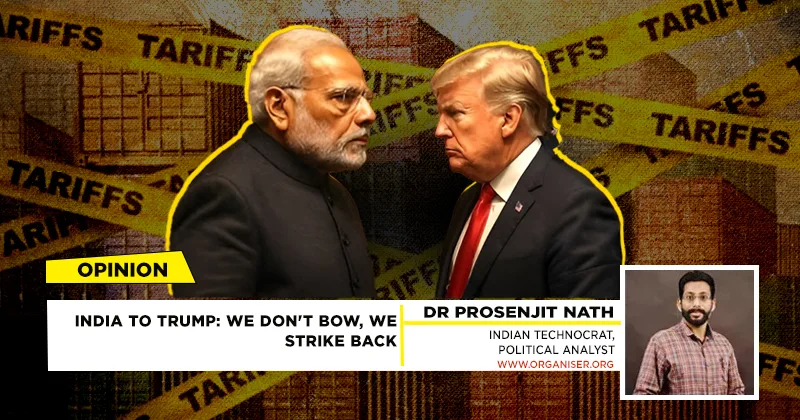
In the latest standoff between Washington and New Delhi, India has drawn a bold red line. The days of polite diplomacy coated with soft ambiguity are over. With former US President Donald Trump issuing fresh threats of a 25 per cent tariff on Indian goods and caustic jibes calling India a “dead economy,” India has responded not with silence, but with fire. A six-point rebuttal from the Ministry of External Affairs (MEA) has not only dismantled Trump’s arguments but also exposed the gross double standards of the United States and its European allies.
The bottom line? India is done playing second fiddle in a Western orchestra out of tune with modern geopolitics.
Trump’s Tariff Tantrum: The Trigger
Donald Trump’s comments on Truth Social accusing India of profiting from Russian oil while Ukrainians perish were nothing short of disingenuous. His words “India “is not only buying massive amounts of Russian oil, but they are then, for much of the oil purchased, selling it on the open market for big profits,” are not just misleading; they are dangerous. They echo a Cold War-style attempt to guilt-trip independent nations into choosing sides in a conflict that they neither started nor escalated.
Trump has chosen to ignore context. When the Ukraine conflict erupted, traditional suppliers diverted oil to Europe, creating a vacuum in Asia. India, acting as any sovereign, rational state, would fill that vacuum with Russian crude to ensure energy security and price stability. Ironically, this decision also prevented a global oil shock. And who encouraged India then? The United States.
Now, as India continues this strategy, Trump’s narrative has flipped. But India isn’t having it.
A Six-Point Slap of Sovereignty
The MEA’s response is not just a defence; it’s an offence. Here’s how India delivered a factual and principled knockout punch to the Western narrative:
- US Encouragement: India reminded the world that Washington had, in fact, “actively encouraged” India to purchase Russian oil as Europe sucked up supplies from elsewhere.
- Compulsion vs. Convenience: India’s oil trade with Russia is based on economic and national compulsions. Meanwhile, the EU and US continue non-essential trade with Russia, luxury items, fertilisers, uranium, and more.
- Double Standards Exposed: In 2023-24, Europe’s trade with Russia stood at a staggering €67.5 billion in goods and €17.2 billion in services, dwarfing India’s trade numbers. Yet, they want to lecture India?
- Imports: From machinery to EV-related metals like palladium, Europe and America haven’t severed ties with Russian industries that bolster their economies. India merely buys oil, vital for 1.4 billion citizens.
- Selective Outrage: The US still imports Russian uranium for its nuclear power plants, palladium for EVs, and chemicals. Where’s the moral outrage there?
- India: the “Dead Economy”? The final point is poetic justice. India reminded Trump that it is a “major economy” and will take “all necessary measures to safeguard its national interests and economic security.” A clear rebuttal to Trump’s “dead economy” insult.
Beyond Rebuttal: India Calls Out Western Hypocrisy
What makes this reaction unprecedented is its tone. It’s not defensive. It is assertive, unapologetic, and confident. India didn’t just defend its oil purchases; it put the West on trial.
For far too long, the West has positioned itself as the moral compass of the world, wagging fingers at the Global South while indulging in duplicity. India has now made it clear: this compass is broken. Europe lectures India on morality while importing Russian gas by the shipload. The US threatens tariffs while quietly doing business with Russian industries.
India’s response shatters this façade. New Delhi is no longer in the business of grovelling.
PM Modi’s Firm Stand: No Ceasefire on National Interest
Prime Minister Narendra Modi’s silence in the face of Trump’s taunts is strategic, not submissive. He hasn’t called Trump since June 18 and even politely declined a US stopover after the G7 Summit. This isn’t mere protocol, it’s posture.
PM Modi’s remarks in Uttar Pradesh last week drive the point home: “Whatever we buy, there should be only one scale: we will buy those things that have been made by the sweat of an Indian.”
That’s not just economic policy. That’s a civilizational assertion. The message is loud and clear: India’s sovereignty is non-negotiable.
The “Make in India” push is no longer just a slogan. It is an economic weapon aimed at self-sufficiency. India is now countering the impact of Trump’s tariffs with a Rs 20,000 crore stimulus plan to boost domestic manufacturing. Unlike the West, which clings to outdated geopolitical leverage, India is building from within.
History as a Weapon: 1971 Reminder
Even the Indian Army joined the fray in its own way. A pointed social media post reminded Indians and the world of America’s long-standing support for Pakistan, even during the 1971 Bangladesh War, when the US shipped $2 billion in arms to Islamabad.
This wasn’t a random history lesson. It was a calibrated message: we know your game, and we haven’t forgotten.
West’s Moral Bankruptcy, India’s Strategic Clarity
The fundamental issue here isn’t just oil. The West cannot accept that the world is no longer unipolar. The US used tariffs, military muscle, and narrative warfare to shape global geopolitics. But the emergence of multipolar power centres like India has disrupted that order.
India’s unwavering relationship with Russia is one such example. Despite mounting pressure, Russian oil keeps flowing into Indian ports. Tankers discharge millions of barrels as India quietly builds energy buffers. The West’s pressure tactics have failed.
And it knows it.
The MEA’s statement is also a subtle prod to the West: Practice what you preach. If you truly believe Russia is the villain, stop doing business with it entirely. Don’t make India a scapegoat for your half-hearted war footing.
Trump’s Ego and Pakistan’s Game
NATO chief Mark Rutte famously called Trump the “daddy” of the alliance, a telling insight into the ego politics that Trump plays. Pakistan, with its tradition of sycophancy, has mastered this game. Every few months, it dangles false promises of oil or cooperation to curry favour with the former president.
India, on the other hand, has chosen dignity over desperation. Trump’s tariffs are not about trade; they are coercion tactics to realign India geopolitically. But India is clear: its foreign policy is dictated by New Delhi, not Washington.
A Nation United, A Message Delivered
Trump has the MAGA crowd to cheer his tariff tirades. But in India, across party lines, there’s unity in defiance. From the Foreign Ministry to the Commerce Ministry, from the Army to the Prime Minister’s office, India has spoken in one voice.
Commerce Minister Piyush Goyal perhaps said it best: “From the Fragile Five, we are now the world’s fastest-growing major economy. We will soon be the third-largest economy globally. India contributes 16% to global growth.”
That’s not a “dead economy.” That’s a superpower in the making.
Conclusion: India Has Outgrown the West’s Guilt Games
India’s response to Trump isn’t just about oil or tariffs. It’s about drawing a new red line, one that marks the boundary of a rising civilisation that will no longer be cowed into submission by Western guilt games.
In a multipolar world, India is no longer a pawn, but it’s a player. The days of strategic patience are over. The era of sovereign assertion has begun.
Donald Trump may rant. He may tweet. He may impose tariffs. But India has just delivered a masterclass in how to respond: with dignity, with data, and with defiance.













Comments