





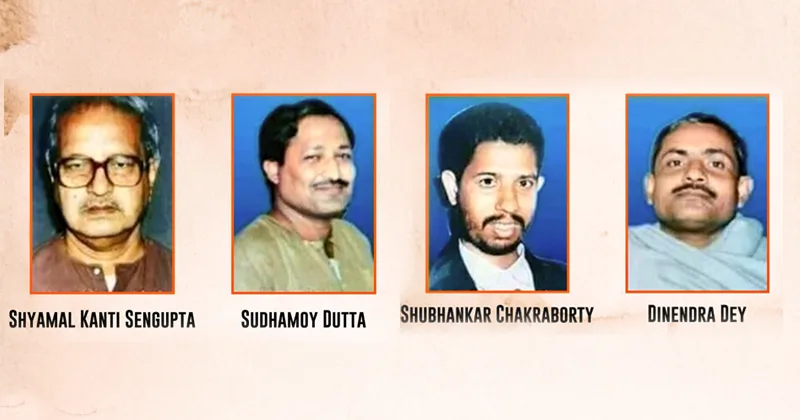
Agartala: In the dense forest of Dhalai district in Tripura near the India- Bangladesh border, the tribal villages with vast diversity are a symbol of the coexistence of nature and human respect for each other. The tribal villages in the forest are home to dozens of RSS Pracharaks who under the belt of Vanavasi Kalyan Ashram work round the year for the development of the tribal people. But on the black day of August 6, 1999, a tragedy unfolded that still lingers in the collective memory of the Rashtriya Swayamsevak Sangh (RSS) and many in the Northeast. Four senior RSS pracharaks—Shyamal Kanti Sengupta, Dinenandranath Dey, Sudhamoy Datta, and Subhankar Chakrabarty—were abducted and later brutally murdered by armed militants of the National Liberation Front of Tripura (NLFT).
Their crime? They were working among tribal communities, promoting education, harmony, and self-reliance—activities that clashed with the increasingly militant and religiously radical vision emerging within the NLFT.
Shocking the people of the Northeastern state, it was later revealed that the mastermind of the brutal killings of the 4 RSS pracharak was a dreaded religious militant leader Zoshua Debbarma, alias Jogendra Debbarma, alias Barnnabas Borok, who called himself “Bubagra,” or King. The christian militant leader who claimed to be in direct communication with Jesus Christ and said he got direct orders to do violence against Hindus and forcibly converts Tripura tribal people to Christianity.
Not only this, but the religious militant leader also demanded Christian theocracy in Tripura and organised forced conversion amongst the tribals. He was of the opinion to annihilate Hindu culture from the tribal areas of the state.
On the dark day of 6 August 1999, 4 Pracharak of RSS were abducted from Vanavasi Kalyan Ashram in Kanchanchhda in Dhalai district of Tripura. Militant group NLFT claimed the responsibility and demanded a ransom of 2 crores from the families of the abducted Pracharak. Intelligence sources later revealed the pracharaks were taken across the border into Bangladesh, a factor that severely complicated rescue efforts.
Religious extremism
This was not an isolated case of violence. From the late 1990s into the early 2000s, Tripura witnessed an explosion of religiously motivated attacks led by the NLFT. The outfit—once a secessionist group—had become a radical Christian insurgency under Zoshua’s influence.
In 2000, popular tribal Hindu leader Shantikali was shot dead in Jirania. A year later, on Makar Sankranti, militants opened fire on villagers at Singicherra Bazaar, killing 16 people, mostly tribals celebrating a traditional festival. Worship of Hindu deities was banned. Women were prohibited from wearing sindoor or bangles, and singing bhajans was declared blasphemy by militants.
The involvement of church leaders in militancy was eventually exposed. In 2000, Nagmanlal Halam, a leader from Noapara Baptist Church, was arrested with a haul of explosives. In 2003, another senior church official from North Tripura was caught smuggling gelatine sticks, sulphur, and potassium—ingredients for IEDs.
Sources revealed that a confidential report dated June 5, 1997, exposed a meeting in Balurghat Church, Sylhet (Bangladesh) where top insurgent groups like NLFT, NSCN, ULFA, and PLA gathered with church leaders and ISI agents to chalk out strategies.
Former Chief Minister of Tripura Manik Sarkar once acknowledged the role of the Baptist Church in aiding separatist activities in the state is exposed in investigations. A 2008 statement by the NLFT-Biswa Mohan group admitted that Zoshua’s anti-Hindu decrees, especially banning Jamatia Hoda (a tribal socio-religious body), and targeting idol worship, had caused unrest even among their own cadres.
The four RSS pracharaks died serving remote communities. Their names are not printed in textbooks. No public monuments honour them. But their story is a brutal reminder of what happens when religion becomes a weapon, and silence becomes complicity.









Comments