




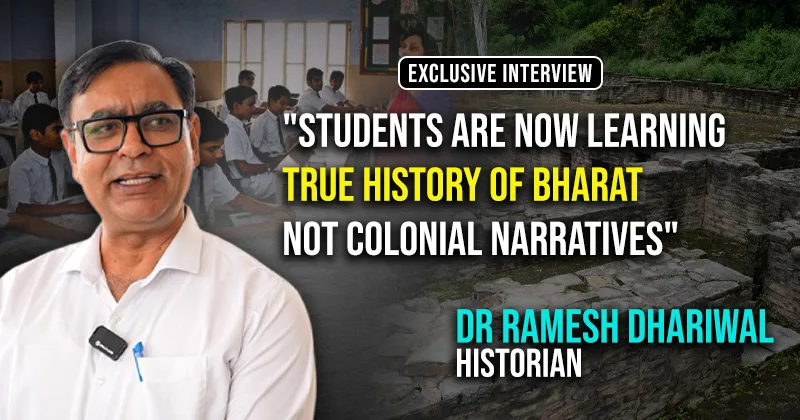
Mentioned over 70 times in the Rigveda and revered as the mother of all rivers, Saraswati was never a myth. However, Britishers with an intent to disconnect Indians from their heritage called it a myth. This falsehood was later promoted by Marxist and left-leaning historians like Irfan Habib and Romila Thapar. But truth, cannot be hidden forever. Today, through the combined efforts of archaeologists, geologists, historians, Saraswati has re-emerged. To understand the journey of River Saraswati from sacred hyms to scientific validation, Organiser, Sub-Editor Yatharth Sikka spoke to Dr Ramesh Dhariwal, a historian based in Yamunanagar. Excerpts:
What is the Saraswati River, is it a real, historically existing river, or merely a mythological concept as claimed by some left-leaning historians?
Ans: If we study the Indian scriptures, we find that in the Rigveda, Saraswati is renowned as the most important river. She is mentioned with great reverence, devotion, and prayer. Saraswati finds repeated references in the Rigveda. When we look into it further, especially the Saraswati-Sindhu civilisation, over 2000 sites have been excavated so far, and a large portion of them, more than 1500, have been identified along the banks of the Saraswati River. These findings point directly to the existence of the river at that time. Additionally, several recent reports by major institutions like ONGC, ISRO, GSI, and especially the Archaeological Survey, also indicate and clarify that Saraswati was a real, ancient river flowing in full bloom. These evidences strongly support the existence of the Saraswati River as described in our ancient texts.
What was the historical and geographical journey of the Saraswati River? From where did it originate and what led to its eventual disappearance?
The Saraswati River originates from the Bandarpunch glacier. From there, it flowed through the Shivalik hills, particularly entering the plains from the Adibadri region in Yamunanagar. This terrain marks the transition from the hilly region to the north Indian plains, where the river sustained a vast and ancient civilisation, what we now call the Saraswati Civilisation. However, over time, due to significant seismic activities and tectonic shifts, the course of the river changed. These geological disturbances blocked the upstream flow and altered its natural path. Consequently, the river gradually dried up over thousands of years, leading to the decline and eventual disappearance of the civilisation that once thrived along its banks.
Regarding the legend of Ved Vyas cursing the river, I would like to clarify something. Ved Vyas, whose real name was Krishna Dwaipayana, was born in a region known as Dwaipa, meaning the land between two rivers. His ashram was situated close to the Saraswati River, at a place called Vyas Pur, about 15–16 km before Adi Badri. This area lies between the Saraswati and Yamuna rivers—or perhaps between Saraswati and Som river. He is revered as the sage who compiled the Vedas and composed the Mahabharata.
We find references to the Saraswati River in the Rigveda and other Vedic scriptures. Could you elaborate on these references and explain why Saraswati is called “the most celebrated river” in the Vedas?
Our scriptures regard water as a vital element. Even in the creation of human life, water is considered the most important among the five elements. In this context, rivers and ponds continue to be held sacred. Oceans, too, are revered. Similarly, around the Saraswati River, a civilisation was formed, a culture was shaped, that why it stands before us as the most revered and sacred river.
When we view the location of Saraswati, it becomes clear why the Ashrams of sages were located along its banks, and gradually major cultural centers and settlements developed there. Among those developed settlements, a place like Rakhigarhi today is emerging before us as the largest site of the Saraswati-Sindhu Civilisation. Therefore, it can be said that Rakhigarhi, located on the banks of the Saraswati is the central hub of this entire civilisation and culture. This is why the foundation and existence of the Saraswati holds great importance.
Some Left-leaning historians like Irfan Habib and Romila Thapar attempted to discredit the existence of Saraswati River. They called her a ‘myth’ by linking it to their manufactured Aryan Invasion Theory.
The word “Aryan” does not denote any particular race. “Aryan” is an adjective. In Sanskrit, the word “Arya” is used to denote excellence. So, terms like ‘Hey Arya Putra’, are used to refer to someone who is superior, good, better, or significant. Associating it with any specific race is a grave distortion of our history and culture. Especially during the colonial period, in the 19th century, this theory was crafted and projected in a way to show that the Indian people, particularly from North India are descendants of Aryans. And Aryans too were invaders, so that British rule could be justified. Then another race was created in the name of Dravidians, and thus by dividing people into Aryans and Dravidians, a deliberate mischief was done with our history.
But now, this theory has been entirely debunked. With ongoing excavations and new DNA results, it has become evident that the present-day population and the skeletal remains from 8000 years ago have matching DNA. They are from the same lineage. Even in ancient tales, if you observe the river flowing through this region, people knew it by the name ‘Surasati’ and worship it with great reverence, some even today called it as ‘Surasati’. If one visits any village in the area through which the Saraswati flows, they will understand all this.
How are today’s historians and academicians working to correct this cultural and educational appraoch?
Now, in the Haryana Board textbooks, the very first chapter in class 6 is on Saraswati Civilisation. Similarly, in the NCERT textbook also, the term Sindhu-Saraswati Civilisation is being used for the past 2 years. Now, we are teaching factual and correct history of Bharat to the students, and not colonial narratives.











Comments