





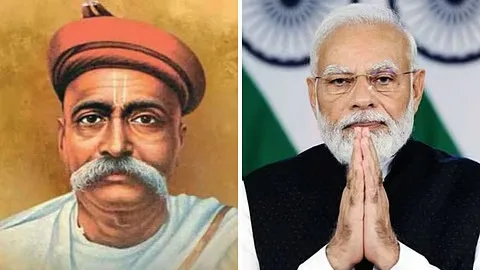
Nearly 120 years after Lokmanya Bal Gangadhar Tilak first ignited the flame of Swadeshi, India is witnessing a powerful resurgence of the same spirit under Prime Minister Narendra Modi’s leadership. On August 1, the nation observed Tilak’s death anniversary, remembering the man who gave Indians a blueprint for economic and intellectual self-reliance at the height of British colonial domination.
Just a day later, on August 2 in Varanasi, Prime Minister Modi rekindled that historic call, urging citizens to ensure that “every new thing that comes into our homes should be Swadeshi.” Far from being a mere patriotic slogan, Modi’s appeal was a clear assertion of economic sovereignty at a time when global geopolitics is fraught with trade wars and tariff sanctions.
🚨 BIG MESSAGE
PM Modi: “With Diwali & wedding season ahead, let’s vow to BUY only Swadeshi products.” 🇮🇳
“This is true service to the nation. I urge everyone — ‘Wed in India’, don’t let India’s wealth flow abroad.” 🪔💍 pic.twitter.com/WznWQfdhGa
— Megh Updates 🚨™ (@MeghUpdates) August 2, 2025
Tariff wars, U.S. threats, and a century-old answer
As trade tensions with the U.S. escalate and new tariff regimes threaten India’s export markets, the concept of Swadeshi, once born as an anti-colonial weapon, has transformed into a strategic shield for economic independence. The Modi government’s push for Atmanirbhar Bharat and ‘Make in India’ echoes the century-old ideology of resisting foreign dominance through indigenous strength.
Tilak’s Trisutri: Then and now
Back in the early 20th century, Tilak introduced his Trisutri (three-fold program), a vision that combined political, economic, and cultural sovereignty:
Swaraj: Self-governance and political freedom
Swadeshi: Promotion of indigenous goods and industries
National Education: Learning rooted in Indian ethos and values
For Tilak, these were not slogans but a practical roadmap to dismantle British hegemony. The Swadeshi movement of 1905, which erupted after Lord Curzon’s partition of Bengal, became a psychological revolution. It asked Indians to boycott foreign goods, build local industries, and restore cultural pride.
Fast forward to 2025, Swadeshi is no longer a throwback; it is an economic compulsion. With the fragility of global supply chains exposed, Western economic pressure mounting, and tariff wars intensifying, India’s pivot to domestic manufacturing and indigenous innovation is not a retreat into the past, but a resilient leap forward.
Prime Minister Modi’s call to “buy Swadeshi” during the festive and wedding season is more than symbolic; it is a battle cry for economic independence, urging citizens to keep India’s wealth within its borders. From Tilak’s boycott of British textiles to Modi’s push for local production, the journey of Swadeshi has come full circle, now powered by global ambitions and digital-age strategies.
U.S. tariffs and a renewed economic nationalism
The recent application of retaliatory tariffs by the United States against Indian exports has set in motion a spasm of introspection and determination within Bharat. U.S. President Donald Trump’s statement that India is a “dead economy” did not simply elicit political outrage; it spurred a national reassertion of economic sovereignty.
Addressing these changing world dynamics from the ancient city of Kashi on August 2, Prime Minister Narendra Modi did so with a clarity. “Today, the world economy is going through many apprehensions, and there is an atmosphere of instability. In such a situation, the countries of the world are focusing on their respective interests. They are focusing on the interests of their respective countries. India is also going to become the third-largest economy of the world. Therefore, India also has to be vigilant about its economic interests. The interests of our farmers, our small industries, and the employment of our youth are of paramount importance to us”.
#WATCH | Earlier today in Varanasi, PM Narendra Modi began his address with the chant “Namah Parvati Pataye, Har Har Mahadev,” followed by greetings in Bhojpuri.#NarendraModi #Varanasi pic.twitter.com/OHjhlZdUqB
— Organiser Weekly (@eOrganiser) August 2, 2025
Amidst this geopolitical uncertainty and economic instability, Modi’s appeal for Swadeshi was not merely an obeisance to tradition; it was a calculated counter-narrative to outside pressure. He appealed to every Indian, irrespective of political persuasion, to awaken a feeling of economic responsibility. His appeal was direct: “Now, whatever we purchase, there should be only one scale; we will purchase what is produced by the sweat of an Indian.”
This call to action was not merely about consumer consumption; it was a larger cultural and economic phenomenon. From rallying citizens to buy Make in India products to requesting shopkeepers to stock only domestic products, Modi emphasised that economic nationalism has to be a collective movement. The festive season ahead, he stated, should be spent celebrating by embracing Vocal for Local in every transaction, every wedding, every ornamentation, and every choice.
In calling for Swadeshi not only as a policy but as a mass movement, Modi comes straight into line with the vision of Bal Gangadhar Tilak, one in which economic self-sufficiency is as important as political freedom. Amidst a time when global supply chains are weaponised and tariffs become diplomatic tools, India’s approach is unequivocal: resilience rather than retaliation, production rather than reliance, and unity rather than vulnerability.
Economic vision: Swadeshi in action
Since 2014, PM Modi has initiated a sequence of economic and policy reforms along the lines of Swadeshi values:
1) Make in India (2014): To encourage domestic manufacturing.
2) Startup India (2016): To encourage innovation and entrepreneurship.
3) Aatmnirbhar Bharat Abhiyan (2020): Self-reliance mission during the COVID-19 pandemic.
4) PLI Schemes (Production Linked Incentives): To lure global companies to manufacture in India.
5) Digital India: To narrow down the digital gap and build local tech ecosystems.
These programmes, supported by fiscal incentives, deregulation, and infrastructure investment, have driven growth in sensitive sectors such as semiconductors, electronics, defence, green energy, and EVs.
India’s Global Rise: A swadeshi outcome
Even in spite of the global economic slowdown, India became the world’s fastest-growing major economy. According to a report published in moneycontrol on 1 August, 2025 following trump’s dead economy comment “India’s economy is likely to reach 6.5 percent growth in 2025-26, above 1.9 percent and 4.8 percent growth rates of US and China, India’s 18.1 percent savings rate and 81 percent debt as percentage of GDP, puts India ahead of major advanced economies.”
Some of the key indicators:
1) GDP (2025): Placed at 4.187 trillion dollars, overtaking Japan. The IMF also placed India at 5.58 trillion dollars by 2028, overtaking Germany to rank third globally.
2) Exports (2024–25): Total exports of India have reached a record high of US 824.9 billion dollars in the financial year of 2024–25
3) GST Collections: Reached over Rs. 1.96 lakh crore in July 2025, marking strong domestic activity.
4) Unicorns: The country’s startup ecosystem, driven by over 100 unicorns, is transforming innovation and new opportunities across industries.
India is the world leader in instant payments, and UPI processed 18.39 billion transactions, amounting to Rs. 24.03 lakh crore during June 2025, which represents 85 percent of the country’s total digital payments. It currently supports 491 million users, 65 million vendors, and links 675 banks, generating close to 50 percent of the world’s real-time digital transactions. UPI is active in 7 nations, including France, Singapore, and the UAE, making India a global fintech leader. Going to France is a milestone as it is UPI’s maiden foray into Europe. As per the PIB backgrounder, India is also encouraging UPI to become the standard for the BRICS group, which now consists of six new member countries. They are not mere statistics; they signify a Swadeshi renaissance, one in which Indians are producers, not merely consumers.
Cultural confidence and economic sovereignty
Tilak always argued that economic independence was intertwined with cultural pride. His promotion of Ganesh Utsav as a public celebration was not just religious; it was political. He wanted Indians to gather, organise, and reclaim public space from colonial restrictions.
Similarly, PM Modi’s vocal support for India’s festivals, traditions, handlooms, and rural industries is part of a broader narrative of cultural assertion.
1) One District One Product (ODOP): Encourages local economies and indigenous crafts.
2) Vocal for Local Campaigns: Encourages consumers to opt for Indian-produced products.
3) GI Tags and Traditional Knowledge: Revival of native rice, turmeric, handloom, and tribal art.
These initiatives celebrate Tilak’s vision of national education, one based on Indian culture and local language, reborn in a new form.
India can produce and consume: The twin engines of Swadeshi
One of India’s greatest strengths in the global economy of the 21st century is its unusual combination of being able to produce and consume at scale, something unmatched and ideally suited to the vision of a new Swadeshi movement.
With more than 1.4 billion population, India is not only a huge consumption market but also a strong production base. This twin ability consolidates the economic nationalism base to the extent that it makes India independent while minimising its reliance on imports from abroad.
On the production side, programs such as Make in India, Aatmanirbhar Bharat, and Production Linked Incentive (PLI) schemes have converted India into a vibrant manufacturing hub.
India is providing frugal, high-quality solutions to both the domestic and international markets from cheap pharma to innovative digital payments. India’s overall exports reached a record high of US 824.9 billion dollars in the financial year 2024–25, as reported by the latest figures unveiled by the Reserve Bank of India on services trade for March 2025, highlighting its increasing strength as a maker.
At the same time, India’s growing middle class, high smartphone penetration, and surging digital economy have triggered a consumption spurt. UPI, ONDC, and e-commerce platforms have made the reach of Indian products to Indian consumers easier than ever before, from metros to the remotest of villages.
This uncommon coincidence of demand and supply within the boundaries of the nation is what provides the advantage to India for pursuing Swadeshi in an effective and sustainable manner. When Indians make locally and consume locally, not only does it give a boost to domestic industry and generate jobs, but also retains economic sovereignty in an increasingly volatile global context.
As Prime Minister Modi highlighted in his speech at Varanasi, “The dream of a developed India will be fulfilled only with everyone’s efforts. Once again, I congratulate you for today’s development work and in the future if we buy Vocal for Local, we will buy Swadeshi, if we decorate our homes, we will decorate them with Swadeshi, if we improve our lives, we will improve them with Swadeshi. Let us move forward with this mantra” .
Having both the ability to make and the capability to consume, India is set to turn Swadeshi from merely a slogan but a self-reliant economic model of the future.
Rupee trade: A strategic enhancement to Swadeshi
In a big thrust towards economic independence, 22 nations such as Russia, UK, Germany, Israel, and Sri Lanka have initiated Special Rupee Vostro Accounts (SRVAs) in Indian banks to enable international trade in Indian Rupees (INR). This action goes strongly in the direction of Swadeshi, cutting down on India’s dependence on the U.S. dollar and enhancing the rupee as an international currency of trade.
The Reserve Bank of India’s historic July 2022 decision to permit invoicing and settlement in INR has already shown rich dividends. From Russian fuel deals to African pharmaceutical exports, India is now making more transactions in its own currency. This trend was further reinforced in January 2025, when the RBI relaxed FEMA rules to permit non-residents to utilise INR balances towards FDI and capital transactions.
By allowing Indian exporters to invoice in rupees and keep export proceeds overseas, the policy protects India from international currency volatility. More significantly, it boosts India’s leverage in foreign trade, making the Swadeshi dream a tangible financial model.
With more countries adopting rupee-based trade, India is one step closer to being not only self-sufficient, but also globally powerful on its own terms.
Scientific Swadeshi: India’s global leadership in innovation
India’s impressive surge in science, technology, and innovation is a contemporary expression of the Swadeshi spirit, consolidating power from within to dominate the globe. India is now leading the way globally in space research, biotechnology, nuclear power, and scientific exploration.
From sending 433 foreign satellites and raking in more than 157 million dollars and 260 million euros, to the success of Chandrayaan-3 and future missions such as Gaganyaan and the Bharatiya Antariksh Station, India’s self-reliant space program is a Swadeshi claim to pride of technological capability.
In biotech, India created the world’s first COVID-19 DNA-based vaccine and a herpesvirus cervical cancer vaccine, displaying its capacity for innovation for the benefit of the world. Its bioeconomy has also grown from $10 billion in 2014 to $140 billion, having been bolstered by close to 9,000 indigenous biotech startups.
As the target is to generate 100 GW of nuclear power by 2047 and become a global leader in the number of scientific publications by 2030, India is showing that Swadeshi truly does not mean being isolated, but developing indigenous capability for national as well as international needs.
This Scientific Swadeshi of a new era is fueling India’s own path to breaking free from dependence to achieve dominance.
Spirit of Tilak continues
India has demonstrated a rare combination of resilience and flexibility. While the world supply chains were clogged, India did not merely cope; it led. It converted challenges into opportunities, from mass-producing PPE kits to becoming a vaccine giant.
With the changes in global alliances and economic nationalism in the West, India’s Swadeshi strategy is more pragmatic than parochial. It aims for self-reliance without insulation.
It is poetic justice that Tilak, who was once imprisoned for sedition by British courts for inciting Indians to rouse their “Atma-Shakti”, is celebrated today as a visionary of his time.
His Swadeshi call was not a conclusion but an inception, a blueprint for an independent India. A hundred years on, as India takes back its voice on the world stage, it does so on the shoulders of such giants as him. As Prime Minister Modi announced in Varanasi, “The feeling of Swadeshi in everything is going to decide our future in the coming days”
In this new era of economic independence, Tilak’s flames burn anew, not on the streets of British India but in the factories, fields, laboratories, and laptops of a 21st-century Azad Bharat.










Comments