






To foster appreciation for Bharat’s temple architecture among the next generation, the AE Foundation organised Saptasindhu-2025, an inter-collegiate temple model-making competition that commenced on July 23 and continued with an exhibition till August 2 at T-Hub, an innovation hub located in Hyderabad’s Hitech City.
The competition witnessed the participation of nearly 90 students from 10 colleges pursuing B.Tech (Architecture), with 16 replicas, who recreated models of ancient Bharatiya temples, blending tradition with modern design principles.
Padma Shri awardee Madugula Nagaphani Sharma, who attended as chief guest, lauded the initiative, stating, “Temples are the soul of Indian culture, blending spirituality, art, and science. Such initiatives bridge our past with the future.” He remarked that out temples and their intricate sculptures continue to astonish the world, adding that spirituality is inseparable from Bharatiya education and tradition. He commended the organisers for involving the youth in such a culturally significant programme.
The judging panel comprised Dr S. Sundararajan (Advisor, Yadagirigutta Temple Development Authority), Ramesh Mantha (MD, Mantha Associates), and DNV Prasad (Chief Sthapati of the Samatamurti Ramanuja statue in Muchintal).
Prasad congratulated all participating students, declaring, “This event has no losers. Every participant showcased extraordinary talent in temple modelling. Participating itself is a triumph.”
The winners of the competition were announced during the prize distribution ceremony held on the opening day:
First Prize of Rs 50,000 was awarded to the student team from Joginapalli Bhaskar Rao (JBR) College of Architecture, who presented a model of the Shri Vidyashankara Temple from Sringeri, Karnataka.
Second Prize of Rs 30,000 went to Sri Venkateshwara College of Architecture, for their model of the Sun Temple at Modhera, Gujarat.
Third Prize of Rs 20,000 was secured by the team from JNFAU Hyderabad, who recreated the Ramappa Temple of Telangana.
Former Telangana BC Commission Chairman Vakulabharanam Mohan Rao, also present as a special guest, commended the organisers for bringing India’s ancient temple grandeur and sculptural brilliance to a contemporary platform like T-Hub. He noted that the craftsmanship of Bharat’s artisans and the depth of Indic sciences were magnificently represented through the models.
Yamuna Pathak, national women’s president of the Vishva Hindu Raksha Parishad and a prominent voice for temple restoration, who emphasised that Hyderabad’s heritage extends far beyond 400 years. She cited archaeological remnants as proof of the city’s ancient civilisational roots.
Rekha Rao, social activist, mountaineer, and principal of Oxford Grammar High School, shared her experiences visiting temples across India, particularly those in Jammu and Kashmir, highlighting their structural and technological uniqueness.
Suresh Kochattil, senior journalist, warned of historical and ongoing threats to temple heritage, including destruction during the reigns of Hyder Ali and Tipu Sultan, and modern-day encroachments on temple lands.
Spiritual speaker Dr Anantalakshmi, Dr Sunita Reddy (VHP state vice president), Avnikant Pandey (entrepreneur and social activist), and Peketi Prasad (columnist and TV panellist) were among other notable attendees.
Reclaiming Bharat’s Architectural Legacy
A highlight of the event was a captivating slide show by historian and author Surendranath Bopparaju, who explored the technical brilliance and artistic genius of India’s temple architects. His presentation offered a rare insight into the engineering precision and cultural depth of temple structures across eras.
Sangeeta Mishra, Director of AE Foundation, Hyderabad based NGO, emphasised the deeper vision behind Saptasindhu-2025. “Architecture is not just about buildings, bridges, and airports. Indian construction has a legacy spanning millennia. Our goal is to reconnect students with that glorious past,” she said.
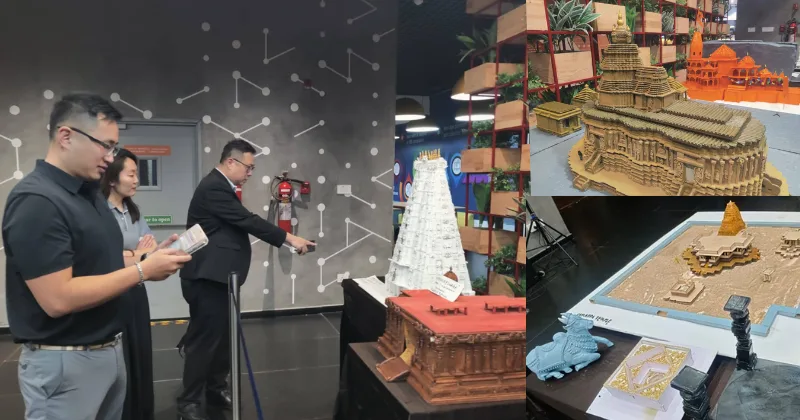
During the 10-day exhibition, hundreds of delegates who visited T-Hub as part of their tech tours took time to appreciate the stunning beauty of Indian temples and the students’ innovation in blending modern technology with traditional designs and preservation efforts — notably, a delegation from Japan expressed special admiration.












Comments