





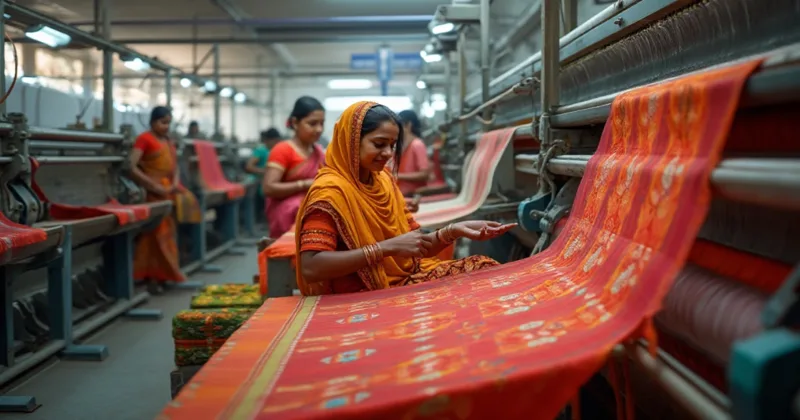
The Prime Minister, Shri Narendra Modi, in his 124th Mann Ki Baat programme, remarked on the 10th anniversary of the National Handloom Day, celebrated on August 7 every year to mark the beginning of the Swadeshi movement in 1905. He said, “Just as Khadi gave new strength to the freedom movement…, today, as the country is moving towards becoming a developed nation, the textile sector is also becoming the strength of the country.” This provides a conducive environment to review and discuss the historical, current, and future roadmap of Indian textiles.
Current Status of the Indian Textile Sector
Following agriculture, the Indian textile sector is the country’s second-largest employer. India’s textile industry is a major employer, directly employing approximately 4.5 crore people, which accounts for about 21 percent of the country’s total employment. According to the Ministry of Textiles’ Annual Report 2023-24, India is the world’s sixth-largest exporter of clothing and textiles. About 4 per cent of the world’s textile and clothing commerce comes from India. India’s annual textile export is about Rs. 3 lakh crores, which is 11 per cent of India’s total exports, and it is expected that by the year 2030, it can be increased three times to Rs. 9 lakh crores.
Historical Perspective of Indian Textiles
The textile industry in India started in the Indus Valley Civilization around 2500-1750 BC. Harappan civilization is credited with being the first to grow cotton in the world. That is why it is known as Sindon by the Greeks. John Austin, a British novelist, wrote that Indian muslin (malmal) was world-famous for its quality.
Reflecting the deep cultural diversity that has long influenced Indian textiles, Bharatendu Harishchandra, the father of modern Hindi literature, once wrote- “चार कोस पर बदले पानी, आठ कोस पर बदले वाणी, बीस कोस पर बदले पगडी, तीस कोस पर छानी.” This means that in our country, water changes at four miles, speech changes at eight miles, the way of wearing a turban change at twenty miles, and the way of wearing clothes changes at thirty miles. This is a symbol of the depth and diversity of our culture. This diversity and specialty of ours also became a medium for the expansion of the textile industry.
But the irony is that this was attacked by the British rule in the nineteenth century, and during this period, India’s deindustrialisation and British rule’s industrialization became strong. As a result, major industrial cities of India like Dhaka, Murshidabad, Surat, etc. collapsed, due to which people went to villages for farming, which led to the Ruralization and Peasantization of the Indian economy. Mahatma Gandhi made Khadi the leading fabric and garment of the freedom struggle, which awakened the spirit of self-reliance, self-rule, and independence in the country. He used to say that Khadi is the “sun of the village’s solar system,” and other rural industries are “planets” by which the villages can become self-reliant.
Key Government Interventions in the Textile Sector
India’s Ministry of Textiles has issued new Quality Control Orders (QCO) setting stringent standards for ropes, cordage, geotextiles and industrial textiles to enhance safety and efficiency at construction sites. Mega Integrated Textile and Apparel Parks (PMMITRA) and Cluster Vikas Yojana are commendable and visionary steps. The Free Trade Agreement 2025 is expected to significantly increase Indian textile exports to the UK, as it eliminates tariffs of up to 12 per cent earlier. Experts predict a sharp increase in orders in the UK for Indian garments, home linen, and made- up products in the next one to two years.
The Budget 2025–2026 contained a five-year Cotton Mission to boost cotton productivity. It also added two types of shuttle-less looms to the list of fully exempted textile machinery. A decrease in the basic customs charge on knitted materials was also announced in the budget. The list of duty-free inputs was expanded to include nine goods, such as seashells, mother of pearl (MOP), cattle horn, wool polishing material, etc. Provisions have been made towards establishing the textile sector as a pillar of self-reliance, exports, innovation and rural employment.
Showcasing Innovation: The Role of Bharat TEX
This year, in February, the second edition of Bharat TEX was held at Bharat Mandapam, New Delhi, under the able and dynamic leadership of Union Textile Minister Shri Giriraj Singh. Global CEOs, legislators, and business executives were among the 1,20,000 trade visitors from more than 120 nations who attended the event. At a time when sustainability, circularity, and traceability are gaining global importance due to rising environmental consciousness and evolving educational priorities, Bharat TEX emerged as a timely and relevant platform. More than just a trade event, it embodied the vision of a developed India deeply rooted in its traditions, offering a space for innovation, dialogue, and cultural expression.
Strategic Roadmap for Future Growth
Redefining Fashion from an Indian Lens: It is noteworthy that due to the ill effects of social McDonaldization and westernization, India has long ignored the diversity of its clothing and has moved towards clothing originating from the new McDonaldized civilization. This, knowingly or unknowingly, became the fashion template of our society, due to which the diverse ancient clothing has faded. But, now is the right time that we define fashion from the Indian perspective so that the world also follows us in the field of textiles.
Focusing on Technical Textiles and Innovation: Technical textiles like geo textiles, agro textiles, etc. are sunrise sectors, and more innovation and research should be further strengthened. Man-made fibers should be promoted.
Geotextiles for the Himalayas: Given the fragility and sensitivity of the Himalayan states and union territories, more and more geotextiles should be used there, which will lead to better disaster management. The central government has successfully implemented the development of infrastructure with geotextiles in the states of the North-East Himalayas. Now is the time to use it in the states of Western Himalayas as well so that mountain erosion, floods, and landslides can be reduced, and better development-oriented disaster management can also be developed.
Reviving Pashmina and Strengthening Livelihoods: In India, the Pashmina livelihood of the Changpa community of Changthang is affected by technical constraints, limited access to markets, lack of government support, and climate change. To overcome this, it is important to strengthen cooperatives, provide modern equipment, promote direct marketing (e-commerce), and get global recognition through the GI tag.
Reimagining the Indian Silk Route: The ancient Indian Silk Route tourism from Leh in the north to Bangalore in the south and Surat in the west to Murshidabad in the east needs to be revived. For example, Murshidabad and Bhagalpur have a glorious textile history, but due to a variety of reasons, these cities have not been able to keep up with the times. Hon’ble Prime Minister Shri Narendra Modi, while inaugurating the 10,000th Farmer Producer Organization (FPO) from Khagaria district of Bihar on 24 February 2025, underlined the global export potential of Bhagalpuri silk and called for special attention to be paid to furthering it. Efforts to connect more and more cities to the Global Network of Silk Cities will have to be accelerated.
Empowering Tribal Textiles and Tourism: Tribal tourism is a unique way to revive the culture of the region. Tribal tourism has to be promoted to save the intellectual property of the ancient local people. Promoting intellectual property and geographical indication of traditional handloom and tribal textiles is a far-reaching step, it reflects our commitment to ‘Vocal for Local’.
Encouraging Startups in the Handloom Sector: Indian startups in the handloom sector are demonstrating creativity and grassroots innovation on global platforms. However, to scale further, they need a more enabling environment—through access to finance, infrastructure, and global branding platforms like Bharat TEX. This will enable the startups to showcase their creativity and grassroots knowledge in the global yarn.
From Tradition to Transformation
The fashion industry will undergo significant changes as a result of India’s distinct cultural and historical identity as well as the commitment of our young people to incorporating enchantment into imaginative items. The significant actions taken under PM Narendra Modi’s leadership to revitalize the distinctive cultural and artistic legacy and to fortify the entire value chain, from fiber, yarn, and fabric to clothing are unmatched and praiseworthy.
The textile sector is based on the ‘5F approach’, which includes ‘Farm to Fibre, Fibre to Factory, Factory to Fashion, Fashion to Foreign’. This vision is now becoming a mission for India. This mission is opening up new opportunities and dimensions of growth for everyone: farmers, weavers, designers, and traders.
Whether it is ‘Lewis’s model’ or the ‘Farm to Factory’ theory, or NITI Aayog’s development framework of ‘Factory in the Farm’, both theories fundamentally require the development of a strong infrastructure. NITI Aayog’s framework of ‘Factory in the Farm’, the goal of doubling farmers’ income, and the vision of inclusive and sustainable development will be significantly strengthened and realized through this approach.
For this, India must adopt the path of the Sixth Industrial Revolution. The sixth industry refers to efforts that utilize agriculture to create new value. In India’s handloom sector, emphasis has been placed on circularity, a comprehensive export policy, accessible credit, One Health, and further strengthening of small and marginal industries.
Overall, the Indian textile sector, through its strong presence from the roots of villages to the global platform (village to global approach), is proving to be a commendable and remarkable initiative towards making the dream of a developed India a reality and continuously strengthening it.














Comments