





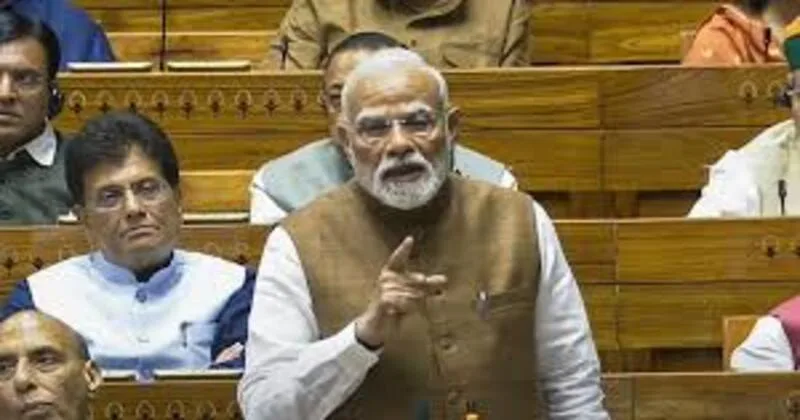
The marathon debate on Operation Sindoor in both houses of the Parliament was another proof of India’s rich and robust democracy. Without exception, all the political parties praised the sterling performance of Indian armed forces during Operation Sindoor. Prime Minister Modi and his capable cabinet ministers placed the entire Operation Sindoor into national perspective. It is important to understand military perspective of Operation Sindoor to clarify the doubts of the countrymen.
There was a mention of a call by Indian Army DGMO to his Pakistani counterpart on the late night of 7 May after India had destroyed nine terror hubs of Pakistan. Our DGMO conveyed to his counterpart that India had achieved the aim of avenging perpetrators of Pahalgam terror attack. India’s military response was calibrated and non-escalatory. It is important to note that both India and Pakistan maintain a hotline for immediate communication between both the DGMOs and such an exercise is a routine affair. While India wanted to exercise restraint, it does not mean that India was not prepared to deal with the likely response from Pakistan. So, when Pakistan escalated the conflict, India gave a strong and befitting military response which forced Pakistan to plead ceasefire in less than four days of war.
Second query was about restricting Indian armed forces only to the terror camps in Pakistan and to leave the military targets. India as a responsible nation has always refrained from targeting civilian population of Pakistan. It has to be understood that based on the political directive, military objectives are decided. Clearly our first military objective was to destroy the terror hubs and terror infrastructure in Pakistan. In modern warfare, the operations are phased as per the escalatory matrix. Also, India maintained its principled stand of not being the aggressor. Not a single country accused India of being an aggressor against Pakistan because India only targeted known terror sites in Pakistan. This act provided India the moral ascendency over Pakistan.
Third query was about restrictions placed on the Indian armed forces. The CCS headed by PM Modi on 23 April itself had already given full freedom to the Indian armed forces to respond to Pahalgam terror attack. Operation Sindoor commenced on 7 May, after 13 days of the terror attack. Thus, Indian armed forces had adequate time to plan the operations against Pakistan and no operational restrictions were placed on them. Even Indian Navy carried out aggressive maritime maneuvers in the Arabian Sea. Indian armed forces were fully prepared to deal with Pakistan’s aggression, both on the borders and LOC. It is through such aggressive posturing of Indian armed forces that Pakistan capitulated so soon during Operation Sindoor.
Fourth doubt is about the ceasefire which India called only temporary cessation of hostilities with Pakistan. Whenever there is a conflict between India and Pakistan, major powers in the world obviously are worried because both the nations are nuclear powers. China was giving military and technical aid to Pakistan prior to and during Operation Sindoor. The telephone call of the US Vice President J.D. Vance on 9 May evening to PM Modi proves that even the US was closely monitoring Pakistan during Operation Sindoor. So, when India accepted cessation of hostilities with Pakistan on its own terms, it is feasible that Pakistan conveyed this message to the US. It is my guess that President Trump jumped the gun by announcing the ceasefire on Social Media platform X. In my opinion, Indo-US relations should not become a victim of such a presumption and world’s two largest democracies need to be together.
Fifth question is about why India did not further press the military advantage against Pakistan and even capture POK. Shri Rajnath Singh, the Raksha Mantri has already clarified that capture of POK was not the military objective of Operation Sindoor. Also, India achieved spectacular military success against Pakistan by not even sending one soldier across the border or the LOC. Pakistan’s ability to further fight India was crippled beyond doubt in less than four days. India had also succeeded in ending the nuclear blackmail of Pakistan that they will use ‘Tactical Nuclear Weapons (TNWs)’ in case of war. Pakistan suffered substantial damage to its military infrastructure and yet was not in a position to prolong war with India. Many international strategic experts have already called India’s military campaign during Operation Sindoor as one of the most outstanding victories in the recent times. In my opinion, Operation Sindoor is harbinger of integration of POK with India in times to come.
Sixth doubt is unethical question about losses on our side during Operation Sindoor, particularly about losses to our fighter aircraft. Here I am pained to state the lack of strategic culture among some of our politicians. It has to be understood that operational details of war including losses are military secret which are not divulged publicly when Operation Sindoor is still on. In war, losses are inevitable but what matters most is victory against the enemy. It is my belief that India suffered no major loss and there was no damage to our defence infrastructure. Pakistan, on the other hand suffered major losses to fighter aircraft, air defence system, airfields, radar stations and casualties to huge number of military personnel. India’s air defence thwarted all the missile and drone attacks of Pakistan and thus we did not suffer casualties along the border states except villages close to the LOC.
Seventhly, opposition parties have quoted statements of the CDS, Deputy Army Chief and DA Indonesia about Operation Sindoor. None of these can be termed official statements. The operational details were conveyed to the country by Indian DGMOs of Army, Navy and Air Force on 11 and 12 May. As far as armed forces are concerned, what they have stated is the official position, nothing more nothing less. But here is a lesson for the uniformed personnel to be careful while articulating operational details. I have similar advice for the respected military veterans who come on television channels during discussion on Operation Sindoor.
Lastly, doubt was also raised about India’s ‘New Normal’ against terrorism. It was said that every terror attack would force India to go to war. This is erroneous interpretation of the new policy. This policy is aggressive version of our ‘Zero Tolerance for Terrorism’. India proved it during Operation Sindoor. India punished the terrorists (destroyed their camps and killed more than 100 terrorists) and also punished Pakistan as the sponsor of such terrorists. The new policy is also a deterrence against terrorism, because now Pakistan would be constrained to harbour and train terrorists against India. Pakistan would think ten times before sending terrorists inside India. The new policy does not mean launching war every time. It means that India reserves the right to retaliate against the terrorists and those who sponsor them as per time and place of its choosing. Thus, the New Normal is a defining moment in India’s crusade against terrorism.
Now that all the three terrorists responsible for the heinous Pahalgam terror attack have been neutralised as part of Operation Mahadev, it can be said that India has successfully completed the first phase of Operation Sindoor. Now is the time to celebrate the outstanding military victory of India over Pakistan. At the same time, India has to be fully prepared to deal with a more collusive Pakistan and China. To fight Pakistan and China together, India certainly needs more boots on ground and also major technological upgradation with superior military hardware and defence systems. PM Modi and his government would certainly analyse the lessons learnt from Operation Sindoor to further sharpen our military response against our adversaries. Jai Bharat!














Comments