





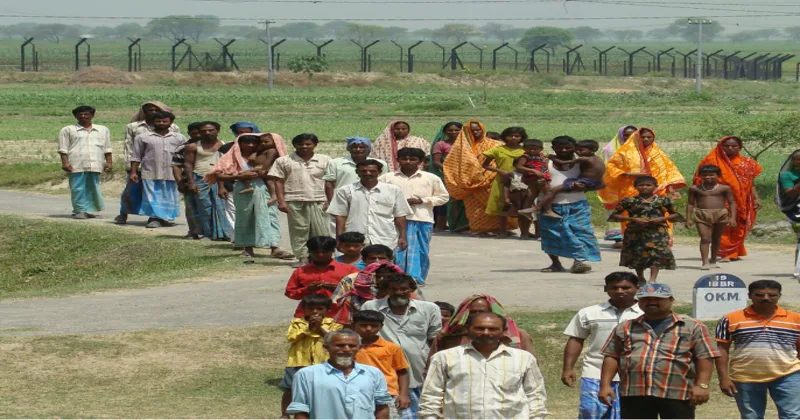
“Lebensraum” means living space and indicates the territory a nation believes it needs to grow and flourish. Bangabandhu Sheikh Mujibur Rehman in his book – ‘Eastern Pakistan: Its Population & Economics’ published in 1944 has written that “because Eastern Pakistan must have sufficient land for its expansion and because Assam has abundant forests and mineral resources, coal, petroleum etc Eastern Pakistan must include Assam to be financially and economically strong.” However for Assam to be included in East Pakistan it had to become a Muslim majority State. To achieve this Muslim League leader and Assam’s then Prime Minister Mohammed Saadullah encouraged massive migration of landless muslim peasants from the Mymensing and Sylhet districts of erstwhile East Bengal. These migrants were settled on government lands and reserve forests in the Brahmaputra and Barak valleys. After partition to reduce pressure on land this concept of migration for lebensraum though illegal was supported by many Pakistani leaders including Zulfikar Ali Bhutto. In 1971 the formation of Bangladesh did not change this concept instead it became a covert State strategy. In 1991 noted Bangladeshi intellectual and columnist Sadeq Khan wrote that “all projections indicate that by the first decade of the 21st century Bangladesh will face a serious crisis of lebensraum. A natural overflow of population is very much on the cards and will not be restrained by barbed wire fencing or border patrols”. This is why Bangladesh objects to the fencing of the Indo-Bangladesh border because land is the crux of its strategy of lebensraum.
The strategy envisaged that the natural overflow of population would be towards the sparsely populated Northeast region particularly Assam which had vast tracts of fallow agricultural lands and abundant forests. A porous Indo-Bangladesh border and political patronage helped illegal immigration. The Assam Accord of 1985 and the revocation of the Illegal Migrants Determination Act (1983) in 2002 did not stop the influx because of a lack of political will. Today even though Bangladesh allegedly has a better Human Development Index than some of the Northeastern States, illegal immigration continues unabated because of rising unemployment and pressure on land in that country.
Despite there being provisions under the Assam Land & Revenue Regulations for regular land surveys and settlement of government lands particularly for indigenous landless people, the interim report of the Committee for Protection of Land rights of Indigenous People of Assam headed by former Chief Election Commissioner of India H.S. Brahma reveals that no land survey and settlement operation has been carried out in Assam according to the provisions of the Assam Land & Revenue Regulations, 1886, since 1964. It has also stated that over the past several decades a nexus of corrupt politicians and bureaucrats facilitated largescale transfer of government lands to doubtful citizens leaving the indigenous population landless. Recently amendments have been made in the Assam Land & Revenue Regulations, 1886, and steps have been taken for settlement of land for the indigenous landless population.
Matabbars facilitated Illegal encroachments and settlements. The Matabbar System of land acquisition prevalent in the feudal era refers to the traditional practice of land management and revenue collection in villages by influential local leaders. They played a significant role in land-related matters, land allocation and settling disputes. Later with political patronage and connivance of corrupt officials it evolved into organized land grabbing/encroachment of government/public land.
In 1991 Assam had 37,847 sq. km of forests. It has decreased to 26,832 sq. km in 2024. According to the India State Forest Report Assam’s forest cover reduction is alarming given its role as a bio-diversity hotspot. The Union Ministry of Environment & Forests ( MoEF) reported to the National Green Tribunal (NGT) that as of March 2024 3620 sq.km of forest land was under illegal encroachment in Assam. In 2022 the Commission for Review & Assessment of Sattra Lands in Assam found that 1889 hectares of Sattra land across 11 districts in Assam was illegally occupied. Data shows that since 1991 there has been a 35% shrinkage in the wetlands of Assam mainly due to human interventions. Large tracts of Village Grazing Reserves (VGR) and Professional Grazing Reserves (PGR) across the State have been illegally occupied. For example in Dokonia under Hajo Revenue circle 22,000 bighas of VGR and PGR have been encroached. In 2021 the International Union for Conservation of Nature reported that land encroachment is a serious threat for the world heritage Kaziranga National Park. Reportedly nearly five lakh families have been illegally settled on government lands. Evicting them is the biggest challenge for the government.
Significantly since 1996 the Supreme Court has given several directives to the State government to stop encroachment of reserve forests, national parks, sanctuaries and wetlands. There were also repeated instructions from MoEF to evict encroachers. But even though eviction drives were started they had to be suspended because of stiff resistance from the settlers backed by vested interests and their political patrons. More recently the Guwahati High Court explicitly directed the State government to clear encroachments from forest areas. While the NGT, New Delhi Bench, set a deadline of December 2026 to remove encroachers in the interest of maintaining the ecological balance, safeguarding wildlife habitats & reducing man-animal conflicts.
The Supreme Court of India has decreed that encroachers on government & private land cannot claim any legal protection. Under Section 3 of the Assam Land Grabbing (Prohibition) Act, 2010, land grabbing or encroaching is a criminal offence & punishable under the relevant sections of the Bharatiya Nyay Sanhita. It is imperative that to save Assam’s biodiversity, flora & fauna the forests, sanctuaries, grazing grounds & wetlands must be freed from illegal encroachments. Moreover to discourage such corrupt practices in the future, accountability must be fixed & those responsible for exploiting the system for personal gain must be punished. At the same time a thorough scrutiny of the antecedents of all evicted persons must be carried out and only genuine Indian citizens who are internally displaced or landless should be rehabilitated.
















Comments