




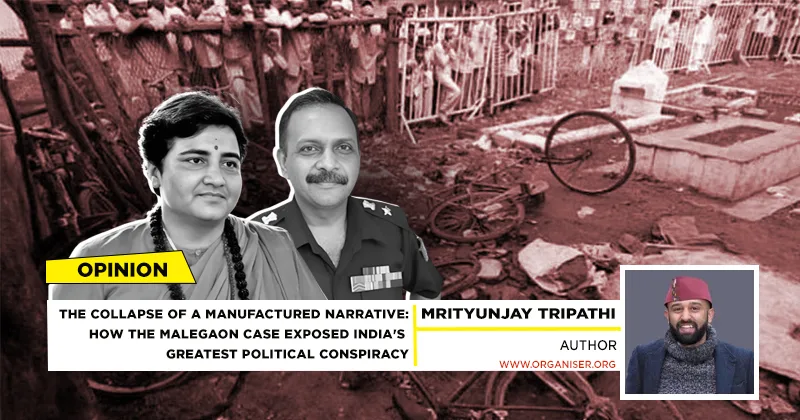
After seventeen long years of legal battles, tortured testimonies, and political machinations, truth finally emerged from the hallowed halls of a Mumbai courtroom on July 31, 2025. The acquittal of all seven accused in the Malegaon blast case marked not just the end of a controversial legal chapter, but the complete demolition of what can only be described as one of independent India’s most audacious attempts at narrative manipulation – the creation of the “Hindu terror” myth.
The Special NIA court’s verdict, delivered by Judge AK Lahoti, did more than simply absolve Sadhvi Pragya Singh Thakur, Lt. Colonel Prasad Purohit, and five others of terrorism charges. It exposed a conspiracy so deep and so calculated that it shakes the very foundations of how we understand political manipulation in modern India. The court’s damning observation that “terrorism has no religion but conviction cannot be based on moral grounds” was not merely a legal pronouncement – it was the final nail in the coffin of a fabricated narrative that had held the nation hostage for over a decade.
The story begins on that fateful evening of September 29, 2008, when a low-intensity bomb exploded near Bhikku Chowk in Malegaon, Maharashtra, killing six innocent people and injuring over 100 others during the holy month of Ramzan[1]. What should have been a straightforward investigation into a terrorist attack quickly transformed into something far more sinister – a carefully orchestrated attempt to rewrite the narrative of terrorism in India.
The Maharashtra Anti-Terrorism Squad (ATS), under the leadership of Hemant Karkare, made arrests that would send shockwaves through the nation’s political establishment. For the first time in India’s modern history, individuals associated with Hindu organizations were being painted as terrorists. The term “Hindu terror” or “saffron terror” entered public discourse with unprecedented force.
But as retired ATS officer Mehboob Mujawar would later reveal in explosive testimony, the investigation was never about finding the truth. “I was directed by Param Bir Singh, and those above him asked me to arrest these individuals -Ram Kalsangra, Sandip Dange, Dilip Patidar, and RSS chief Mohan Bhagwat,” Mujawar disclosed. The scope of the conspiracy becomes clear when he adds, “It was beyond my capacity to arrest someone like Mohan Bhagwat, who holds significant influence in Maharashtra.”
The Machinery Of Deception
The creation of the “Hindu terror” narrative was not a spontaneous development born out of investigative findings. It was, as RVS Mani, former Under Secretary in the Ministry of Home Affairs, documented in his revealing book, a systematic effort that began as early as 2006. Mani’s insider account provides chilling details of how the UPA government forced Home Ministry officials to manufacture a false narrative about Hindu terrorism.
In a particularly damning revelation, Mani describes being summoned by then Home Minister Shivraj Patil along with Congress leader Digvijaya Singh and ATS chief Hemant Karkare. When Mani informed them that “a particular religious group was in most of the terror attacks,” both Singh and Karkare expressed dissatisfaction with this information. This meeting, according to Mani, marked the moment when “the first seed of the canard” of Hindu terror was sown.
The evidence of this manufactured narrative extends far beyond individual testimonies. The very language used by senior Congress leaders reveals the calculated nature of this campaign. Home Minister P. Chidambaram’s infamous remarks about “saffron terrorism” being a “new phenomenon” at a conference of state police chiefs in 2010 was not an off-the-cuff observation but part of a broader strategy.
The political dimensions of this conspiracy become even more apparent when examining the statements and actions of key Congress leaders during this period. Digvijaya Singh, who today claims he “never used the terms ‘saffron terror’ and ‘Hindu terror'”, was photographed inaugurating a book titled “26/11 RSS Ki Saazish?” (26/11, An RSS Conspiracy?) in 2010, giving credence to theories that blamed Hindu organizations for the Mumbai attacks.
The calculated nature of this narrative construction is further evidenced by leaked diplomatic cables from WikiLeaks, which revealed that in July 2010, when US Ambassador Timothy Roemer asked about Lashkar-e-Taiba’s activities, Rahul Gandhi responded by suggesting that “the bigger threat may be the growth of radicalised Hindu groups”[11]. This was not casual conversation but reflected a deliberate positioning that had been years in the making.
Union Home Minister Sushilkumar Shinde’s controversial statements about “Hindu terrorism” at the Congress Chintan Shivir, where he accused the RSS and BJP of promoting Hindu terror in their training camps, represent the culmination of this systematic campaign[12][13]. The political calculation was clear: create a counter-narrative to Islamic terrorism that would serve electoral purposes while appeasing specific vote banks.
The Torture And Fabrication Machine
Perhaps the most disturbing aspect of this entire episode was the systematic torture and coercion used to extract confessions and build cases. The NIA court’s 1,036-page judgment revealed that “almost all witnesses during the course of evidence deposed that they had not given their statements voluntarily but that these were taken under coercion by ATS officers”.
Sadhvi Pragya Singh Thakur’s harrowing account of her treatment in custody provides a glimpse into the lengths to which the investigating agencies went to construct their narrative. “On the first day itself, they started beating me. When they used to hit me with a belt, the entire nervous system used to go blank. They used to stop only when they feared that now blood would begin to come out,” she had testified.
The systematic nature of this torture is further corroborated by the court’s observation that while two premier investigating agencies were involved in the case, “allegations of misconduct, torture and illegal detention have been leveled only against the ATS officers and not those from the NIA”. This distinction is crucial – it suggests that the torture and fabrication were not merely the result of overzealous investigation but part of a specific agenda pursued during a particular period.
The Unravelling Of The Conspiracy
The transfer of the case to the NIA in 2011 marked the beginning of the end for the manufactured narrative. The central agency’s findings diverged significantly from the ATS’s conclusions, with the NIA eventually dropping charges under MCOCA and exonerating several individuals previously named by the ATS. By 2016, the NIA’s supplementary charge sheet acknowledged serious flaws in the ATS investigation, including allegations that confessions were extracted through torture.
The collapse of the “Hindu terror” narrative accelerated as key cases began falling apart. The 2019 acquittal of all accused in the Samjhauta Express blast case, where similar allegations had been made against Hindu organizations, provided another nail in the coffin of this fabricated theory. The pattern was clear: wherever the “Hindu terror” angle had been pursued, the cases were collapsing due to lack of evidence and procedural irregularities.
Lieutenant Colonel Purohit’s vindication was particularly significant. The court found no evidence that he had sourced RDX from Kashmir or assembled bombs, despite years of allegations. His statement after acquittal – “Bygones are bygones” – reflected not just personal relief but the broader recognition that institutional damage had been done to India’s security apparatus.
The Malegaon acquittals have triggered a political earthquake that extends far beyond the courtroom. BJP leaders have demanded unconditional apologies from Congress leaders, with party spokesman Gaurav Bhatia asking, “Who will be held accountable for years of humiliation, injustice, and media trials? Will Rahul Gandhi apologise to the nation and all Hindus?”
Maharashtra Chief Minister Devendra Fadnavis’s response shows upon the broader political implications: “More than the police, the then UPA government was responsible for the case. They had conspired to appease a certain community and extremist ideology. The court verdict has exposed the conspiracy”. This assessment reflects the growing recognition that what happened in Malegaon was not merely investigative failure but deliberate political manipulation.
The Institutional Damage
The long-term implications of the “Hindu terror” fabrication extend far beyond individual cases or political parties. The systematic attempt to create a false equivalence between Islamic terrorism and alleged Hindu extremism has damaged India’s counter-terrorism capabilities and international standing. As former Home Ministry official R.V.S. Mani pointed out, the narrative was deliberately constructed to provide talking points for Pakistan in international forums.
The collapse of witness testimonies – with over 40 out of 323 prosecution witnesses turning hostile in the Malegaon case alone – speaks to the broader erosion of investigative credibility. When the state apparatus is used to manufacture narratives rather than pursue truth, the damage to institutional credibility can take generations to repair.
The vindication of figures like Sadhvi Pragya Singh Thakur, who went from being branded a terrorist to becoming a Member of Parliament, illustrates the complete reversal of fortunes that truth ultimately brings. Her statement that “this case was not just fought by me but by Bhagwa (saffron)” captures the symbolic significance of this victory.
The Media’s Role in Narrative Construction
The role of mainstream media in amplifying and legitimizing the “Hindu terror” narrative cannot be overlooked. The uncritical acceptance of ATS claims, the sensationalization of arrests, and the reluctance to question obvious procedural violations all contributed to the success of this manufactured conspiracy. The media’s subsequent silence on the systematic collapse of these cases is equally telling.
The contrast between the extensive coverage given to the initial arrests and the relatively muted response to the acquittals reveals the deep-seated biases that enabled this conspiracy to succeed for so long. Independent journalism that questions official narratives, rather than merely amplifying them, could have exposed these fabrications much earlier.
Lessons For Democracy
The Malegaon case offers profound lessons about the fragility of democratic institutions when they are captured by partisan interests. The systematic use of investigative agencies, the judicial system, and media platforms to construct false narratives represents a clear and present danger to democratic governance.
The case also demonstrates the resilience of truth when institutional safeguards, however imperfect, are allowed to function. The NIA’s eventual acknowledgment of ATS failures, the court’s detailed examination of evidence, and the courage of officers like Mehboob Mujawar to speak truth to power all contributed to the eventual collapse of this manufactured narrative.
The “Hindu terror” narrative was not merely a domestic political tool but had significant international implications. By creating false equivalences between Islamic terrorism and alleged Hindu extremism. The systematic nature of this narrative construction, including the involvement of senior political leaders in book launches and international diplomatic conversations, suggests a coordinated effort to reshape India’s international image in ways that served narrow political interests rather than national security.
Satya Ki Jeet
The acquittal of all accused in the Malegaon blast case represents more than legal victory – it marks the complete collapse of one of independent India’s most audacious attempts at narrative manipulation. The “Hindu terror” myth, carefully constructed over years through systematic torture, fabricated evidence, and political manipulation, has been definitively exposed and discredited.
The real tragedy of this case lies not just in the lives destroyed or the years lost, but in the damage done to India’s institutions and international credibility. The systematic attempt to manufacture a false narrative about terrorism for political gain represents a betrayal of democratic values that should serve as a warning for future generations.
As Sadhvi Pragya Singh Thakur observed after her acquittal, “Today Bhagwa has won, justice has won”. But this victory comes at an enormous cost – years of institutional damage, international embarrassment, and the erosion of public trust in investigative agencies. The price of manufacturing narratives for political gain is ultimately paid by democracy itself.
The Malegaon case will be remembered not just as a terrorist attack that was eventually solved, but as a cautionary tale about what happens when political expediency overrides truth, when institutions are captured by partisan interests, and when the apparatus of the state is used to manufacture rather than discover reality. In exposing this conspiracy, the courts have not just delivered justice to the accused rather they have reaffirmed the fundamental principle that in a democracy, truth must ultimately prevail over manufactured narratives, no matter how powerful their creators.
The collapse of the “Hindu terror” myth marks not just the end of a legal case, but the restoration of truth over propaganda, justice over political convenience, and institutional integrity over partisan manipulation. It is a victory that extends far beyond the individuals involved to encompass the very soul of Indian democracy itself.














Comments