





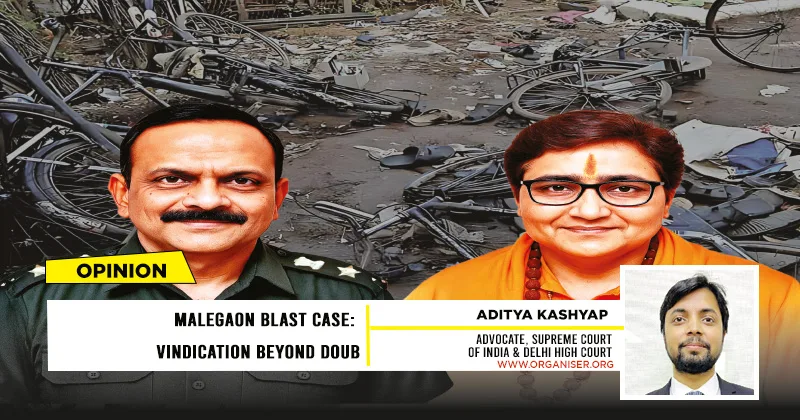
On July 31st, 2025, a courtroom in Mumbai resounded with a verdict that had taken 17 years in the making. Special Judge AK Lahoti of the National Investigation Agency (NIA) Court acquitted all seven accused in the 2008 Malegaon bomb blast case, observing that the prosecution had failed to establish the guilt of the accused beyond reasonable doubt. Among those acquitted are Member of Parliament Pragya Singh Thakur and decorated Army officer Lt Col Prasad Shrikant Purohit, both of whom were demonised relentlessly to the extent that they were portrayed as faces of what a politically motivated narrative termed “Hindu terror.” Their acquittal marks not just personal vindication but also raises significant questions about investigative accountability, media trials, and the politicisation of national security cases.
Backdrop & Bias
On September 29, 2008, in Malegaon, a textile town in Maharashtra’s Nashik district, a devastating blast took place in a busy chowk. An IED allegedly mounted on a motorcycle exploded, killing six and injuring over a hundred. At a time when the country was grappling with a series of terror attacks, including the Jaipur and Ahmedabad blasts earlier that year, Malegaon stood out – where unlike previous attacks where jihadi outfits were the primary suspects, here, the needle of suspicion was pointed at the so-called alleged Hindu extremists.
False Narrative
Within a month, the Maharashtra Anti-Terrorism Squad (ATS) under Hemant Karkare, arrested Sadhvi Pragya Thakur, an ascetic and former ABVP activist, along with others, including Lt. Col. Purohit, Major (Retd.) Ramesh Upadhyay, and Sameer Kulkarni. The narrative that was portrayed was as explosive as the blast itself. The ATS alleged that disgruntled Hindus, enraged by a spate of jihadi attacks and perceived Government inaction, plotted violence in retaliation.
Thus emerged the term “Saffron Terror.” Sections of ideologically and politically motivated media and intelligentsia, ever eager to impose a false parity in the discourse on terrorism, descended upon the narrative as vultures circling wounded prey. For them, it was not about evidence, it was blaming and shaming Hindus. For the accused and their families, it marked the beginning of a protracted ordeal – one that would strip them of liberty, dignity, and presumption of innocence for nearly two decades.
Projecting Braveheart as a Villain
Lt Col Purohit, once an intelligence asset working on the Students Islamic Movement of India (SIMI), was accused of not only supplying RDX but also of floating an organisation called Abhinav Bharat with seditious aims. Sadhvi Pragya was said to have provided the motorcycle used in the blast. Others were accused of being part of conspiracy meetings in places like Bhopal and Faridabad. The charges ranged from murder and criminal conspiracy under the IPC to stringent sections of the Unlawful Activities (Prevention) Act (UAPA) and the Maharashtra Control of Organised Crime Act (MCOCA).
NIA Unravels the Truth
But over the years, the narrative, which was a facade, fell apart. In 2011, with the National Investigation Agency (NIA) taking over the investigation in the case, came a sharp turn and professionalism in the investigation that was hitherto missing. The NIA, after re-recording witness statements and reviewing forensic lapses, filed a supplementary chargesheet in 2016 where it dropped charges under MCOCA. The confessions obtained by the ATS were declared inadmissible and significant inconsistencies were found in the evidence. The agency even admitted that due to the passage of time, no recoveries could be made from the spot for forensic verification.
Further weakening the prosecution’s case was the fact that over 40 witnesses turned hostile during the trial. Some even alleged they were coerced by the ATS. Others contradicted earlier statements, questioning the credibility of the investigative foundation itself. As delays mounted, over 30 witnesses passed away before they could be examined. For Lt Col Purohit, the most damning allegations, such as the procurement of explosives and formation of Abhinav Bharat for subversive activity, found no evidentiary backing in court. His defence argued that he was working undercover, informing his Army superiors about the very meetings the ATS later construed as conspiracy. For Pragya Singh Thakur, the initial allegation that her motorcycle was used in the blast collapsed when chain-of-custody and ownership could not be conclusively established. The NIA itself found no credible evidence linking her to the conspiracy.
Verdict and Vindication
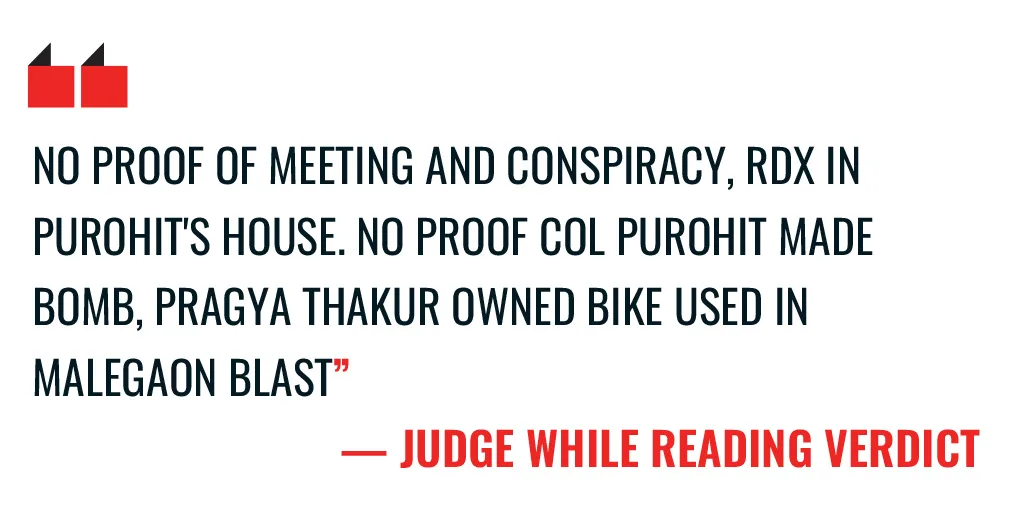
On July 31st 2025, Special Judge Lahoti acquitted all seven accused. His findings, as being reported, are unambiguous – firstly, the prosecution failed to prove who planted the bomb. Secondly, the conspiracy meetings were uncorroborated by credible witnesses. Thirdly, call data evidence was inconclusive, and authorisations of interception were legally defective. Fourthly, no reliable forensic or material evidence linked the accused to the crime. Fifthly, suspicion alone is not proof beyond reasonable doubt; and sixthly, the court also held there was no evidence that Abhinav Bharat was used to fund terror activities. Recognising the human toll of the blast, the court directed the Government to pay Rs 2 lakh to the families of the deceased and Rs 50,000 to each injured victim. While this is a necessary gesture of state responsibility, the larger moral question remains – what of the accused who lost nearly two decades of their life to false allegations?
Irreparable Damage Done to Patriots
For the accused, the acquittal came too late to undo the damage. Lt Col Purohit spent nine years in custody. His career, reputation, and personal life were shattered. He faced threats, isolation, and mental agony, an Army officer accused of betraying the nation! Sadhvi Pragya Singh Thakur suffered multiple ailments during incarceration, and her bail was delayed despite medical deterioration. While she was elected to Parliament in 2019, the tag of a “terror accused” followed her relentlessly. Other co-accused, Major (Retd.) Ramesh Upadhyay, Ajay Rahirkar, Sameer Kulkarni, Sudhakar Chaturvedi, and Swami Amrutanand (Sudhakar Dhar Dwivedi) – each of them lost years of their lives, livelihoods, and public standing. Most of them were professionals or religious figures with no prior criminal records.
Injustice, in this case, came not merely from the judicial process but from the weaponisation of public opinion. The media trial, led by anchors and op-eds with barely concealed ideological motives, painted the accused as guilty before a single shred of proof had been tested.
The court may have provided legal closure, but moral and political reparations are far from achieved. There has been no formal accountability for the officers who framed defective charges. No apology from the public intellectuals and media houses who built careers on accusing “Hindu extremists.” No reflection from the politicians who used this case to delegitimise ideological opponents and defame Hindus as a society.











Comments